

- Also known as:
- Chinese geomancy
- Related Topics:
- Chinese architecture

feng shui
-
What is feng shui?
Feng shui is an ancient Chinese practice dating back to the Zhou dynasty (1046–256 BCE) that orients buildings and significant sites to harmonize with the flow of qi. Qi, like prana in Indian culture, is a vital life force. Literally meaning "wind water," feng shui maintains that wind can disperse qi, while water can stop it.
Rooted in Daoism, feng shui incorporates the complementary energies of yin and yang and the theory of the five elements: water, wood, fire, earth, and metal. Historically, feng shui influenced the layouts of gardens, tombs, and city blocks. Today, feng shui principles can be applied in architecture and interior design. However, feng shui has faced criticism for lacking empirical science.
3 Britannica SourcesCreated from Britannica articles using AI. AI can make mistakes, so verify using Britannica articles. -
Where did feng shui come from?
Feng shui, an ancient Chinese practice, orients buildings and objects in harmony with qi (vital life force). It is rooted in Daoist concepts of yinyang and the five elements: water, wood, fire, earth, and metal.
Likely the oldest continuing geographic tradition, feng shui goes back to the early Zhou dynasty (1046–256 BCE). The term "feng shui" (literally, "wind water") first appeared in The Book of Burial, attributed to Guo Pu (276–324 CE), which asserts that wind disperses qi and water stops it.
By the end of the Tang dynasty, traditional Chinese architectural siting techniques had synthesized into geomantic systems known as fengshui or kanyu. These systems had origins reaching back to the earliest Zhou times (1046–256 BCE).
2 Britannica SourcesCreated from Britannica articles using AI. AI can make mistakes, so verify using Britannica articles. -
What are the main ideas behind feng shui?
Feng shui is an ancient Chinese practice of arranging buildings, spaces, and objects in harmony with qi, the vital life force. Feng shui, which literally means "wind water," is rooted in the concept of yinyang and the five elements: water, wood, fire, earth, and metal.
Architects take feng shui seriously, using it to determine auspicious sites and building orientations. They consider the flow of qi, the relationship between earth and the heavens, and astral charts to bring good fortune to buildings, viewing proper timing as more important than architectural engineering.
3 Britannica SourcesCreated from Britannica articles using AI. AI can make mistakes, so verify using Britannica articles. -
How does feng shui say we should arrange spaces, like homes or rooms?
Feng shui is an ancient Chinese practice of harmonizing structures and sites with the flow of qi, or vital life force. Rooted in Daoism, feng shui emphasizes balancing complementary yinyang energies and aligning with the five fundamental elements: water, wood, fire, earth, and metal. Traditional techniques involve geomantic systems to integrate heaven and earth. Northern traditions use a magnetic compass, considering astral and earthly principles, while Southern traditions emphasize landscape, protective mountains, and water flow. Feng shui masters consider the flow of qi, timing, and the relation of earth to the heavens.
3 Britannica SourcesCreated from Britannica articles using AI. AI can make mistakes, so verify using Britannica articles. -
What is "qi" (chi) and why is it important in feng shui?
In feng shui, qi (also spelled ch'i) is the vital life force or psychophysical energy that animates the universe. Comparable to prana in Indian culture, qi is the fundamental principle behind feng shui, the ancient Chinese practice of harmonizing people with their surrounding environment.
Feng shui seeks to orient buildings, objects, and significant sites in accordance with the flow of qi, using the concept of yinyang and the five elements (water, wood, fire, earth, and metal) to achieve this balance. Two primary schools of feng shui, the Form school and the Compass school, use different methods to assess the balance of yinyang and the flow of qi in structures and sites.
3 Britannica SourcesCreated from Britannica articles using AI. AI can make mistakes, so verify using Britannica articles. -
How do colors and objects influence energy and harmony in feng shui?
Feng shui is an ancient Chinese practice that aims to harmonize individuals with their environment by strategically orienting buildings, objects, and spaces to enhance the flow of qi, the vital life force. Rooted in Daoist philosophy, feng shui incorporates the complementary energies of yin and yang and the theory of the five fundamental elements: water, wood, fire, earth, and metal.
Colors and objects play a crucial role in influencing energy and harmony. The strategic placement of objects and the use of specific colors can affect the flow of qi, creating balance and positive energy in a space. Proper timing and siting are critical features that shape this practice.
3 Britannica SourcesCreated from Britannica articles using AI. AI can make mistakes, so verify using Britannica articles.
feng shui, an ancient Chinese practice of orienting significant sites, buildings, and the spaces and objects within them in harmony with the flow of qi (also spelled ch’i). Qi (“breath” or “dragon’s breath”) is the vital life force, comparable to prana in Indian culture. Feng shui is rooted in the Daoist (also spelled Taoist) concept of the complementary energies of yinyang and the theory of the five fundamental elements in the universe: water, wood, fire, earth, and metal.
Overview
Feng shui is likely the oldest continuing geographic tradition in the world, reaching back to the early Zhou dynasty (1046–256 bce). The term feng shui—literally, “wind water”—first appears in The Book of Burial, attributed to poet Guo Pu (276–324 ce), which asserts that qi can be dispersed by wind and stopped by water.
The practice of feng shui has been incorporated in determining sites for burial grounds and buildings; the layouts of tombs, gardens, and city blocks; and every aspect of architecture. A classic example of feng shui design is the Forbidden City in Beijing, which is built on a north-south axis with the main entrance facing south, which was considered the most auspicious direction by the feng shui masters at the time of construction. In addition, feng shui has influenced the design of many modern iconic buildings, including the steel-and-glass pyramid addition to the Louvre Museum in Paris, the HSBC Building in Hong Kong, Trump Tower in Manhattan, and the Sydney Opera House in Sydney.



 " height="20" alt="HEW Logo">

Schools of classical feng shui
There are two commonly known schools of classical feng shui: the Form school (Chiangsi school) and the Compass school (Fujian school). The Form school, founded by Yang Yun-Sung in the 800s ce, involves assessing yinyang balance and qi flow in natural sites and taking features such as rivers, trees, and mountains into consideration to identify the optimal place for a burial site or home or other building.
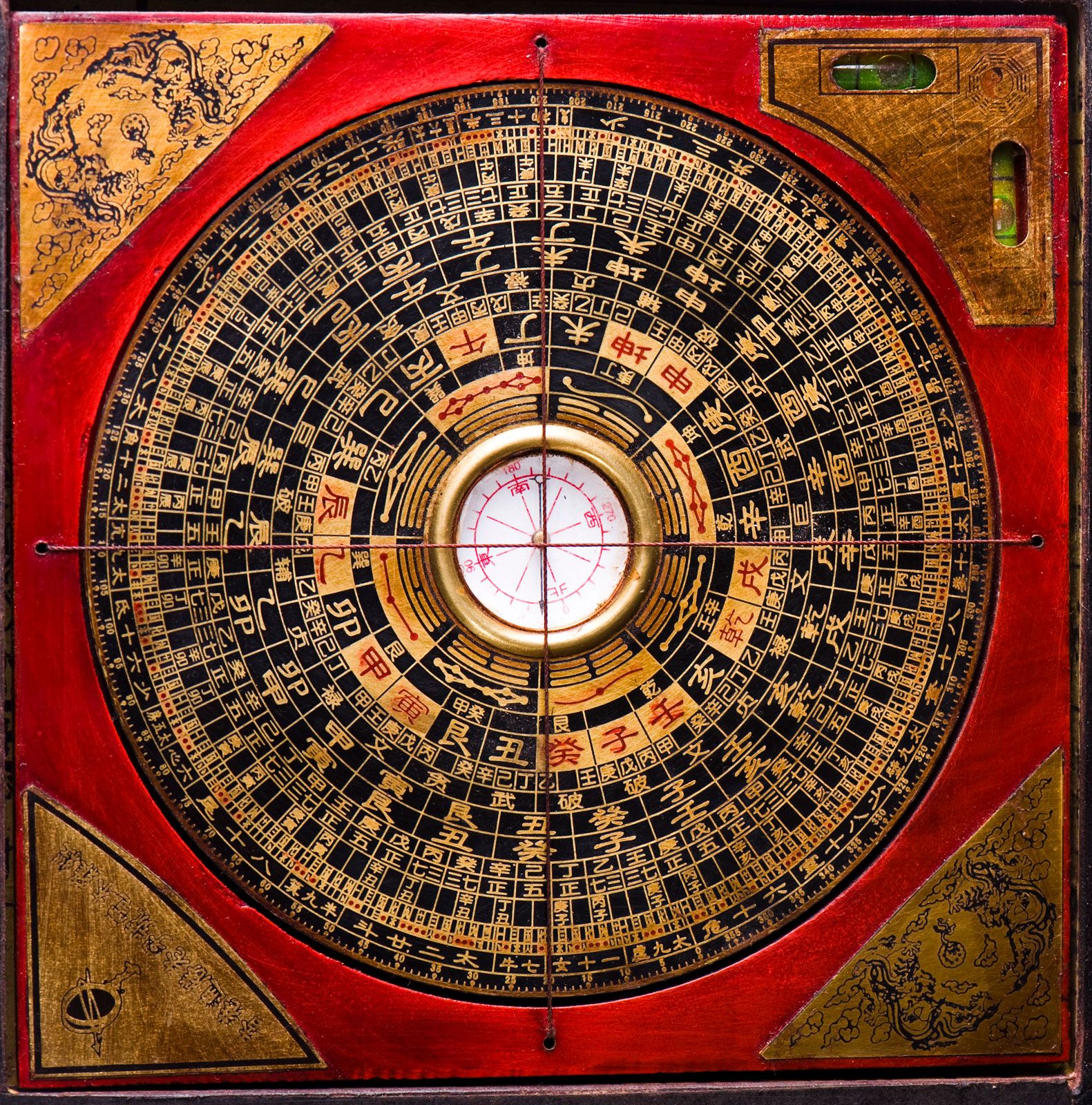
The invention of a magnetic compass, called the luopan, heralded the rise of the Compass school in the 900s, which focuses not on direct study of natural features but rather complex calculations involving compass directions and astrology. The luopan includes markings for 24 directions (also known as the Twenty Four Mountains), and the needle points to the south magnetic pole. The compass may also include other categories related to yinyang, the five elements, and the eight Daoist symbols noted in the Yijing (often translated as Book of Changes), which represent foundational concepts of reality. In English, these Daoist symbols are usually referred to as bagua, or pakua, trigrams. A Chinese almanac of auspicious dates may also be used in feng shui calculations.
Contemporary feng shui
In 1949 the Chinese Communist Party (CCP) banned the practice of feng shui, considering it to be a superstition. Consequently, during the Cultural Revolution (the upheaval launched by CCP Chairman Mao Zedong from 1966 to 1976), the CCP persecuted feng shui masters. However, feng shui remained widely popular in Hong Kong and Taiwan. The CCP became more tolerant of feng shui after the Cultural Revolution came to an end, and the country saw a resurgence of the practice; however, there were crackdowns on businesses or CCP members who were involved in the practice of feng shui.
Feng shui gained new prominence in the West after U.S. Pres. Richard Nixon’s visit to China in 1972. In the 1980s, feng shui master Thomas Lin Yun Rinpoche founded the influential Black Hat Sect Tantric Buddhist (BTB) style of feng shui in Berkeley, California. This form of feng shui became widely popular in the West. The BTB method uses a bagua chart that shows correspondences between cardinal directions and aspects of life, including wealth and prosperity, fame and recognition, love and relationships, family, health, creativity and children, knowledge and self-cultivation, career, and travel and helpful people.
The trusted destination for professionals, college students, and lifelong learners.
SUBSCRIBE


Outside of the established methods or schools, some followers of contemporary feng shui may apply feng shui principles in architecture and interior design through self-study. Additionally, some followers may employ a feng shui master or consultant.
Criticism
Because feng shui has little to no grounding in empirical science, and because of its complexity and the diverse forms with which it is practiced, many have criticized it as irrational, fraudulent, or both. Some Chinese academics have viewed the renewed study of feng shui as a regression. Some Christians have argued that the practice of feng shui is incompatible with belief in a sovereign God, and others have claimed that verses in the Christian Bible that warn against divination, magic, and sorcery may pertain to feng shui. Some scholars and practitioners of more traditional feng shui methods have argued that the popular versions of feng shui are oversimplified and removed from its roots.