


- Key People:
- Curtis E. LeMay
- Giulio Douhet
- Related Topics:
- strategy
- fighter sweep
- bombing


strategic bombing
-
What is strategic bombing?
Strategic bombing is a military tactic that employs aerial bombardment to undermine a country's war-making capacity by attacking infrastructure essential for producing and supplying war materials and by demoralizing civilians. It is a facet of total war, using all of a society’s resources to aid in a conflict.
Initially, air forces attacked only military targets; however, this changed when the German Luftwaffe conducted air raids on British cities in 1940. From that point on, civilian populations became targets to undermine industrial production and demoralize the population. The atomic bombings of Hiroshima and Nagasaki in 1945 remain the most significant examples of strategic bombing.
2 Britannica SourcesCreated from Britannica articles using AI. AI can make mistakes, so verify using Britannica articles. -
How is strategic bombing different from other types of bombing in war?
Strategic bombing aims to undermine a country's war-making ability by striking infrastructure like factories and railways, intending to demoralize civilians, differing from tactical approaches that support ground troops.
Initially, air forces targeted only military objectives; however, the German Luftwaffe's raids on British cities during the summer of 1940 caused a shift that made civilian populations targets to undermine industrial production and demoralize the population.
Strategic bombing became a fundamental part of military combat during World War II. The most significant instance of strategic bombing was the atomic bombing of Hiroshima and Nagasaki in 1945.
2 Britannica SourcesCreated from Britannica articles using AI. AI can make mistakes, so verify using Britannica articles. -
What goals do militaries hope to achieve with strategic bombing?
Strategic bombing is designed to undermine a country’s capacity to wage war by demoralizing civilians and targeting infrastructure essential for the production and supply of war materials, such as factories, railways, and refineries. It aims to destroy the enemy's ability to produce war materials by striking key infrastructure and weakening public morale. Some definitions include supporting ground troops in combat operations.
1 Britannica SourceCreated from Britannica articles using AI. AI can make mistakes, so verify using Britannica articles. -
How did strategic bombing play a role in World War II?
Strategic bombing played a significant role in World War II by targeting an enemy's infrastructure and ability to wage war. It aimed to undermine industrial production and demoralize the population, making civilians targets.
Initially, all nations' air forces attacked only military targets. However, after the German Luftwaffe bombed British cities in 1940, strategic bombing became a fundamental part of military combat.
Allied strategic bombing was a deadly form of economic warfare. The United States used conventional bombing raids to devastate civilian centers in both Germany and Japan, and the U.S. Army Air Forces carried out strategic missions. The most significant episode of strategic bombing during World War II was the dropping of atomic bombs on Hiroshima and Nagasaki in 1945.
3 Britannica SourcesCreated from Britannica articles using AI. AI can make mistakes, so verify using Britannica articles. -
What kinds of targets are usually chosen during strategic bombing campaigns?
Strategic bombing campaigns aim to undermine a country's ability to wage war by targeting infrastructure essential for war materials, such as factories, railways, and refineries. These campaigns also focus on demoralizing the population, making civilian populations targets.
During World War II, the Allies targeted factories, rail depots, dockyards, bridges, and dams to destroy Germany’s war industries and deprive civilians of housing to undermine their will to continue the war. The Royal Air Force (RAF) also commenced mass attacks on German industries.
3 Britannica SourcesCreated from Britannica articles using AI. AI can make mistakes, so verify using Britannica articles. -
What are some arguments for and against the use of strategic bombing?
Strategic bombing is an approach to aerial bombardment meant to undermine a country's ability to wage war by targeting infrastructure and demoralizing civilians.
Arguments for strategic bombing:
* It can cripple an enemy's capacity to produce and supply war materials by destroying key infrastructure.
* It may pave the way for ground offensives, as seen in the Persian Gulf War and the intervention in Yugoslavia.
* Some assessments suggest it can be decisive in war, leading to the collapse of the enemy's economy and war effort.Arguments against strategic bombing:
* It often leads to civilian casualties, raising moral questions, as highlighted by the debate over the failure to bomb Auschwitz.
* Its effectiveness can be mixed; for example, Operation Rolling Thunder in Vietnam was considered ineffective.
* The potential forTotal destruction and the impact on technical civilization raise concerns about its long-term consequences.3 Britannica SourcesCreated from Britannica articles using AI. AI can make mistakes, so verify using Britannica articles.


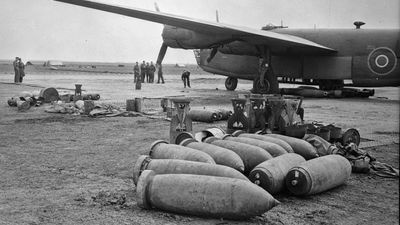
strategic bombing, approach to aerial bombardment designed to destroy a country’s ability to wage war by demoralizing civilians and targeting features of an enemy’s infrastructure—such as factories, railways, and refineries—that are essential for the production and supply of war materials. Some definitions of strategic bombing, however, also include roles for supporting ground troops in combat operations. Strategic bombing is a facet of total war, the enlistment of a society’s entire resources to aid in a conflict.
Aerial bombardment was first practiced by Italy, under the command of General Guilio Douhet, in Libya during Italy’s war with the Ottoman Empire (1911–12). During World War I, aircraft were first used for surveillance purposes, but by 1915 they were increasingly used in offensive operations. Between January 1915 and May 1918, Germany flew more than 100 strategic bombing raids using squadrons of airships and airplanes against England, which resulted in the deaths of more than 1,400 people. During the interwar period the value of strategic bombing was recognized. Technological developments during that time, such as longer flying times and the ability to reach higher altitudes, also made the strategy more feasible.
At the start of World War II, all nations’ air forces had a policy of attacking military targets only. That changed, however, once the German Luftwaffe began conducting air raids on British cities, including London, during the summer of 1940. As a result, strategic bombing became a fundamental part of military combat. The purpose of strategic bombing was not only to undermine industrial production but also to demoralize the population. Thus, civilian populations became the targets of many bombing missions. Meanwhile, as more and more planes were shot down, both sides began adopting a policy of night raids, which, while less accurate, were safer for bomb crews.


 " height="20" alt="HEW Logo">

The most-significant episode of strategic bombing during World War II was the dropping of the atomic bombs on Hiroshima and Nagasaki in 1945. The United States had already used conventional bombing raids to devastate civilian centres in both Germany and Japan. However, the use of atomic weapons had a permanent impact on the conduct of war and international relations after World War II.
After World War II the arms race for weapons switched from airplanes to other vehicles for the delivery of nuclear weapons. The focus of international relations shifted to missiles and defense systems meant to destroy incoming nuclear missiles. Strategic bombers, however, did remain as one-third of the strategic “nuclear triad” (nuclear arsenals traditionally made up of bombers, intercontinental ballistic missiles [ICBMs], and submarine-launched ballistic missiles) in the United States. Strategic bombers offered a greater flexibility in the event of heightened tensions and a potential conflict, because a bomber could be retrieved, whereas a missile could not. In addition, missile silos housing ICBMs were stationary and thus vulnerable to attack, whereas bombers were mobile and, thus, less vulnerable.
Nevertheless, strategic bombing continued to play an important role in U.S. military strategy, but the results of bombing campaigns have been mixed. During the Vietnam War, for example, Operation Rolling Thunder, which was implemented by President Lyndon Johnson and designed to be a ceaseless and relentless bombing campaign against North Vietnam, was ultimately regarded as ineffective. In addition, images of civilian bombing casualties broadcast in the United States may have also depleted support for the war effort.
In contrast, the Persian Gulf War, which pitted an international coalition of countries led by the United States against Iraq, began with an air campaign aimed at paving the way for the ground campaign that followed. It targeted airfields, antiaircraft batteries, command-and-control centres, and key pieces of Iraq’s transportation network using largely precision-guided weapons, such as smart bombs. The intervention of the North Atlantic Treaty Organization (NATO) in former Yugoslavia in 1999 also involved a bombing campaign that was essential to the success of the operation. At the beginning of the Iraq War in 2003, U.S. Defense Secretary Donald Rumsfeld famously referred to the “shock and awe” to be produced by the air offensive. The air offensive set the stage for the ground offensive that resulted in the capture of Baghdad, Iraq’s capital city, some three weeks after the war began.
The trusted destination for professionals, college students, and lifelong learners.
SUBSCRIBE

