

Adding us as a Preferred Source tells Google you trust our content, so our articles show up more often in your Google Search, Discover feed, and AI Overviews.
verifiedCite
While every effort has been made to follow citation style rules, there may be some discrepancies.
Please refer to the appropriate style manual or other sources if you have any questions.
Select Citation Style
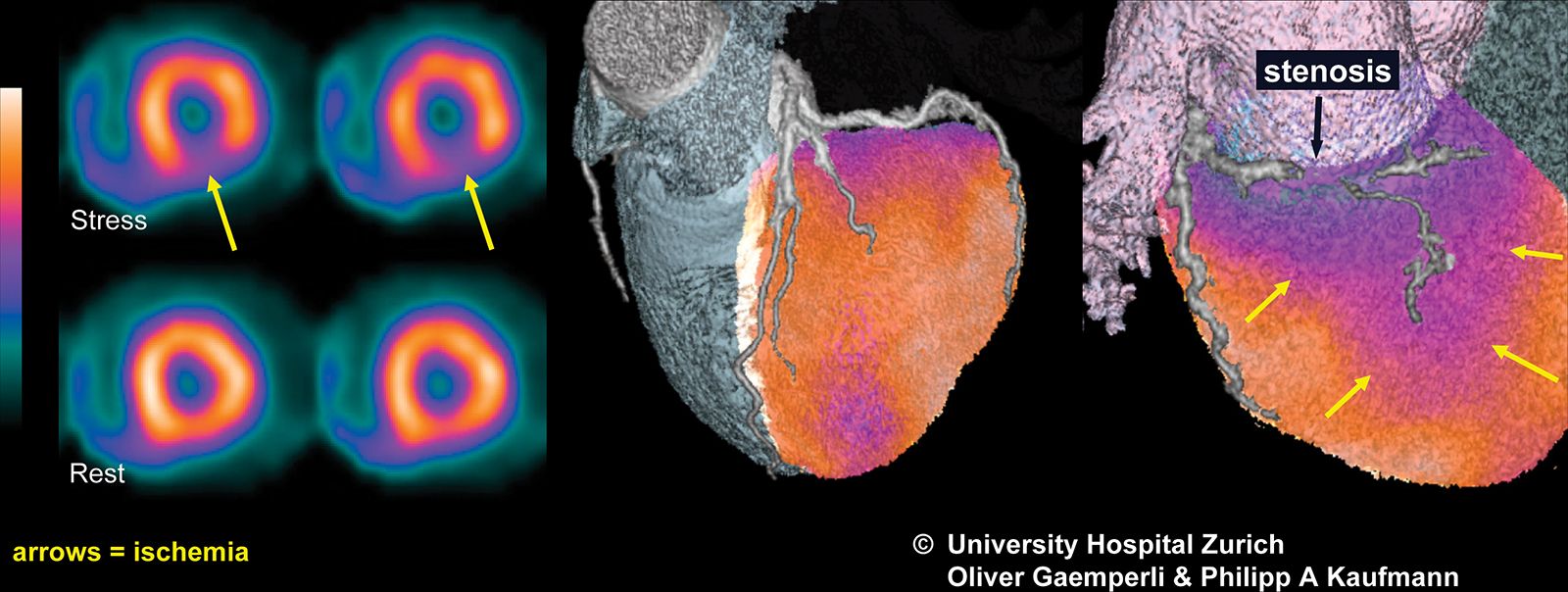
Single photon emission computed tomography (SPECT) can be used to image blood flow to the heart (left) in order to monitor conditions such as ischemia (decreased blood flow). When information gathered via SPECT is combined with imaging information from computed tomography (CT), a fusion image (centre and right) can be obtained.
single photon emission computed tomography
imaging technique
Also known as: SPECT
single photon emission computed tomography (SPECT), imaging technique used in biomedical research and in diagnosis. SPECT is similar to positron emission tomography (PET), in which a compound labeled with a positron-emitting radionuclide is injected into the body; however, its pictures are not as detailed as those produced using PET.
SPECT is much less expensive than PET because the tracers it uses have a longer half-life and do not require an accelerator nearby to produce them. It can be used to diagnose or evaluate a wide range of conditions, including diseases of the heart, cancer, and injuries to the brain.
This article was most recently revised and updated by Kara Rogers.


Discover how ordinary objects work, and expand your understanding of the familiar.

 " height="20" alt="HEW Logo">
By clicking "Sign Up", you consent to the Britannica Privacy Policy and Terms of Use.