
income-consumption curve
Quick Summary
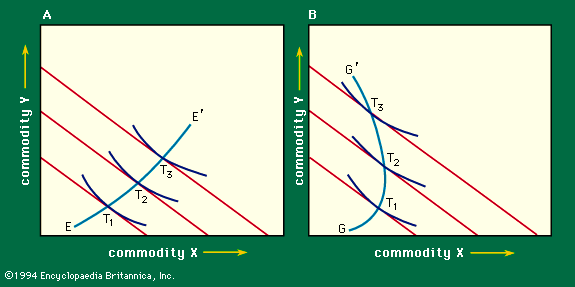
The income-consumption curve illustrates how a consumer's purchasing habits change as their income rises or falls, assuming prices remain constant. This curve is derived from a series of points where the consumer's budget line (representing their purchasing power) is tangent to different indifference curves (representing combinations of goods that provide equal satisfaction).1
As income increases, the budget line shifts outward, allowing the consumer to reach higher indifference curves. The income-consumption curve connects these optimal points, showing the relationship between income and the quantities of goods consumed. Typically, as income rises, consumers buy more of most goods, leading to an upward-sloping income-consumption curve. However, if a good is considered "inferior," a consumer may buy less of it as their income increases.1
Ask Britannica AI about this topic
Britannica doesn't have a full article on this topic, so we've curated a list of our relevant coverage.