

history of Saint Kitts and Nevis
-
Where are Saint Kitts and Nevis located?
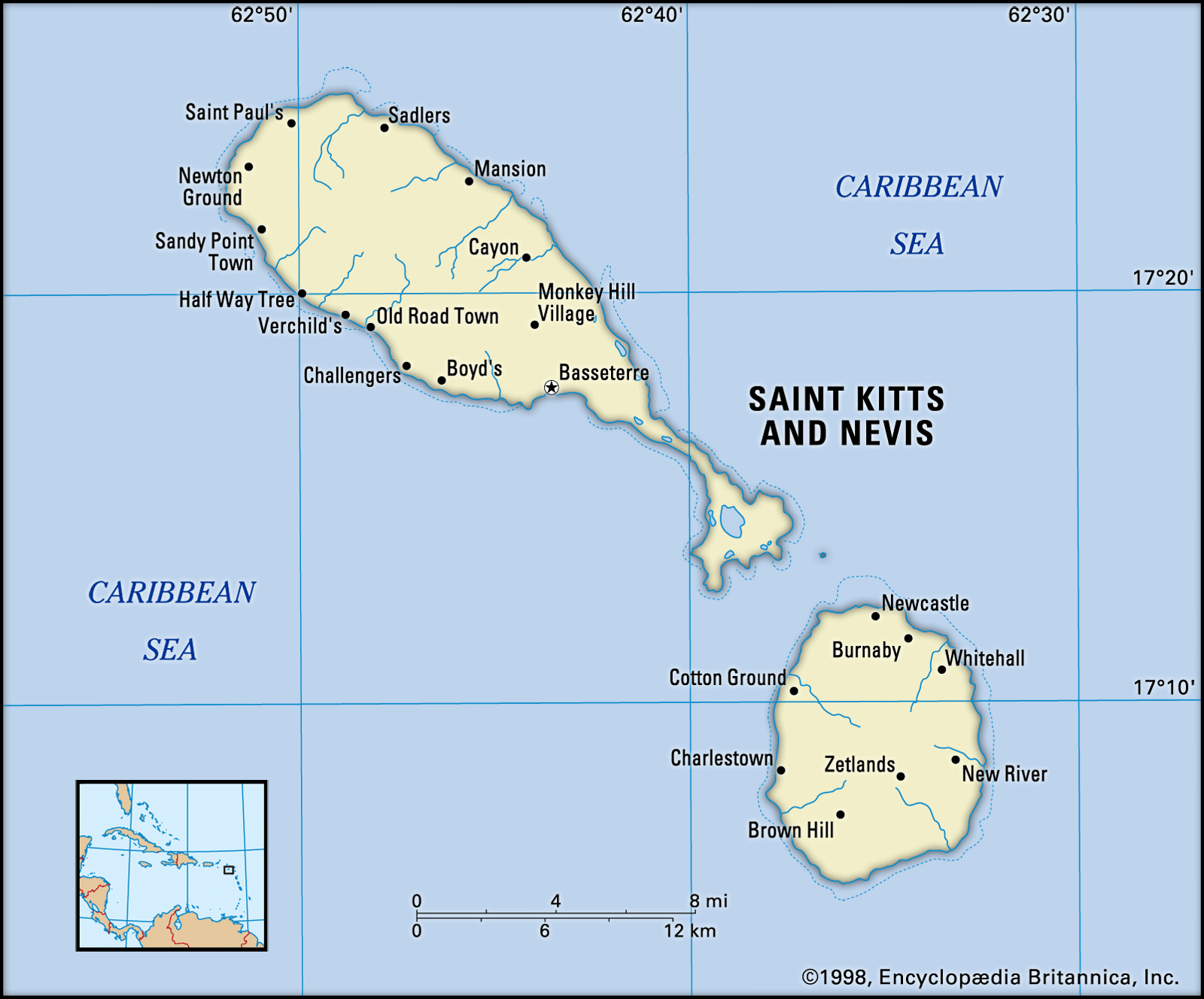
Saint Kitts and Nevis is a two-island state in the Lesser Antilles, situated in the eastern Caribbean Sea. Saint Kitts is oval-shaped, 23 miles (37 km) long and 5 miles (8 km) wide, with a volcanic mountain ridge forming a semicircle around a southeastern plain. Mount Liamuiga is its highest point. Nevis, surrounded by coral reefs, is circular and lies 2 miles (3 km) southeast of Saint Kitts. Basseterre, the capital, is located on the southwestern coast of Saint Kitts.
3 Britannica SourcesCreated from Britannica articles using AI. AI can make mistakes, so verify using Britannica articles. -
Who were the first people to live on Saint Kitts and Nevis?
In 1493, Christopher Columbus arrived on Saint Kitts during his second voyage and found the island inhabited by the Carib people. He named it Saint Christopher after his patron saint, which English settlers later shortened to Saint Kitts when they established the first successful English colony in the West Indies in 1623. The French arrived in 1625, establishing their own colony by 1627.
Columbus also sighted Nevis in 1493, naming it after the clouds atop Nevis Peak, describing them as las nieves, or "the snows." The English settled Nevis in 1628, and it became one of the most prosperous islands in the Antilles.
2 Britannica SourcesCreated from Britannica articles using AI. AI can make mistakes, so verify using Britannica articles. -
How did European colonization affect these islands?
European colonization significantly shaped the history of Saint Kitts and Nevis. Christopher Columbus's arrival in 1493 marked the initial European contact. In 1623, English settlers, led by Thomas Warner, established the first successful English colony in the West Indies on Saint Kitts. The French also colonized the island, leading to a division between French and English colonists during the 17th century.
Britain gained control of Saint Kitts in 1713 through the Treaty of Utrecht. Nevis was settled by the English in 1628 and became a prosperousAntilles island. Despite attacks, it remained economically sound until the mid-19th century. The shift from sugar cultivation to tourism reflects the lasting economic changes from colonization.
3 Britannica SourcesCreated from Britannica articles using AI. AI can make mistakes, so verify using Britannica articles. -
Why were Saint Kitts and Nevis important in the sugar industry?
Saint Kitts and Nevis were vital to the sugar industry due to their climate and land suitability for sugarcane cultivation. Beginning in the early 17th century, sugar plantations became the mainstay of the islands' economy, especially after the decline of tobacco. This led to a high demand for labor, resulting in the importation of African slaves, who were forced to work on the plantations. The sugar industry was so profitable that the islands devoted most of their land to sugarcane, importing food and other necessities. Although sugarcane cultivation ceased in 2005, its legacy remains a significant part of the islands' history and culture.
4 Britannica SourcesCreated from Britannica articles using AI. AI can make mistakes, so verify using Britannica articles. -
When did Saint Kitts and Nevis gain independence?
Saint Kitts and Nevis became independent on September 19, 1983, after a constitutional conference in London in 1982. Since then, it has been an independent member of the Commonwealth, with the British monarch as its head of state. The first prime minister of the independent Saint Kitts and Nevis was Kennedy Simmonds, who remained in office until 1995. The country has since sought to diversify its economy, with tourism and offshore financial services becoming leading income producers.
2 Britannica SourcesCreated from Britannica articles using AI. AI can make mistakes, so verify using Britannica articles. -
How has the history of Saint Kitts and Nevis influenced its culture today?
The history of Saint Kitts and Nevis has significantly shaped its culture today. As the site of the first successful English colony in the West Indies, established in 1623, it was divided between warring French and English colonists during the 17th century. Britain gained control in 1713. This colonial past is reflected in the official language, English, and the prominence of Anglican and Methodist denominations.
The shift from a sugar-based economy to tourism and financial services has also influenced the culture. While the population is largely black, there are also small mulatto, South Asian, and white groups, contributing to a diverse cultural landscape. Most cultural activity is concentrated in Basseterre.
2 Britannica SourcesCreated from Britannica articles using AI. AI can make mistakes, so verify using Britannica articles.
history of Saint Kitts and Nevis, a survey of important events and people in the history of Saint Kitts and Nevis, an independent member of the Commonwealth that was also the site of the first successful English colony in the West Indies.
Early settlement and European colonization
The Carib people inhabited Saint Kitts when Christopher Columbus arrived in 1493 on his second voyage. Columbus referred to the island as Saint Christopher, for his patron saint, and later English settlers shortened that name to Saint Kitts when they arrived in 1623 under Thomas Warner. Their colony at Old Road on the west coast was the first successful English colony in the West Indies. The French first arrived on the island in 1625 and established a colony of their own in 1627 under Pierre Bélain, sieur d’Esnambuc. Divided during the 17th century between warring French and English colonists, Saint Kitts was given to Britain by the Treaty of Utrecht in April 1713 and remained in British possession despite the 1782 capture of Brimstone Hill by the French. The island was restored to Great Britain by the Peace of Paris treaty signed by Britain and France at Versailles in 1783.
Nevis was also sighted by Columbus in 1493. The island’s name derives from Columbus’s description of the clouds atop Nevis Peak as las nieves, or “the snows.” It was settled by the English in 1628 and soon became one of the most prosperous of the Antilles. Although it suffered from French and Spanish attacks in the 17th and 18th centuries, it maintained a sound economic position until the mid-19th century.


 " height="20" alt="HEW Logo">
Federation and independence movements
The islands of Saint Kitts, Nevis, and Anguilla were united by federal act in 1882 and became an independent state in association with the United Kingdom on February 27, 1967. The islands were granted full internal self-government, with the United Kingdom retaining responsibility for defense and foreign affairs.
After the islands had assumed the status of associated states, Anguilla complained of domination by the Saint Kitts administration. In May 1967 the Anguillans ejected the Saint Kitts police and established their own council. In July of the same year, they proclaimed their independence. After unsuccessful negotiations, the Anguilla Act of July 1971 placed Anguilla directly under British control. On February 10, 1976, Anguilla was granted a constitution, and its union with Saint Kitts and Nevis was formally severed in 1980.
A constitutional conference was held in London in 1982, and, in spite of disagreement over special provisions for Nevis, Saint Kitts and Nevis became independent on September 19, 1983. A drop in world sugar prices hurt the nation’s economy through the mid-1980s, and the government sought to reduce the islands’ dependence on sugar production and to diversify the economy.
Kennedy Simmonds, the first prime minister of the independent Saint Kitts and Nevis, remained in office until 1995, when his People’s Action Movement was decisively defeated by the Saint Kitts–Nevis Labour Party (SKNLP). One of the early issues in the administration of the new prime minister, SKNLP leader Denzil Douglas, was a secession movement on Nevis. A referendum was held there in 1998 on the question of independence for the island, but it fell short of the two-thirds majority needed to secede. The nationalized sugar industry continued to slump and, after years of operating it at a loss, the government closed it down after the 2005 harvest. Tourism and the hosting of offshore financial and service companies became the leading income producers in the country’s economy. Douglas won reelection in 2000, 2004, and 2010 but was defeated in 2015 by Team Unity, a coalition of opposition parties led by former foreign minister Timothy Harris, who became the new prime minister. The SKNLP, under the leadership of Terrance Drew, was returned to power in 2022 after snap elections.
The trusted destination for professionals, college students, and lifelong learners.
SUBSCRIBE

