

- Related Topics:
- insect
- heteropteran
- Coleoptera
- termite
- Would You Eat Bugs?


entomophagy
-
What is entomophagy?
Entomophagy is the practice of humans consuming insects as a source of nutrition and is common in most parts of the world, especially in the tropics, where more than 2,000 species of insects are known to be consumed.
Edible insects generally provide satisfactory amounts of energy and protein, meet amino acid requirements for humans, and are high in mono- and polyunsaturated fatty acids. Several insect species also have high amounts of micronutrients.
Insects are also very efficient in converting feed to edible body weight. Entomophagy is considered an important means of helping to meet the global rise in food demand, especially in the context of meat production.
2 Britannica SourcesCreated from Britannica articles using AI. AI can make mistakes, so verify using Britannica articles. -
Which kinds of insects are commonly eaten by people?
Entomophagy, the practice of humans consuming insects as food, is common worldwide, especially in tropical regions, where over 2,000 insect species are consumed.
Most edible insects belong to these groups:
* Beetles (Coleoptera)
* Moths and butterflies (Lepidoptera). Larval stages like caterpillars are preferred over butterflies.
* Wasps, bees, and ants (Hymenoptera)
* Crickets, grasshoppers, and locusts (Orthoptera)
* True bugs (Hemiptera)
* Termites (Isoptera)
* Dragonflies (Odonata)
* Flies (Diptera)Insects can be a good source of energy and protein, with many containing high amounts of mono- and polyunsaturated fatty acids. For example, mopane caterpillars and crickets have high iron levels.
While insect pathogens are different from those affecting humans, hygienic production is still essential. Allergies are a concern, particularly for those allergic to house dust mites.
2 Britannica SourcesCreated from Britannica articles using AI. AI can make mistakes, so verify using Britannica articles. -
In what parts of the world is eating insects a common practice?
Entomophagy, the practice of humans consuming insects as food, is common in most parts of the world, especially in the tropics, where over 2,000 insect species are consumed.
Across the globe, the most consumed insects are beetles, moths, butterflies, wasps, bees, ants, crickets, grasshoppers, locusts, true bugs, termites, dragonflies, and flies; the larval stages of insects are typically preferred for consumption.
Because of the high nutritional value and low environmental impact of eating insects, entomophagy is seen as an important way to meet the rising global demand for food.
2 Britannica SourcesCreated from Britannica articles using AI. AI can make mistakes, so verify using Britannica articles. -
Why do some cultures include insects in their diet?
Entomophagy, or the consumption of insects, is a dietary practice common in most parts of the world, especially in tropical regions, where over 2,000 insect species are consumed. This is due to insects being a good source of nutrition. Edible insects generally provide sufficient amounts of energy and protein, meet the human body's amino acid requirements, and contain high amounts of mono- and polyunsaturated fatty acids.
Compared to traditional livestock, insects convert feed to body weight far more efficiently and produce fewer greenhouse gas emissions. Making insects appealing is a major challenge for entomophagy, especially in the Western world, but stressing the nutritional and environmental benefits is important.
3 Britannica SourcesCreated from Britannica articles using AI. AI can make mistakes, so verify using Britannica articles. -
What nutrients can people get from eating insects?
Entomophagy is the practice of humans consuming insects as food. While the nutritional value of insects varies, they generally provide sufficient energy and protein, meeting human amino acid requirements, and are high in both monounsaturated and polyunsaturated fatty acids.
Several insect species contain high amounts of micronutrients. For example, mopane caterpillars and crickets have high amounts of iron and could serve as valuable sources of nutrients for those suffering from iron deficiency anemia. Chitin, a polysaccharide in the exoskeleton of insects, may also strengthen the human immune system.
3 Britannica SourcesCreated from Britannica articles using AI. AI can make mistakes, so verify using Britannica articles. -
What are some challenges or concerns about using insects as food on a large scale?
Entomophagy faces challenges in large-scale adoption. A primary concern involves ensuring food safety, including hygienic production to avoid pathogen contamination. Allergies are also a significant issue, potentially requiring specific labeling. Another challenge lies in making insects palatable and appealing, especially in the Western world, where cultural acceptance is lower.
Additionally, while insects are efficient in converting feed to body weight compared to traditional livestock, sustainable harvesting from nature is not always feasible as demand increases. The cost of farmed insects for human consumption can also be high due to labor costs. Regulations and legislation for using insects as food are still developing.
1 Britannica SourceCreated from Britannica articles using AI. AI can make mistakes, so verify using Britannica articles.
entomophagy, the consumption of insects as a source of nutrition by humans. Entomophagy is practiced in most parts of the world, though it is especially common in the tropics, where more than 2,000 different species of insects are known to be consumed. Most species of insects that are eaten by humans fall within the following taxonomic groups: Coleoptera (beetles), Lepidoptera (moths and butterflies), Hymenoptera (wasps, bees, and ants), Orthoptera (crickets, grasshoppers, and locusts), Hemiptera (also called Heteroptera; true bugs), Isoptera (termites), Odonata (dragonflies), and Diptera (flies). That beetle species are well represented seems logical as they are the most abundant of all described insect species in the world. Among most insect species, the larval stages are preferred for consumption; for example, from Lepidoptera, almost all species are eaten as caterpillars and not as butterflies.
Entomophagy in the tropics
There may be a number of reasons why insects are predominantly eaten in the tropics. First, although most edible insect species occur seasonally there, they occur in different seasons; thus, as a food resource, insects are available throughout the year. By contrast, insects in temperate zones are not available during winter, since many spend that season in diapause or quiescence. Tropical insect species are also larger than many other insect species found in other parts of the world. In addition, in the tropics, harvesting is often relatively easy, since insects are often clumped together (e.g., locust swarms or caterpillars in trees).
Entomophagy versus meat
Compared with conventional livestock, insects are very efficient in converting feed to edible bodyweight. For example, to arrive at 1 kg (2.2 pounds) edible body weight, crickets need 2.1 kg of feed, compared with 4.5 kg for chickens, 9.1 kg for pigs, and 25 kg for cattle. In addition, conventional livestock are responsible for about 14.5 percent of global greenhouse gas emissions, because of the release into the atmosphere of nitrous oxide from manure and methane from enteric fermentation. Livestock also account for two-thirds of ammonia emissions, which contribute to the acidification of soils and the eutrophication of water bodies. Insects, by comparison, produce far fewer greenhouse gas emissions. Life-cycle analysis has shown that insect protein production, such as from mealworms, requires much less land area than that needed for the production of protein in the form of milk, pork, chicken, or beef. Protein production by livestock also requires large amounts of fresh water; by some estimates, 43,000 litres (about 11,360 gallons) of water are needed for every kilogram of beef produced.


 " height="20" alt="HEW Logo">

Although some insects are raised on cereals, many other insect species (e.g., mealworms) can be grown on organic waste. Such waste streams need to be certified to ensure that they do not pose safety concerns. For other waste streams, research is needed to understand how insects deal with possible contaminants. Experiments with mealworms have shown, for example, that pathogen infection (infection with a disease-causing entity) induces the production of antimicrobial compounds, which neutralize contaminants.
Given its relatively low impact on the environment, entomophagy is considered to be an important means in helping to meet the global rise in food demand. That is especially evident in the context of meat production. World meat production traditionally has been heavily and disproportionately concentrated in industrial countries but is projected to double by 2050, with most of that growth occurring in less-developed countries. Of all agricultural land in the world, however, 70 percent is used for livestock production. Although lowering meat consumption is one way of addressing the problem, other solutions include the development of in vitro meat-production systems, the use of microalgae, and entomophagy.
Nutritional value of insects
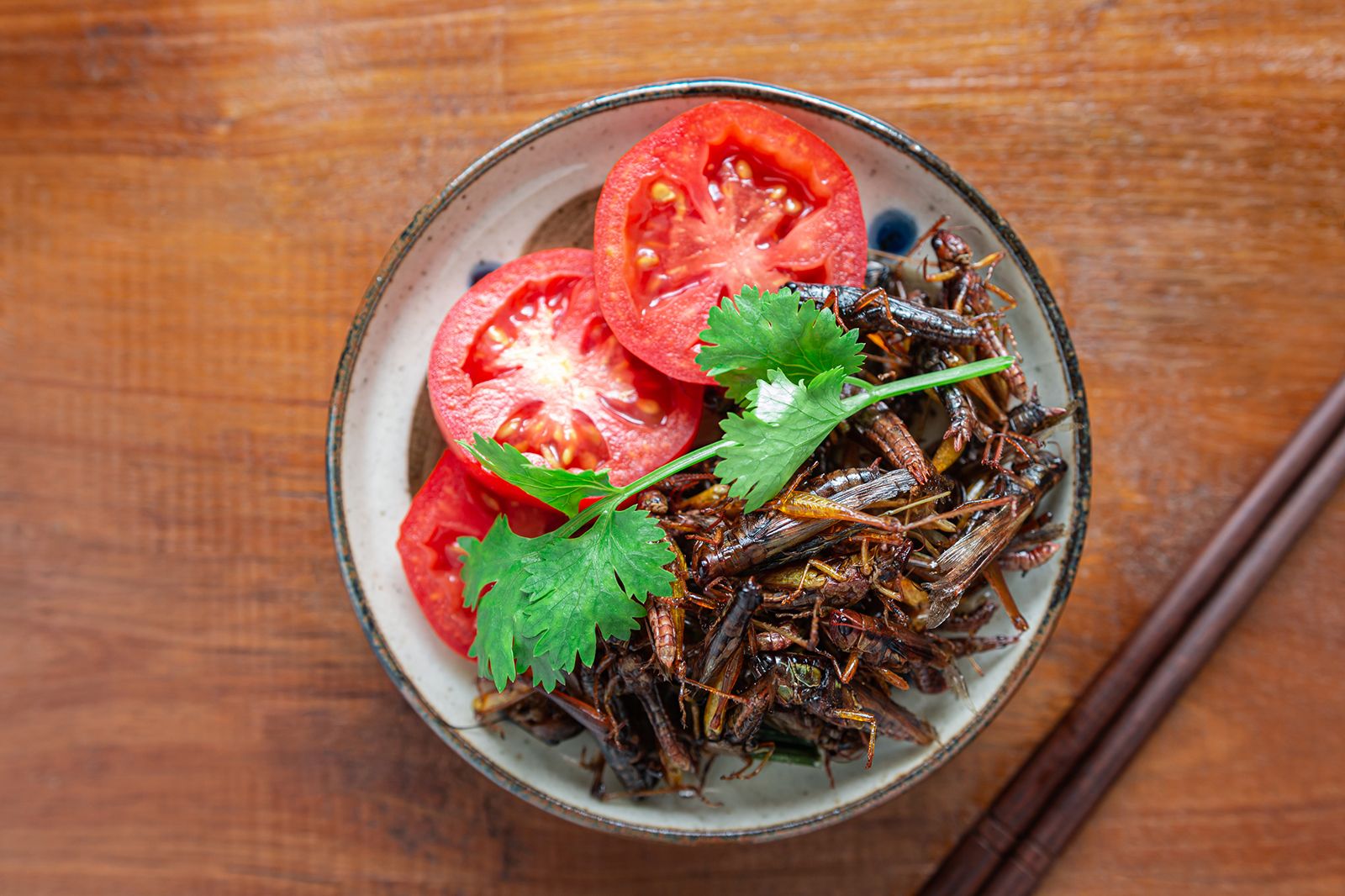
It is difficult to generalize the nutritional value of the many edible insect species, since nutritional content depends on the stage of the harvested insect, the insect’s diet, and rearing and processing (e.g. drying, boiling, and frying) conditions. However, edible insects in general provide satisfactory amounts of energy and protein, meet amino acid requirements for humans, and are high in monounsaturated and polyunsaturated fatty acids. Several insect species also have high amounts of micronutrients. Mopane caterpillars and crickets, for example, have high amounts of iron, making them potentially valuable sources of nutrients for the one billion people worldwide who suffer from iron deficiency anemia, in particular pregnant women and preschool children. Chitin, a polysaccharide found in the exoskeleton of insects, has been shown to strengthen the human immune system.
Farming insects
Insects in tropical countries are predominantly harvested from nature, although that approach cannot be continued sustainably as the demand for edible insects grows. In Thailand, 20,000 cricket farms produced an average of 7,500 tonnes (16.5 million pounds) of insects per year in 1996–2011 for home consumption and for the market. In the Western world, insects are mainly farmed as pet food. However, some insect-rearing companies in the Netherlands have set up special production lines for human consumption; those insects are sold freeze-dried. A major challenge with such products is to bring down the cost to consumers, which are high because of labour costs.
The trusted destination for professionals, college students, and lifelong learners.
SUBSCRIBE


Food safety, preservation, and legislation
Edible insects, similar to other food products, are subject to safety and regulatory issues. Insect pathogens are phylogenetically distinct from vertebrate pathogens and are generally regarded as harmless to humans. However, because contamination by pathogens may pose a danger to humans in some instances, insects should be hygienically produced.
A more-significant safety concern with edible insects has been allergies. Some people, for example, may have allergies to house dust mites, and cross-reactivity of allergens may occur with the consumption of insects. A solution to such allergy concerns would entail appropriate labeling of the product. Processing methods, such as boiling, toasting, and frying, are recommended to ensure a safe product. Edible insects and insect products can be preserved without the use of a refrigerator through techniques such as drying, acidifying, and lactic fermentation.
The regulation and legislation of using insects as human food are unclear. National and international food-safety authorities are engaged in addressing safety concerns.
Gastronomy
Making insects tasty and attractive is one of the major challenges of entomophagy, particularly in the Western world. To stress nutritional and environmental benefits is important, but consumers will only be convinced when palatability is appealing in terms of colour, texture, taste, and flavour. However, while food preferences are influenced by cultural history, experience, and adaptation, entomophagy in the Western world is also a matter of education. Cookbooks on insects can be used to help consumers identify appealing recipes.