
- German:
- “people’s community”
- Related Topics:
- fascism


Volksgemeinschaft
-
What does the word 'Volksgemeinschaft' mean?
Volksgemeinschaft meant a racially unified and hierarchically organized body in Nazi Germany. Within this community, individual interests were strictly subordinate to the nation, or Volk. The people's community would be permanently prepared for war and accept the discipline that this required.
The establishment of a Volksgemeinschaft was perhaps the main purpose and goal of the Nazi revolution. Its creation required the purification and increase of the German "race" and its biological separation from the Jews, whose infusion of evil into the German bloodstream, the Nazis claimed, served to pollute and undermine Germany’s well-being.
3 Britannica SourcesCreated from Britannica articles using AI. AI can make mistakes, so verify using Britannica articles. -
How was the idea of Volksgemeinschaft used by the Nazis?
The Nazis used the idea of Volksgemeinschaft to establish a racially unified and hierarchically organized national community. They considered inequality between races and individuals as natural, and they saw the German Volk as the greatest, with the state existing to serve it.
To create the Volksgemeinschaft, the Nazis aimed to purify and increase the German "race" and separate it from Jews, who they believed polluted Germany's well-being. Nazi efforts included the Law for the Protection of Hereditary Health and the Nuremberg Laws. They also sought to integrate German workers into the Volksgemeinschaft by providing employment and leisure activities.
2 Britannica SourcesCreated from Britannica articles using AI. AI can make mistakes, so verify using Britannica articles. -
Who was included and excluded from the Nazi Volksgemeinschaft?
The Nazi Volksgemeinschaft was a racially unified and hierarchically organized "people's community" prepared for war, where individual interests were strictly subordinate to the nation.
Inclusion:
* The Volksgemeinschaft was meant to attract the German working class by providing employment and leisure activities.
* The Nazis idealized mothers and celebrated motherhood to increase the "Aryan" birth rate.Exclusion:
* The Nazis sought the purification of the German "race" and its separation from Jews, whom they claimed polluted Germany's bloodstream. The Nuremberg Laws of 1935 forbade marriage or sexual relations between Jews and Germans and assigned Jews to a lower class of citizenship.
* Other groups excluded from the Volksgemeinschaft included political dissidents, trade unionists, Social Democrats, homosexuals, Jehovah’s Witnesses, Germans of African descent, Roma, and Sinti.
* The Nazis initiated the T4 Program to murder intellectually or physically disabled and emotionally disturbed Germans, who they believed violated the Nazi ideal of Aryan supremacy.
* In occupied Poland, the Nazis killed Polish priests and politicians and kidnapped children of the Polish elite to be raised as "Aryans" in Germany.5 Britannica SourcesCreated from Britannica articles using AI. AI can make mistakes, so verify using Britannica articles. -
How did the Nazis try to create a sense of unity and belonging in their Volksgemeinschaft?
The Nazis aimed to establish a Volksgemeinschaft, a racially unified and organized entity where individual interests were subordinate to the nation. They sought to purify and expand the German race while excluding those deemed undesirable, such as Jews.
To foster unity, the Nazis implemented policies such as the Marriage Subsidy Law to encourage "Aryan" births and the "Strength Through Joy" program, which subsidized leisure activities for workers. They also used propaganda events like the Nuremberg Rally to promote enthusiasm and showcase the power of National Socialism. Organizations such as the Hitler Youth indoctrinated young people with Nazi principles to ensure conformity and dedication to the regime.
5 Britannica SourcesCreated from Britannica articles using AI. AI can make mistakes, so verify using Britannica articles. -
What role did propaganda and youth organizations play in building the Volksgemeinschaft?
The Nazis used propaganda and youth organizations to establish a Volksgemeinschaft, a racially unified and hierarchical society where individual interests were subordinate to the nation.
Propaganda promoted the idea of a pure German race and excluded groups like Jews, while youth organizations such as the Hitler Youth and the League of German Girls indoctrinated young people with Nazi principles from a young age, emphasizing dedication, fellowship, and conformity. These organizations aimed to create a generation loyal to the Nazi regime and its ideals of racial purity and national unity.
3 Britannica SourcesCreated from Britannica articles using AI. AI can make mistakes, so verify using Britannica articles. -
How did the concept of Volksgemeinschaft help the Nazis justify discrimination and violence against certain groups?
The Nazi concept of Volksgemeinschaft (people's community) envisioned a unified, racially pure, and hierarchical society where individual interests were subordinate to the nation. Adolf Hitler and Nazi propagandists promoted the idea that Germans needed to be separated from groups they considered to be Germany's racial enemies, such as Jews and socialists.
The Nazis used this ideology to justify discrimination and violence against those deemed outside the Volksgemeinschaft. They believed these groups posed a threat to the purity and well-being of the German race. This concept served as the basis for anti-Semitic legislation like the Nuremberg Laws, which stripped Jews of their rights and prohibited marriage or sexual relations between Jews and Germans. The Volksgemeinschaft was central to the Holocaust, providing the ideological justification for the persecution and extermination of Jews and other minority groups.
1 Britannica SourceCreated from Britannica articles using AI. AI can make mistakes, so verify using Britannica articles.
Volksgemeinschaft, in Nazi Germany, a racially unified and hierarchically organized body in which the interests of individuals would be strictly subordinate to those of the nation, or Volk. Like a military battalion, the people’s community would be permanently prepared for war and would accept the discipline that this required.

Although the Nazis had not given specific indications of the shape that German politics and society would take under their rule, Adolf Hitler and his propagandists had communicated clearly that the changes would be fundamental and would come at the expense of Germany’s racial enemies. Hitler regarded inequality between races and individuals as part of an unchangeable natural order, and he exalted the “Aryan race” as the sole creative element of mankind. For Hitler the natural unit of mankind was the Volk, of which the German was the greatest, and the state existed only to serve the Volk—a mission that the Weimar Republic had betrayed, according to the Nazis. All morality and truth was judged by this criterion: whether it was in accordance with the interest and preservation of the Volk. For this reason democratic government stood doubly condemned. It assumed an equality within the Volk which the Nazis believed did not exist, and it supposed that what was in the interests of the Volk could be decided by discussion and voting. In fact, the unity of the Volk found its incarnation in the Führer, endowed with absolute authority. Below the Führer, the party (which Hitler often called the “movement,” to distinguish it from democratic parties) supposedly was drawn from the best elements of the Volk and was in turn its safeguard.
Thus, the establishment of a Volksgemeinschaft was perhaps the main purpose and goal of the Nazi revolution. Its creation required the purification and increase of the German “race” as well as its biological separation from the Jews, whose infusion of evil into the German bloodstream, the Nazis claimed, served to pollute and undermine Germany’s well-being. Under National Socialism alone, the Nazis insisted, could Germans unify under “Ein Reich, ein Volk, ein Führer” (“One empire, one people, one leader”) and get on with the task of combating Germany’s real enemies: socialists, Jews, and those defeatists who had “stabbed in the back” the German army during World War I. This amalgam of fervent nationalism, anti-Semitism, and populism, not to mention the charismatic spell of Hitler’s oratory and the hypnotic pomp of Nazi rallies, was psychologically appealing to a populace gripped by the effects of the Great Depression.


 " height="20" alt="HEW Logo">
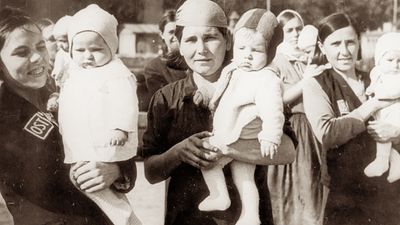
Nazi efforts to purify and unify the German “race” were cloaked in an air of scientific respectability from the pseudoscience of eugenics and coated with a patina of legality through the structures of the Nazi police state. The Law for the Protection of Hereditary Health (July 14, 1933) allowed for the eventual sterilization of as many as two million people deemed unworthy of propagating. The Marriage Subsidy Law of July 1933 aimed to stimulate the “Aryan” birth rate by granting loans to newly married couples; these loans would be forgiven incrementally with the birth of each additional child. The Nazi idealization of mothers and the celebration of motherhood as a special service to the Reich had the same objective. Hitler spoke of an eventual doubling of the German population through these measures. The most notorious of the steps taken to purify the German “race” was also a milestone in the anti-Jewish legislation promulgated by the Nazis: the infamous Nürnberg Laws of September 1935, which forbade marriage or sexual relations between Jews and Germans and assigned to Jews a lower class of citizenship. The legal and political framework that was created to establish the Volksgemeinschaft was, in essence, the foundation upon which the Holocaust was carried out.