

- Also called:
- Holy Shroud
- Italian:
- Santa Sindone

Shroud of Turin
What is the Shroud of Turin?
What is the image on the Shroud of Turin?
Is the Shroud of Turin real?
What is the scientific evidence of the Shroud of Turin’s authenticity?
News •
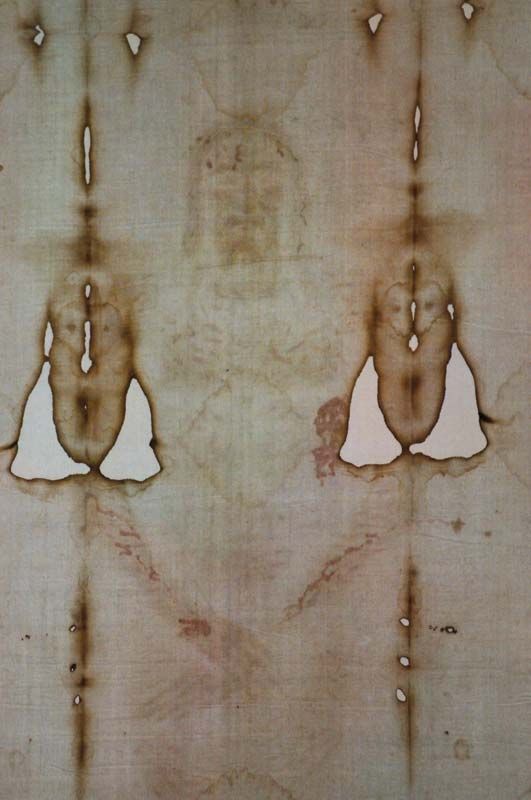
Shroud of Turin, a length of linen that is purported to be the burial garment of Jesus Christ. It has been preserved since 1578 in the royal chapel of the Cathedral of San Giovanni Battista in Turin, Italy. For centuries, the shroud has been the focus of debates about its authenticity and an object of devotion by those who believe that it is truly a relic of Christ.
Description
Measuring 4.3 meters (14 feet 3 inches) long and 1.1 meters (3 feet 7 inches) wide, the shroud seems to portray two faint brownish images, those of the back and front of a gaunt, sunken-eyed, 1.7-meter- (5-foot 7-inch-) tall man—as if a body had been laid on its back lengthwise along one half of the shroud while the other half had been doubled over the head to cover the whole front of the body, from face to feet. The images contain markings that allegedly correspond to the crucifixion wounds of Jesus, including thorn marks on the head, lacerations (as if from flogging) on the back, bruises on the shoulders, and various stains of what is presumed to be blood.
The Shroud of Turin is distinct from the Veil of Veronica, which is depicted in the Stations of the Cross as a piece of fabric that was imprinted with Christ’s face during his walk to Golgotha (see St. Veronica).


 " height="20" alt="HEW Logo">
How was the Shroud of Turin discovered?

The first historical account of the shroud occurs in 1354, when it is recorded that it wound up in the hands of a famed knight, Geoffroi de Charnay, seigneur de Lirey. There is no record of how he came into possession of it. In 1389, when it went on exhibition, the shroud was denounced as false by the local bishop of Troyes, who declared it “cunningly painted, the truth being attested by the artist who painted it.” The Avignon antipope Clement VII (reigned 1378–94) refrained from expressing his opinion on the shroud’s authenticity but sanctioned its use as an object of devotion provided that it be exhibited as an “image or representation” of the true shroud.
However, subsequent popes, from Julius II on, took the shroud’s authenticity for granted. In 1453 Geoffroi de Charnay’s granddaughter Marguerite gave the shroud to the house of Savoy at Chambéry, and there it was damaged by fire and water in 1532. It was moved to the new Savoyard capital of Turin in 1578. Ever since, it has been publicly exhibited only rarely, as on the marriage of Prince Umberto (1931) and on the 400th anniversary of its arrival in Turin (1978).
In 1998 and 2000 Pope John Paul II arranged for public viewings; he called the shroud “a mirror of the Gospel.” Pope Benedict XVI similarly arranged a public display in 2010, and Pope Francis made a pilgrimage to see it in 2015. A replica of the shroud is housed in the Museum of the Shroud in Turin.
Analyses of the shroud’s authenticity

Scholarly analyses—attempting to use scientific methods to prove or disprove the relic’s authenticity—have been applied to the shroud since the late 19th century. In 1898 it was noticed that the sepia-tone images on the shroud seem to have the character of photographic negatives rather than positives. Beginning in the 1970s, tests were made to determine whether the images were the result of paints (or other pigments), scorches, or other agents; none of the tests proved conclusive.
The trusted destination for professionals, college students, and lifelong learners.
SUBSCRIBE


In 1988 the Vatican provided three laboratories in different countries with postage-stamp-sized pieces of the shroud’s linen cloth. Having subjected these samples to carbon-14 dating, all three laboratories concluded that the cloth of the shroud had been made sometime between 1260 and 1390, thus indicating that it was inauthentic. However, some scientists raised doubts about the researchers’ methodology. Upon receiving the results of the tests, the Vatican encouraged scientists to conduct further investigations of the shroud’s authenticity and recommended that Christians continue to venerate the shroud as an inspiring image of Christ. Nonetheless, the Holy See has not made any official pronouncements concerning the relic’s authenticity.
In 2022 researchers in Italy published the results of a study in which they used the technique of wide-angle X-ray scattering (WAXS) to analyze a small piece of the shroud. The study concluded that the structural degradations of the shroud’s linen were “fully compatible” with those of another linen sample that has been dated, according to historical records, to 55–74 ce. Environmental carbon contamination was suggested as the source of the discrepancy between those findings and the results of the carbon dating in the 1980s. The 2022 study’s results bolstered the hypothesis that the Shroud of Turin truly is from the time of Christ, although the researchers made no conclusion regarding its authenticity as a relic. They also noted that further testing is needed to confirm their conclusions.