
- In full:
- Motor Vessel Wilhelm Gustloff


Wilhelm Gustloff
-
What was the Wilhelm Gustloff?
The MV Wilhelm Gustloff was a German ocean liner and the first ship built for the Nazi Kraft durch Freude program, meant to provide leisure activities to German workers. It served as a cruise ship, a hospital ship, and later as a floating barracks. In January 1945, it was evacuating German troops and civilians from East Prussia when a Soviet submarine torpedoed it. The sinking of the Wilhelm Gustloff is the deadliest maritime disaster in history, with approximately 9,000 deaths.
2 Britannica SourcesCreated from Britannica articles using AI. AI can make mistakes, so verify using Britannica articles. -
Who owned and operated the Wilhelm Gustloff?
The MV Wilhelm Gustloff was owned and operated by the German Labour Front’s Kraft durch Freude (Strength Through Joy) program. This program, part of Nazi Germany, aimed to provide leisure activities for German workers and serve as a propaganda tool for the Third Reich.
Launched in 1937, the ship initially carried holidaymakers on cruises. With the onset of World War II, the German navy requisitioned the Wilhelm Gustloff and converted it into a hospital ship. Later, it served as a floating barracks. In early 1945, it was tasked with evacuating German troops and civilians from East Prussia.
3 Britannica SourcesCreated from Britannica articles using AI. AI can make mistakes, so verify using Britannica articles. -
What was the ship originally used for before World War II?
Before World War II, the German ocean liner Wilhelm Gustloff served the Nazi Kraft durch Freude ("Strength Through Joy") program, offering leisure activities to German workers and acting as a propaganda tool for the Third Reich. Launched in 1937, it provided cruises in the North Atlantic and Mediterranean for German vacationers. In addition to cruises, the Gustloff was used for public-oriented missions, such as serving as a polling place for Germans and Austrians living in England to vote on the annexation of Austria in 1938 and bringing soldiers of the Condor Legion back to Germany after the Spanish Civil War ended in 1939.
2 Britannica SourcesCreated from Britannica articles using AI. AI can make mistakes, so verify using Britannica articles. -
How was the Wilhelm Gustloff used during World War II?
During World War II, the German ocean liner Wilhelm Gustloff served multiple purposes for the Third Reich. Initially, it was converted into a hospital ship and later became a floating barracks. In the war's closing months, it was used to evacuate German troops and civilians from East Prussia as Soviet armies advanced. By this time, the ship had been designated as a viable military target because it had shed its noncombatant markings, had troops on board, and had antiaircraft guns on its deck. On January 30, 1945, the Wilhelm Gustloff was sunk by a Soviet submarine, resulting in approximately 9,000 deaths.
2 Britannica SourcesCreated from Britannica articles using AI. AI can make mistakes, so verify using Britannica articles. -
What happened to the Wilhelm Gustloff in 1945?
In January 1945, the MV Wilhelm Gustloff, a German ocean liner, was evacuating German troops and civilians from East Prussia ahead of advancing Soviet armies. On January 30, carrying an estimated 10,000 people, it was struck by three torpedoes fired by a Soviet submarine. The ship sank in just over an hour in the frigid Baltic Sea. Only 1,200 people were saved, while approximately 9,000 lives were lost in the deadliest shipwreck in history.
2 Britannica SourcesCreated from Britannica articles using AI. AI can make mistakes, so verify using Britannica articles. -
Why is the sinking of the Wilhelm Gustloff considered one of the greatest maritime disasters in history?
The sinking of the Wilhelm Gustloff is considered one of the greatest maritime disasters in history due to the enormous loss of life. On January 30, 1945, the ship, evacuating German troops and civilians from East Prussia, was struck by three torpedoes fired by a Soviet submarine.
The Wilhelm Gustloff was built to accommodate roughly 1,900 people, but it carried an estimated 10,000 passengers when it set sail that day. The torpedoes hit the crew quarters, killing those best trained to deal with the situation. Over 9,000 lives were lost in the sinking, making it the deadliest shipwreck in history.
3 Britannica SourcesCreated from Britannica articles using AI. AI can make mistakes, so verify using Britannica articles.

Wilhelm Gustloff, German ocean liner that was sunk by a Soviet submarine on January 30, 1945. An estimated 9,000 passengers were killed in the sinking, making it the greatest maritime disaster in history.

The MV Gustloff was the first ship built specifically for the German Labour Front’s Kraft durch Freude (“Strength Through Joy”) program, which subsidized leisure activities for German workers. It measured 684 feet (208.5 metres) in length and weighed more than 25,000 tons. The ship was named for the leader of the Swiss Nazi Party, who had been assassinated on February 4, 1936, and it was launched in the presence of Adolf Hitler on May 5, 1937. The Gustloff started on its maiden voyage on March 24, 1938, and over the course of 17 months it went on some 50 cruises, transporting some 65,000 vacationers.
The ship had enough space to accommodate roughly 1,900 people, including some 400 crew members. For propaganda purposes, all the cabins aboard the Gustloff were sized and apportioned similarly, making the Gustloff—in appearance, at least—a “ship without social classes.” The sole exception was one larger cabin reserved for Hitler. It was not possible to simply book a voyage on the Gustloff, however. The people who were allowed to travel on the Kraft durch Freude flagship were chosen by the party.


 " height="20" alt="HEW Logo">

Aside from its operation as a cruise ship, the Gustloff was used for public-oriented missions. On April 10, 1938, it functioned as a polling place for Germans and Austrians living in England to vote on the annexation of Austria. In May 1939 the Gustloff, along with other ships from the Kraft durch Freude fleet, was ordered to bring soldiers of the Condor Legion back to Germany after the Spanish Civil War ended. With the beginning of World War II, the Gustloff was requisitioned by the German navy to serve as a hospital ship in the Baltic Sea and Norway. From November 1940 onward, it lay at anchor at Gdynia, Poland, to serve as barracks for the 2nd Submarine Training Division. During a U.S. air attack on the harbour on October 9, 1943, the ship took minor damage.
As the Red Army advanced on East Prussia, Adm. Karl Dönitz began preparations for Operation Hannibal, the mass evacuation of German troops and civilians from the area. Beginning on January 21, 1945, an estimated two million Germans were brought to the west in an operation that far exceeded the British evacuation at Dunkirk. The Gustloff was ordered to bring the soldiers of the 2nd Submarine Training Division to western Germany. On January 25 the ship started taking other refugees on board, and by the afternoon of January 29 the count had reached 7,956 when registration was stopped. Witnesses estimated that perhaps another 2,000 people boarded after that point.
Shortly after noon on January 30, the Gustloff left the harbour. Although it was originally planned that the Gustloff would be but one element in a larger convoy, mechanical problems forced two ships to turn back, and the Gustloff was accompanied by only the torpedo boat Löwe. Because he was worried about the Gustloff’s engines failing after years of sitting idle, Capt. Friedrich Petersen decided that the ship would travel no faster than 12 knots (14 miles [22 km] per hour). In doing so, he ignored the advice of Wilhelm Zahn, commander of the 2nd Submarine Training Division, who argued that increasing speed to 15 knots (17 miles [28 km] per hour) would reduce the likelihood of an attack, as Soviet submarines would not be able to keep up. Petersen also rejected the recommendation of First Officer Louis Reese, who had advised a course that hugged the coastline. Ultimately, the Gustloff headed for a deepwater route that was known to be clear of mines.
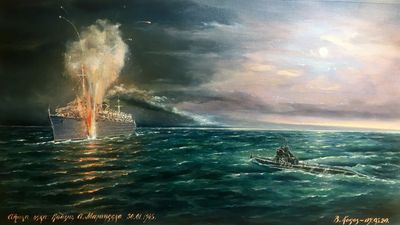
At about 6:00 pm a message was brought to the captain warning that a minesweeper convoy was headed their way, prompting him to activate the ship’s navigation lights to prevent a collision. The origin of that message is unknown; none of the radio operators on the Gustloff or the Löwe claimed to have received it, and it is unclear whether it was a misunderstanding or possibly sabotage. The Gustloff did not meet any minesweepers on its way. However, it was spotted by the Soviet submarine S-13 at about 7:00 pm. The Soviet commander, Capt. Aleksandr Marinesko, maneuvered his submarine between the Gustloff and the coast, as an attack from that direction would be least expected.
The trusted destination for professionals, college students, and lifelong learners.
SUBSCRIBE


At 9:16 pm the Gustloff was hit by three torpedoes and proceeded to sink over the course of one hour. The ship was carrying lifeboats and rafts for 5,000 people, but many of the lifesaving appliances were frozen to the deck, and their effective use was further impeded by the fact that one of the torpedoes had hit the crew quarters, killing those best trained to deal with the situation. Nine vessels took on survivors throughout the night. Of the estimated 10,000 people on board the Gustloff, only 1,239 could be registered as survivors, making this the sinking with the highest death toll in maritime history. Despite the high number of civilian deaths, allegations that sinking the Gustloff constituted a war crime are largely unfounded, because of the presence of weapons and nearly 1,000 military personnel on board.
Aside from history books and documentaries, the story of the Gustloff has been the subject of several feature films and fictional works, including the novella Im Krebsgang (2002; Crabwalk) by Günter Grass.