

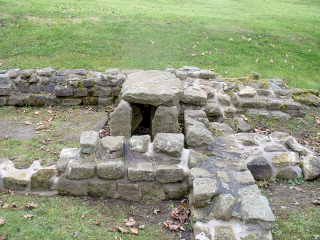
Antonine Wall
Antonine Wall, Roman frontier barrier in Britain, extending about 36.5 miles (58.5 km) across Scotland between the River Clyde and the Firth of Forth. The wall was built in the years after ad 142 on the orders of the emperor Antoninus Pius by the Roman army under the command of the governor Lollius Urbicus (Quintus Lollius Urbicus). The wall was of turf on a stone base 15 Roman feet (4.44 metres) wide and stood perhaps 10 feet (3 metres) high; in front was a ditch up to 40 feet (12 metres) wide and 12 feet (4 metres) deep; a wide, shallow mound was formed on the ditch’s north side when the material was tipped out. Sixteen forts—built in two stages—are known along the wall, and fortlets lay between many of these. All were connected by a road, the Military Way. An aerial survey has revealed 20 camps used by the soldiers who built the wall.
Legionaries from Legions II, VI, and XX who constructed the wall recorded their work in a spectacular series of “distance slabs.” These slabs not only recorded the lengths of the wall sections—with measurements sometimes as precise as to the nearest foot—but also depicted in friezes various aspects of the campaign against the “northern barbarians” and the Roman victory. Seventeen of the 20 known slabs are in the Hunterian Museum at the University of Glasgow, Scotland.
The Antonine Wall was abandoned in the 160s, and the army returned to Hadrian’s Wall.


 " height="20" alt="HEW Logo">