


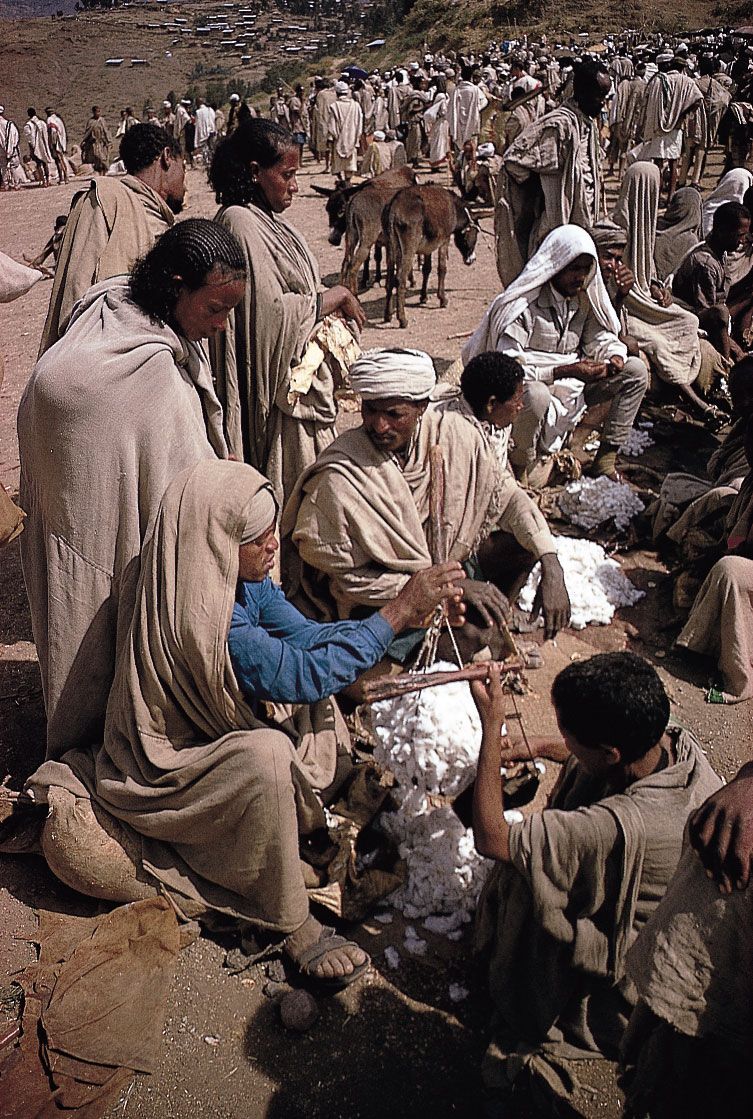
Amhara
-
Who are the Amhara people?
The Amhara people are an ethnolinguistic group inhabiting the central highlands of Ethiopia, constituting over one-fourth of the country’s population. They speak Amharic, an Afro-Asiatic language related to Geʻez.
Historically, the Amhara have been dominant in Ethiopia, with Amharic serving as the official language until the 1990s. From 1270 to 1974, almost all Ethiopian emperors were Amhara. They are primarily agriculturists, producing crops such as corn, wheat, barley, and teff. Their society traditionally featured strong ties between patrons and clients, with land ownership determining a man’s importance.
3 Britannica SourcesCreated from Britannica articles using AI. AI can make mistakes, so verify using Britannica articles. -
Where do most Amhara people live?
The Amhara people primarily live in the central highlands of Ethiopia. As descendants of ancient Semitic conquerors, they inhabit much of the central and western parts of the country. The Amhara are one of Ethiopia's two largest ethnolinguistic groups, making up more than a quarter of the country’s population. The Amhara Plateau in northern and central Ethiopia is the historical home of the Amhara and Tigre peoples. Though most Ethiopians live in scattered rural communities, urban centers such as Addis Ababa, Gonder, and Dese also have Amhara residents.
5 Britannica SourcesCreated from Britannica articles using AI. AI can make mistakes, so verify using Britannica articles. -
What language do the Amhara people speak?
The Amhara people, residing in the central highlands of Ethiopia, primarily speak Amharic. Amharic is an Afro-Asiatic language belonging to the Southwest Semitic group and is related to Geʻez, the sacred language of the Ethiopian Orthodox Church. Amharic held official status in Ethiopia until the 1990s and remains important. About 18.7 million people spoke Amharic in the early 21st century.
4 Britannica SourcesCreated from Britannica articles using AI. AI can make mistakes, so verify using Britannica articles. -
What are some traditional customs or festivals of the Amhara people?
The Amhara people, residing in the central highlands of Ethiopia, have a rich cultural heritage deeply influenced by the Ethiopian Orthodox Church. This is reflected in their observance of major religious holidays like Easter (Yetinsa-e Be-al or Fassika), Christmas (Yelidet Be-al or Genna), and the Finding of the True Cross (Meskel), which have become dominant national holidays.
Traditional Amhara society also emphasizes strong social graces, respect for human sanctity, and the blessings of accumulated wisdom, with religion providing the basic tenets of morality. Hospitality is a key expression of grace, and old age earns respect and prominence.
3 Britannica SourcesCreated from Britannica articles using AI. AI can make mistakes, so verify using Britannica articles. -
What role has the Amhara group played in Ethiopian history?
The Amhara people, one of Ethiopia's two largest ethnolinguistic groups, have historically played a dominant role in the country. From 1270 to 1974, all but one of Ethiopia's emperors were Amhara. The Amharic language was the official language of Ethiopia until the 1990s.
This dominance has led to tensions and quarrels with other Ethiopian ethnic groups, such as the Tigray and the Oromo. In 2023, a rebellion led by Amhara militants, the Fano, broke out in Amhara, with fighters claiming they were fighting to end the oppression of the Amhara people.
The Amhara are primarily agriculturists, producing corn, wheat, barley, sorghum, and teff. Traditionally, their social structure was dominated by strong ties between patrons and clients.
5 Britannica SourcesCreated from Britannica articles using AI. AI can make mistakes, so verify using Britannica articles.
Amhara, people of the Ethiopian central highlands. The Amhara are one of the two largest ethnolinguistic groups in Ethiopia (the other group being the Oromo). They constitute more than one-fourth of the country’s population. The Amharic language is an Afro-Asiatic language belonging to the Southwest Semitic group. It is related to Geʿez, the sacred literary language of the Ethiopian Orthodox church, an ancient religion that took root in the Aksum Empire in the 4th–5th century and affirmed a miaphysite doctrine. The Amhara, along with the Tigray peoples, are the principal adherents of this church.
The Amhara long dominated the history of their country; Amharic was the official language of Ethiopia until the 1990s, and it remains important. As descendants of a southward movement of ancient Semitic conquerors who mingled with indigenous Cushitic peoples, they inhabit much of the central and western parts of present-day Ethiopia. All except one of the country’s emperors from 1270 to 1974 were Amhara; this dominance created competitive quarrels between the Amhara and their northern neighbours, the Tigray, and other Ethiopian ethnic groups, such as the Oromo. Tensions rose between the Amhara and the Oromo during the period of socialist rule (1974–91), as the Oromo claimed an increasingly prominent role in the nation’s social and political affairs. After 1991 a measure of Amhara sentiment was directed against the Tigray, who had gained influence during the struggle against the Marxists.
The Amhara are primarily agriculturists, producing corn (maize), wheat, barley, sorghum, and teff (Eragrostis tef), a cereal grass that is grown for its grain and is a staple of the region. Traditionally, Amhara social structure was dominated by strong personalized ties between patrons and clients, superiors and inferiors. Generally, a man’s importance was in direct proportion to the amount of land he owned. A man of wealth who owned no land, such as a merchant, had little influence. Under the imperial system, land was granted to titled nobles in return for military service to the emperor. The land was farmed by tenant clients. Even in family life all privilege and authority devolved from the patriarch.


 " height="20" alt="HEW Logo">
Descent is reckoned patrilineally, and married couples usually reside near the husband’s home. The Amhara practice three types of marriage: kal kidan, qurban, and damoz. Kal kidan (also called serat or semanya [“eighty”]) is marriage by civil contract. It is by far the most common form, though a great percentage of such unions end in divorce. Qurban marriages are performed in church and are regarded as sacred; they cannot be dissolved, even after the death of one partner, except in extraordinary circumstances. Because of these restrictions, it is the least common form of marital union; most couples choosing to celebrate the rite are already long married under kal kidan and have children. Qurban also is the only type of wedlock into which Ethiopian Orthodox priests may enter. First marriages of the kal kidan or qurban types are normally arranged by the parents. The third type of marriage—that with the lowest status—is damoz, an arrangement by which the woman is paid to be a temporary wife, most often for a period of one or two months. While the woman in a damoz relationship receives no claim to the estate of her transient husband, children born under such unions are considered legitimate. Damoz unions were outlawed from the mid-20th century, but they continued in practice.