two-cavity klystron
electronics
Quick Summary
two-cavity klystron
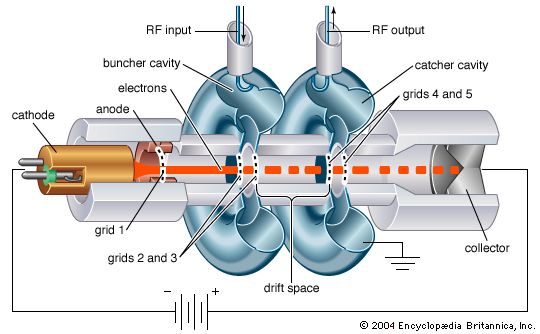
Two-cavity klystron.
A klystron is an electron tube used to generate or amplify microwaves by controlling the speed of electrons. In a two-cavity klystron, electrons are accelerated and pass through a gap in a resonator. A radio-frequency field in this gap causes the electrons to bunch together. As these bunched electrons pass through a second resonator's gap, they induce a strong signal. Klystrons are utilized in ultrahigh-frequency (UHF) television transmission and microwave radar systems, capable of producing oscillations up to 400 gigahertz.123
Summary created from Britannica articles
using AI.
AI can make mistakes, so verify using Britannica articles.
3 Britannica Sources
Ask Britannica AI about this topic
Britannica doesn't have a full article on this topic, so we've curated a list of our relevant coverage.