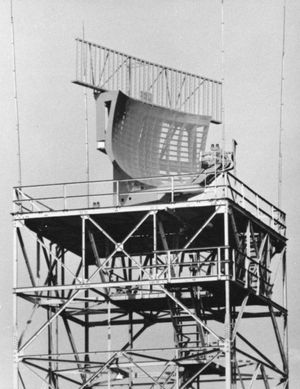
transmitting antenna
Quick Summary
A transmitting antenna is a crucial component in electronics, particularly in radio, television, and radar systems. Its primary function is to direct radio waves into space. These antennas are typically made of metal and come in various shapes and sizes, from simple mast-like structures to large parabolic reflectors.1
The concept of the antenna was first explored by Heinrich Hertz in the late 1880s as part of his experiments to test James Clerk Maxwell's theory of electromagnetic waves. Later, Guglielmo Marconi, a pioneer in wireless telegraphy, developed various antennas for both sending and receiving signals, discovering the importance of tall antennas for transmitting low-frequency signals.1
The size of an antenna relative to the wavelength of the electromagnetic radiation it handles is significant. For instance, at ultrahigh frequencies, individual antennas can be quite small, around 50 centimeters (20 inches) long. The performance of a radar system, including its maximum range, is heavily influenced by the transmitter's power and the antenna's physical size.23
Ask Britannica AI about this topic
Britannica doesn't have a full article on this topic, so we've curated a list of our relevant coverage.