



radio technology
-
What is radio technology?
Radio technology involves the transmission and detection of communication signals using electromagnetic waves. These waves travel through the air, either in a straight line or by reflecting off the ionosphere or a satellite. A transmitting antenna converts a time-varying electric current into an electromagnetic wave, which is then picked up by a receiving antenna and converted back into an electric current.
Radio waves are used in mobile, satellite, deep-space, and broadcast communications. The process of attaching information to a radio-frequency carrier wave for transmission is called modulation. Radio receivers use variable tuned circuits to isolate modulated carriers in their separate channels.
2 Britannica SourcesCreated from Britannica articles using AI. AI can make mistakes, so verify using Britannica articles. -
How does radio allow people to send and receive information without wires?
Radio technology enables wireless communication through electromagnetic waves that travel in straight lines or reflect off the ionosphere or satellites. A transmitting antenna converts electric current into electromagnetic waves, which propagate through the air. A receiving antenna picks up these waves and converts them back into electric current, allowing information to be sent and received without a physical connection.
Information is added to a carrier wave via modulation, which varies the amplitude, frequency, or duration of the carrier wave. The electromagnetic spectrum encompasses all types of electromagnetic radiation, including radio waves.
5 Britannica SourcesCreated from Britannica articles using AI. AI can make mistakes, so verify using Britannica articles. -
What are radio waves, and how do they work?
Radio waves are a type of electromagnetic radiation with frequencies lower than microwaves, ranging from 3 Hz to 1 gigahertz. They travel at approximately 300,000,000 meters (186,000 miles) per second.
Radio waves carry information by a modulation process that varies their amplitude, frequency, or duration. They can travel in straight lines, reflect off the ionosphere, or be relayed by satellites. Antennas transmit and receive radio waves, with their size relative to the wavelength being an important factor.
4 Britannica SourcesCreated from Britannica articles using AI. AI can make mistakes, so verify using Britannica articles. -
What are the main parts of a basic radio system?
A basic radio system consists of several key components that work together to transmit and receive information. The antenna is essential for projecting electromagnetic energy into space from the transmitter and extracting energy from electromagnetic waves at the receiver.
For transmission, a modulator attaches information to a carrier wave by varying its amplitude or frequency. The transmitter generates a high-power signal.
On the receiving end, a demodulator recovers the original information from the modulated carrier wave. A tuned circuit isolates the desired signal.
3 Britannica SourcesCreated from Britannica articles using AI. AI can make mistakes, so verify using Britannica articles. -
How do radios tune into different stations or frequencies?
Radios tune into different stations using a tuner, which isolates modulated carrier waves transmitted on specific frequency channels. The superheterodyne principle underlies most modern radio receivers. Here, the incoming radio frequency mixes with an oscillator's output, and the difference between them remains constant, resulting in an intermediate frequency.
Tuning is achieved through variable tuned circuits, which consist of inductance and capacitance. Adjusting the capacitance, often with interleaved metal plates, or varying the inductance using a ferrite core in a copper wire coil tunes the radio.
4 Britannica SourcesCreated from Britannica articles using AI. AI can make mistakes, so verify using Britannica articles. -
What are some ways radio technology is used today besides playing music and news?
Radio technology extends beyond music and news, serving various critical functions in modern society.
Radio-based navigation systems, such as the Global Positioning System (GPS), use radio signals from satellites to pinpoint the location of receivers on the ground, in the air, and at sea. Air traffic controllers use radio beams to guide aircraft during landings, especially in low-visibility conditions.
Satellite communication relies on radio waves to transmit signals between Earth and satellites for broadcasting, data communication, and mobile telephony. Radio technology is also essential for police communication, enabling dispatchers and officers to coordinate efforts and respond to emergencies. Additionally, amateur radio is used for non-commercial communication and providing emergency services during disasters.
7 Britannica SourcesCreated from Britannica articles using AI. AI can make mistakes, so verify using Britannica articles.
radio technology, transmission and detection of communication signals consisting of electromagnetic waves that travel through the air in a straight line or by reflection from the ionosphere or from a communications satellite.
Basic physical principles
Electromagnetic radiation includes light as well as radio waves, and the two have many properties in common. Both are propagated through space in approximately straight lines at a velocity of about 300,000,000 metres (186,000 miles) per second and have amplitudes that vary cyclically with time; that is, they oscillate from zero amplitude to a maximum and back again. The number of times the cycle is repeated in one second is called the frequency (symbolized as f ) in cycles per second, and the time taken to complete one cycle is 1/f seconds, sometimes called the period. To commemorate the German pioneer Heinrich Hertz, who carried out some of the early radio experiments, the cycle per second is now called a hertz so that a frequency of one cycle per second is written as one hertz (abbreviated Hz). Higher frequencies are abbreviated as shown in Table 3.
| term | cycles per second | abbreviation | equivalent |
|---|---|---|---|
| 1 hertz | 1 | 1 Hz | |
| 1 kilohertz | 1,000 | 1 kHz | 1,000 Hz |
| 1 megahertz | 1,000,000 (106) | 1 MHz | 1,000 kHz |
| 1 gigahertz | 1,000,000,000 (109) | 1 GHz | 1,000 MHz |
A radio wave being propagated through space will at any given instant have an amplitude variation along its direction of travel similar to that of its time variation, much like a wave traveling on a body of water. The distance from one wave crest to the next is known as the wavelength.



 " height="20" alt="HEW Logo">
Wavelength and frequency are related. Dividing the speed of the electromagnetic wave (c) by the wavelength (designated by the Greek letter lambda, λ) gives the frequency: f = c/λ. Thus a wavelength of 10 metres has a frequency of 300,000,000 divided by 10, or 30,000,000 hertz (30 megahertz). The wavelength of light is much shorter than that of a radio wave. At the centre of the light spectrum the wavelength is about 0.5 micron (0.0000005 metre), or a frequency of 6 × 10¹⁴ hertz or 600,000 gigahertz (one gigahertz equals 1,000,000,000 hertz). The maximum frequency in the radio spectrum is usually taken to be about 45 gigahertz, corresponding to a wavelength of about 6.7 millimetres. Radio waves can be generated and used at frequencies lower than 10 kilohertz (λ = 30,000 metres).
Mechanism of wave propagation
A radio wave is made up of electric and magnetic fields vibrating mutually at right angles to each other in space. When these two fields are operating synchronously in time, they are said to be in time phase; i.e., both reach their maxima and minima together and both go through zero together. As the distance from the source of energy increases, the area over which the electric and magnetic energy is spread is increased, so that the available energy per unit area is decreased. Radio signal intensity, like light intensity, decreases as the distance from the source increases.
A transmitting antenna is a device that projects the radio-frequency energy generated by a transmitter into space. The antenna can be designed to concentrate the radio energy into a beam like a searchlight and so increase its effectiveness in a given direction (see electronics).
Frequency bands
The radio-frequency spectrum is divided arbitrarily into a number of bands from very low frequencies to superhigh frequencies (see Table 4). Sections of the spectrum have been allocated to the various users (see Click Here to see full-size table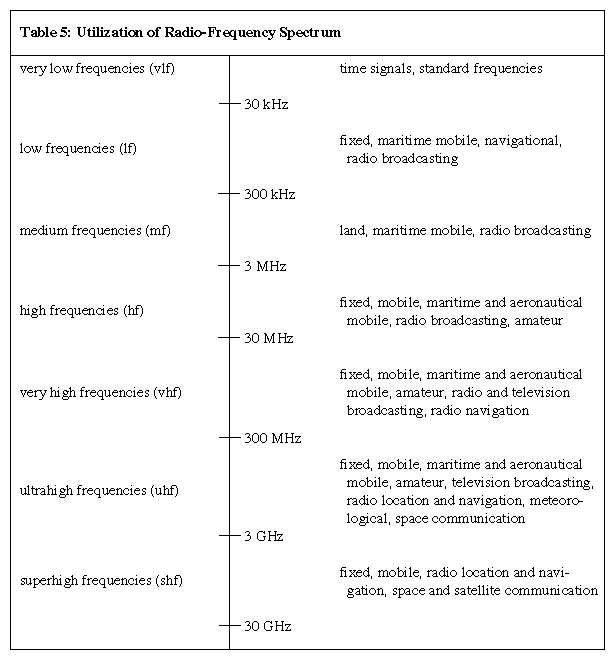 Table 5), such as telegraph, telephonic speech, telemetry, and radio and television broadcasting.
The trusted destination for professionals, college students, and lifelong learners.
SUBSCRIBE


| frequency designation | frequency range | wavelength range |
|---|---|---|
| *Also called shortwaves. | ||
| very low frequencies (VLF) | 3–30 kilohertz | 100,000–10,000 m |
| low frequencies (LF) | 30–300 kilohertz | 10,000–1,000 m |
| medium frequencies (MF) | 300–3,000 kilohertz | 1,000–100 m |
| high frequencies (HF)* | 3–30 megahertz | 100–10 m |
| very high frequencies (VHF) | 30–300 megahertz | 10–1 m |
| ultrahigh frequencies (UHF) | 300–3,000 megahertz | 1 m–10 cm |
| superhigh frequencies (SHF) | 3–30 gigahertz | 10–1 cm |
The radio-frequency bandwidth is the range of frequencies covered by the modulated radio-frequency signal. The information carried by the signal has a certain bandwidth associated with it, and the carrier must have a channel width at least as great as the information bandwidth. For regular amplitude-modulated (AM) broadcasting the radio-frequency bandwidth must be twice the information-frequency bandwidth. Teleprinter and telex operation requires only a small bandwidth, on the order of 200 hertz, depending on the maximum speed of the pulses forming the information code. Telephonic speech must have high intelligibility, but naturalness (high fidelity) is not of great importance. Tests have shown that the main components of speech lie between about 300 and 3,500 hertz, and telephonic channels carried by radio are therefore normally confined to a bandwidth of about four kilohertz. The smaller the information bandwidth employed, the more speech channels can be carried in a given carrier bandwidth and the more economical the system will be.
Young people can hear audio frequencies ranging from about 30 hertz to 18 kilohertz, but, as they grow older, hearing ranges from about 100 hertz to 10 kilohertz. For high-quality (high-fidelity) reproduction of voice or speech, the range should be not less than about 30 hertz (the lowest frequency of a large organ pipe) to 15 kilohertz (piccolo, cymbal, triangle). Acceptable audio quality under certain circumstances may be achieved with a bandwidth as small as five kilohertz, as in AM radio; a much larger bandwidth is needed for transmitting a moving picture because it is necessary to convey the overall average light content of a picture as well as the picture detail. The average light content requires frequencies as low as 20 hertz to be transmitted, and picture detail demands frequencies up to five megahertz for a standard television picture.