

modified chemical vapour deposition
Quick Summary
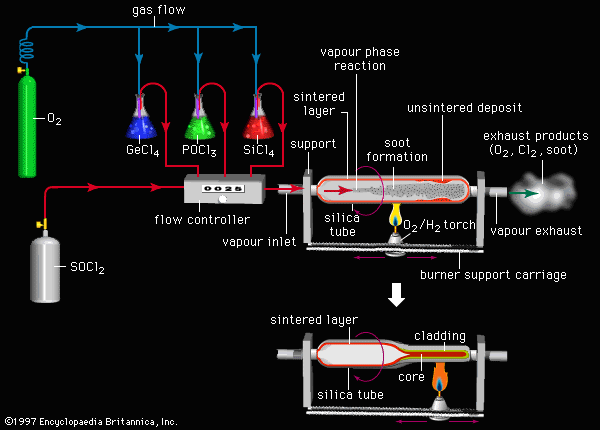
Modified Chemical Vapor Deposition (MCVD) is a technique used in the fabrication of graded-index optical fibers. This process involves mixing silicon tetrachloride vapors with other chemicals like phosphorus oxychloride and germanium or boron trichloride. When heated to high temperatures (1,300°–1,600° C), these vapors react to form a soot containing silica and other oxides. This soot is then deposited onto a cooler substrate, forming multiple layers. After dehydration and sintering, the composition of these layers is controlled by the initial chloride mix to achieve the desired refractive index for the optical fiber. The resulting glass preform is then heated and drawn into a fiber, with its diameter precisely controlled.1
Ask Britannica AI about this topic
Britannica doesn't have a full article on this topic, so we've curated a list of our relevant coverage.