
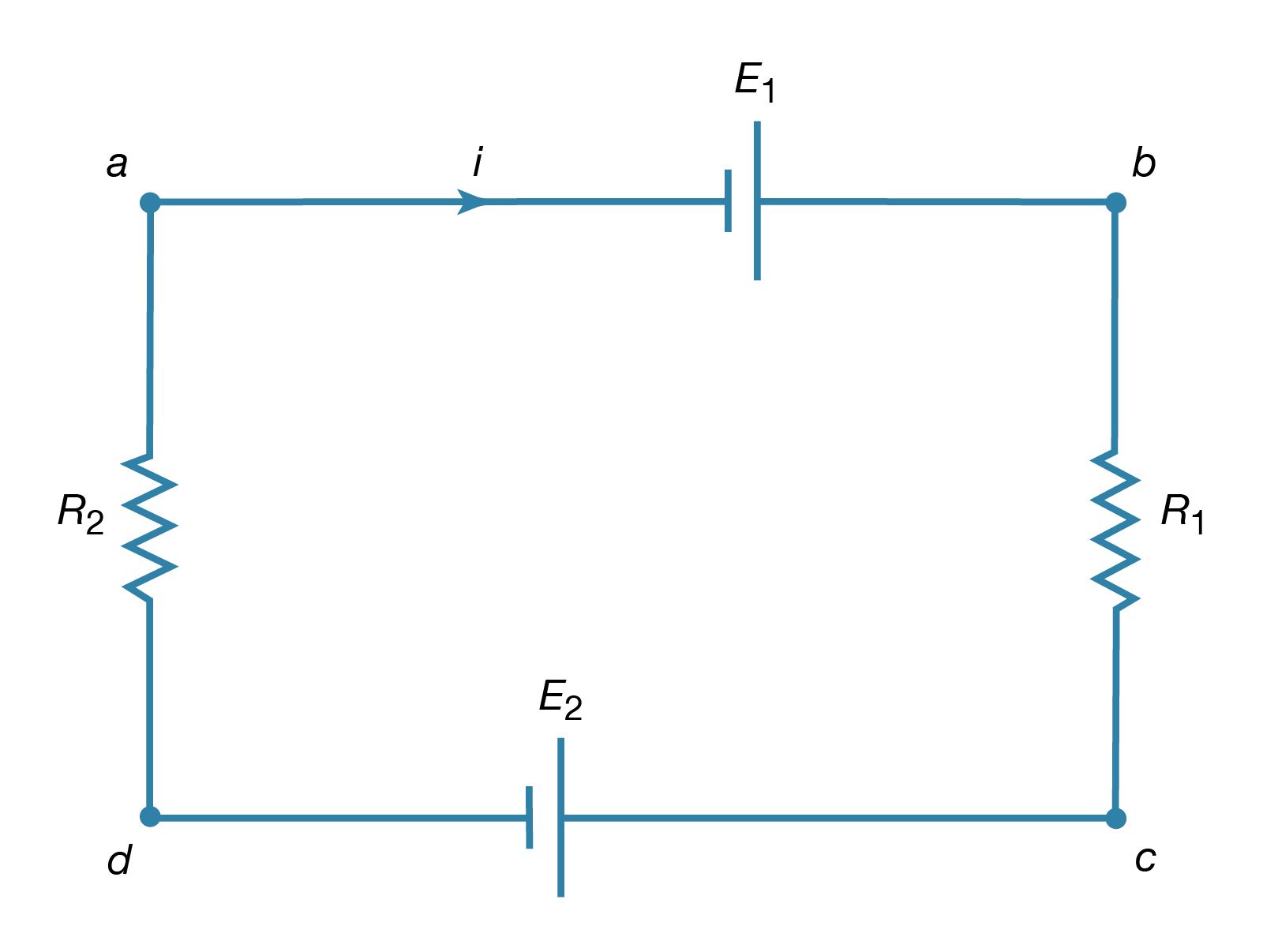

loop equation
Quick Summary

Kirchhoff's loop equation is a fundamental principle in electronics used to analyze electric circuits with multiple loops. It's derived from the law of conservation of energy.
The loop equation states that the sum of all electromotive forces (voltages from sources like batteries) around any closed loop in a circuit must equal the sum of all potential drops (voltages across resistors) in that same loop. This means that the total energy supplied by the sources within a loop is entirely dissipated by the components in that loop.12
By applying this rule, along with Kirchhoff's junction theorem (which deals with current at circuit junctions), engineers can write a system of equations to solve for the unknown currents in different parts of a complex circuit. These principles are applicable to both direct current (DC) and alternating current (AC) circuits.123
Ask Britannica AI about this topic
Britannica doesn't have a full article on this topic, so we've curated a list of our relevant coverage.
- Kirchhoff’s rules
The second rule, the loop equation, states that around each loop in an electric circuit the sum of the emf’s (electromotive forces, or voltages, of energy sources such as batteries and generators) is equal to the sum of the potential drops, or voltages across each of the resistances, in…
Read MoreThe second rule, the loop equation, states that around each loop in an electric circuit the sum of the emf’s (electromotive forces, or voltages, of energy sources such as batteries and generators) is equal to the sum of the potential drops, or voltages across each of the resistances, in…
Read More - electricityKirchhoff’s laws of electric circuits
…of electromotive forces in a loop equals the sum of potential drops in the loop. When electromotive forces in a circuit are symbolized as circuit components as in Figure 15, this law can be stated quite simply: the sum of the potential differences across all the components in a closed…
Read More…of electromotive forces in a loop equals the sum of potential drops in the loop. When electromotive forces in a circuit are symbolized as circuit components as in Figure 15, this law can be stated quite simply: the sum of the potential differences across all the components in a closed…
Read More