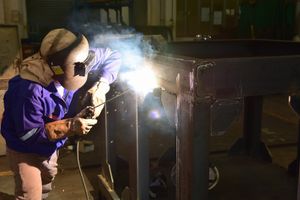
friction welding
Quick Summary
Friction welding is a solid-phase joining process that consolidates a joint by bringing two workpieces together under load, with one part rapidly revolving. The resulting frictional heat plasticizes the material at the interface, allowing the rotation to stop and the load to increase, thereby consolidating the joint. This process is considered a variation of pressure welding because it results in plastic deformation and a strong joint.1
Metallurgy, the science and engineering of metals, encompasses their properties, production, and fabrication. Welding, a key fabrication technique, involves joining metallic parts, historically through forge welding and more recently through fusion welding processes like arc welding and resistance welding. Solid-phase processes, including friction welding, produce welds without melting the base material, relying instead on pressure and sometimes heat.12
Ask Britannica AI about this topic
Britannica doesn't have a full article on this topic, so we've curated a list of our relevant coverage.