

float-glass method
Quick Summary
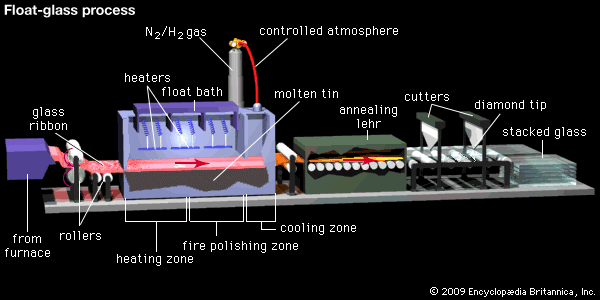
The float-glass method is a modern technique for producing flat glass, commonly used for windows and mirrors. This process involves pouring molten glass onto a bath of molten tin. The high temperature of the tin smooths the glass, creating a flat and even surface. As the glass floats and cools, it solidifies into a sheet. This method eliminates the need for grinding and polishing, which were previously required for flatness and optical clarity in older methods like the crown and broad glass processes. The float process allows for precise thickness control and results in strong glass sheets.123
Ask Britannica AI about this topic
Britannica doesn't have a full article on this topic, so we've curated a list of our relevant coverage.
 constructionGlass as a building material
…Brothers in England developed the float glass process, in which a continuous 3.4-meter- (11-foot-) wide ribbon of glass floated over molten tin and both sides were fire finished, avoiding all polishing and grinding; this became the standard method of production. Pilkington also pioneered the development of structural glass mullions in…
Read More…Brothers in England developed the float glass process, in which a continuous 3.4-meter- (11-foot-) wide ribbon of glass floated over molten tin and both sides were fire finished, avoiding all polishing and grinding; this became the standard method of production. Pilkington also pioneered the development of structural glass mullions in…
Read More- industrial glassFlat glass
…Pilkington introduced in 1959 the float glass process, which altogether eliminated the need for grinding and polishing. (The float process is described in Glass forming: Flat glass.) A further development, the electro-float process, introduced in 1967, made it possible to implant copper and other metal ions into the upper surface…
Read More…Pilkington introduced in 1959 the float glass process, which altogether eliminated the need for grinding and polishing. (The float process is described in Glass forming: Flat glass.) A further development, the electro-float process, introduced in 1967, made it possible to implant copper and other metal ions into the upper surface…
Read More
- plate glass
…in the 1950s, called the float-glass method, results in an important economy of space. The molten glass is conveyed onto a bath of a molten metal, such as tin. The high temperature of the molten metal smooths out any irregularities on the surface, making a flat, even sheet. As the…
Read More…in the 1950s, called the float-glass method, results in an important economy of space. The molten glass is conveyed onto a bath of a molten metal, such as tin. The high temperature of the molten metal smooths out any irregularities on the surface, making a flat, even sheet. As the…
Read More - industrial glassFlat glass
…windows and mirrors is the float process, in which molten glass is brought over the lip of a broad spout, allowed to pass between rollers, and floated over a bath of molten tin in a steel container (see Figure 10). Glass enters the container at approximately 103.5 poise—a viscosity that,…
Read More…windows and mirrors is the float process, in which molten glass is brought over the lip of a broad spout, allowed to pass between rollers, and floated over a bath of molten tin in a steel container (see Figure 10). Glass enters the container at approximately 103.5 poise—a viscosity that,…
Read More