

flat glass
Quick Summary
Flat glass refers to sheets of glass that are drawn or rolled, used primarily for windows and mirrors. The Romans were among the first to develop flat glass for windows, with early methods like casting and the medieval crown process producing uneven disks. The broad glass process, which involved blowing large cylinders that were then flattened, allowed for larger pieces but still had surface waviness.123
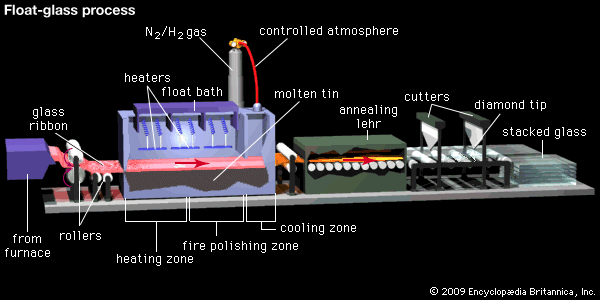
Modern production relies heavily on the float process, where molten glass is floated on a bath of molten tin. This method yields glass with excellent thickness control and strength, eliminating the need for grinding and polishing. Glass is an elastic solid, resistant to corrosion, and its properties are largely isotropic, meaning they are the same in all directions. While glass can exhibit plastic deformation under a diamond microindenter, it typically fails in a brittle manner due to its amorphous atomic structure.24
Ask Britannica AI about this topic
Britannica doesn't have a full article on this topic, so we've curated a list of our relevant coverage.