


- Key People:
- Hans Ulrich Grubenmann
- Johannes Grubenmann
- Timothy Palmer
- Related Topics:
- truss bridge

covered bridge
-
What is a covered bridge?
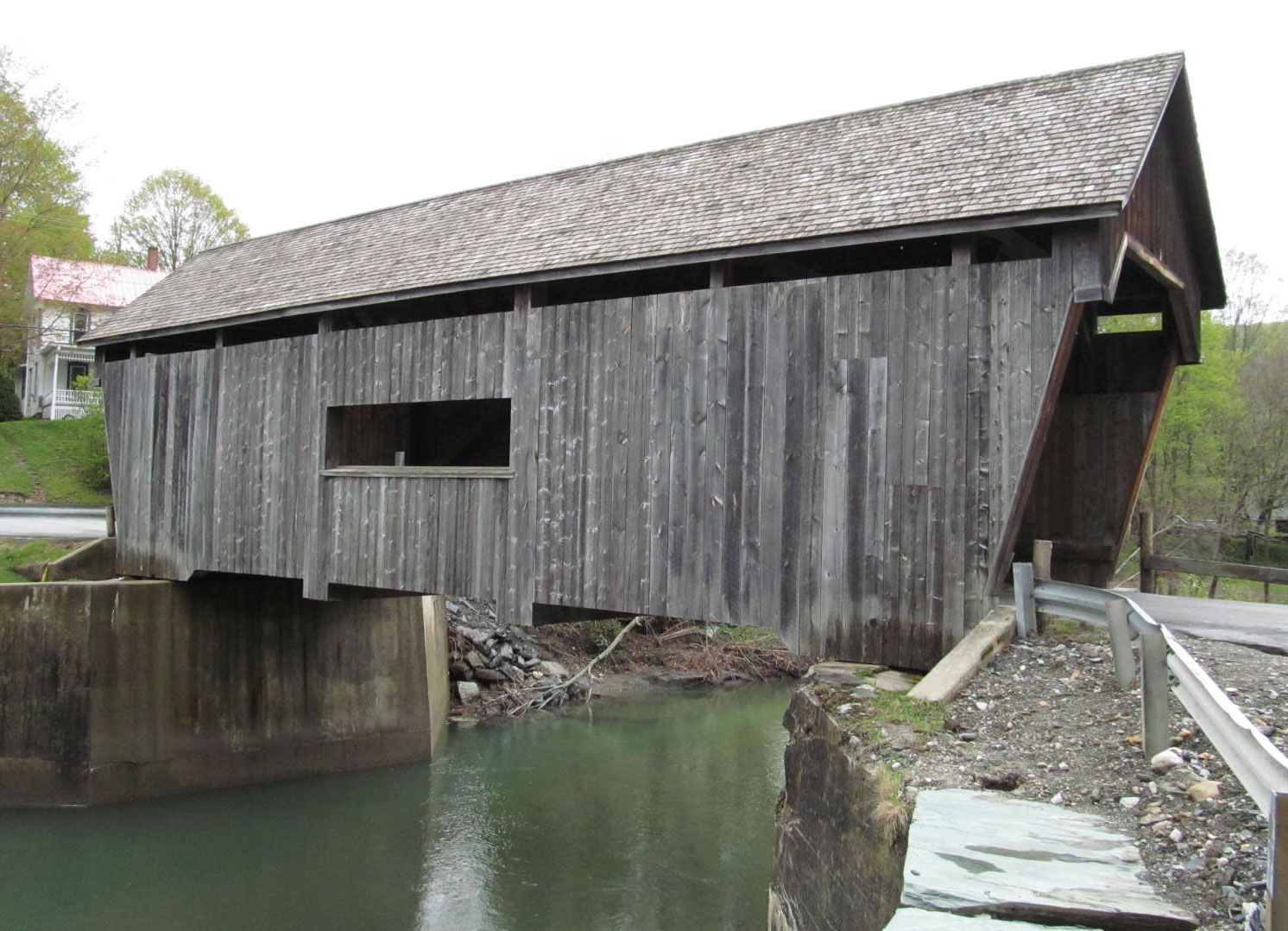
A covered bridge is a timber-truss bridge that carries a roadway over an obstacle like a river. The roof and siding create an enclosure protecting the wooden structural members, arranged in triangles, from the weather.
These bridges evolved in North America from simple king-post trusses. The first long covered bridge in America was built in 1806 over the Schuylkill River at Philadelphia.
While iron and steel replaced timber for railroad bridges, covered timber bridges continued to be built into the 20th century.
3 Britannica SourcesCreated from Britannica articles using AI. AI can make mistakes, so verify using Britannica articles. -
Why do engineers put roofs and sides on some bridges?
The purpose of roofs and sides on covered bridges is to protect the wooden structural parts, especially the timber truss, from the weather. The enclosure helps prevent weather-related damage to the wood.
Covered bridges use a truss, which is a series of triangles, to support the roadway over a river or other obstacle.
3 Britannica SourcesCreated from Britannica articles using AI. AI can make mistakes, so verify using Britannica articles. -
How does a covered bridge last longer than an uncovered one?
Covered bridges last longer than uncovered ones because the roof and siding protect the wooden structural members, specifically the timber-truss, from the weather. The enclosure that the covering creates shields the wood from rain, snow, and sun, preventing decay and extending the bridge's lifespan.
3 Britannica SourcesCreated from Britannica articles using AI. AI can make mistakes, so verify using Britannica articles. -
What materials are commonly used to build covered bridges?
Covered bridges are commonly made of timber because wood was readily available and economical for builders. The roof and siding protect the wooden structural members from the weather.
In North America, 18th-century carpenters used simple king-post trusses, where the roadway was supported by heavy timber triangles. Ithiel Town patented the Town lattice, using light pieces diagonally crisscrossed in place of heavy timbers. Theodore Burr combined a Palladio truss with an arch.
To carry heavy railroad loads, builders adopted iron for covered bridges, and steel later replaced iron. Metal trusses don't require weather protection, so they were not covered. Modern bridges are almost exclusively built with steel, reinforced concrete, and prestressed concrete.
2 Britannica SourcesCreated from Britannica articles using AI. AI can make mistakes, so verify using Britannica articles. -
What types of engineering designs are used in covered bridges?
Covered bridges rely on timber-truss designs to support their roadway across a span. The covering protects the wooden structural members from the weather.
Common truss designs include:
* King-post trusses These use heavy timber triangles to support the roadway.
* Town lattice This design uses many light, crisscrossed pieces in place of heavy timbers.
* Burr truss This combines a truss with an arch. Theodore Burr's design was based on a drawing by Palladio.In the 19th century, iron replaced wood to carry the heavier loads of railroad traffic. Steel soon replaced iron.
4 Britannica SourcesCreated from Britannica articles using AI. AI can make mistakes, so verify using Britannica articles. -
How do engineers maintain and restore old covered bridges today?
Covered bridges are timber-truss bridges with a roof and siding to protect the wood from the weather. Modern engineers maintain and restore these historic structures using various techniques to ensure their preservation and functionality.
When restoring covered bridges, engineers prioritize the preservation of the original materials and construction methods. Repairs often involve replacing damaged or deteriorated wooden members with new timber that matches the original in species and dimensions. Steel reinforcements might be added to strengthen the bridge's structure while minimizing the impact on its historical appearance.
2 Britannica SourcesCreated from Britannica articles using AI. AI can make mistakes, so verify using Britannica articles.
covered bridge, timber-truss bridge carrying a roadway over a river or other obstacle, popular in folklore and art but also of major significance in engineering history. The function of the roof and siding, which in most covered bridges create an almost complete enclosure, is to protect the wooden structural members from the weather. A truss is a basic form in which the members are arranged in a triangle or series of triangles.

There is no evidence of timber-truss bridges, with or without covering, in the ancient world, but the 13th-century sketchbook of the French architect Villard de Honnecourt depicts a species of truss bridge, and the Italian Andrea Palladio’s “Treatise on Architecture” (1570) describes four designs. Several notable covered bridges were constructed in Switzerland. The Kappel Bridge (1333) of Luzern has been decorated since 1599 with 112 paintings in the triangular spaces between roof and crossbeams, depicting the history of the town and the lives of its two patron saints. In the 18th century the Grubenmann brothers of Switzerland built covered timber bridges of considerable length, notably an arch-truss bridge over the Limmat River in Baden with a clear span of 60 metres (200 feet).

In North America the covered bridge underwent further evolution. From simple king-post trusses, in which the roadway was supported by a pair of heavy timber triangles, New England carpenters in the 18th century developed bridges combining simplicity of construction with their other economic advantages. The first long covered bridge in America, with a 55-metre (180-foot) centre span, was built by Timothy Palmer, a Massachusetts millwright, over the Schuylkill River at Philadelphia in 1806. Covered timber-truss bridges soon spanned rivers from Maine to Florida and rapidly spread westward. A New Haven architect named Ithiel Town patented the Town lattice, in which a number of relatively light pieces, diagonally crisscrossed, took the place of the heavy timbers of Palmer’s design and of the arch; it could be “built by the mile and cut off by the yard,” in its inventor’s phrase. Another highly successful type was designed by Theodore Burr, of Torrington, Connecticut, combining a Palladio truss with an arch. Numerous Town and Burr designs remained standing throughout North America into the late 20th century, some dating back to the early 19th century.



 " height="20" alt="HEW Logo">
To carry the heavy loadings of the railroad, iron was adopted for covered bridges, at first for only part of the truss, in either vertical or diagonal members, and later for the whole truss. Iron was soon replaced by steel, and a principal form of the modern railroad bridge rapidly evolved. The metal truss did not require protection from the weather and consequently was not covered. The building of covered timber bridges, however, continued even in the second half of the 20th century.