
cordless telephone
Quick Summary
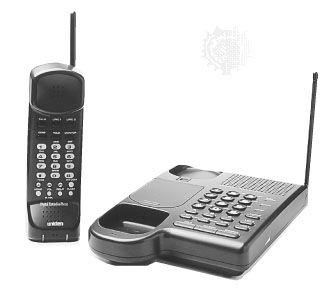
Cordless telephones are devices that allow for limited mobility within a home or office, typically up to 100 meters (330 feet). They function as a wireless extension of existing telephone wiring by communicating with a base unit that is plugged into a telephone jack.1
Unlike traditional telephones that draw power from a central switching office, cordless phones use a small, rechargeable battery located in the portable handset to power their radio transmitters. The base unit, in turn, is powered by a connection to a standard electrical outlet.2
Early cordless phones used analog modulation and operated on specific frequency bands, such as 1.7 and 49 megahertz. Over time, advancements have led to phones operating on higher frequency bands (e.g., 46-49 MHz, 902–928 MHz, and even gigahertz regions like 5.8 GHz) and employing digital or spread-spectrum modulation, offering improved quality and range. The term "cordless" simply means having no cord, often implying battery power.13
Ask Britannica AI about this topic
Britannica doesn't have a full article on this topic, so we've curated a list of our relevant coverage.