constant-voltage accelerator
Quick Summary
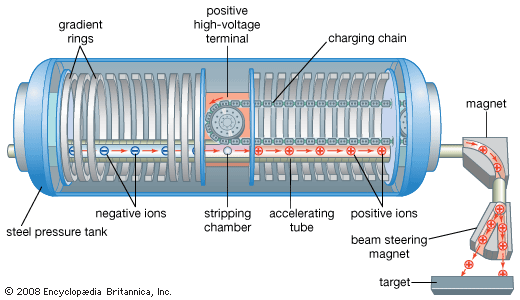
A constant-voltage accelerator is a type of particle accelerator that uses a high voltage to propel particles. The simplest design involves an evacuated tube with a particle source at one end and a high voltage applied between the ends. This voltage accelerates the particles. However, achieving voltages over one million volts (1 MV) becomes challenging due to electrical discharges that dissipate the needed potential.12
Two common types of constant-voltage accelerators are:
- Van de Graaff generators: These use a moving belt to transport electric charge to a high-voltage terminal, allowing for potentials up to about 20 megavolts. They are often used in tandem accelerators to achieve higher particle energies.1
- Voltage multipliers (cascade generators): Developed by Cockcroft and Walton, these use rectifiers and capacitors to build up high direct voltages. This technology was used in the first artificial nuclear reaction.2
These accelerators are crucial for research and have applications in areas like cancer therapy and sterilization.1
Ask Britannica AI about this topic
Britannica doesn't have a full article on this topic, so we've curated a list of our relevant coverage.