
How does mechanical pressure produce a voltage in a piezoelectric ceramic?
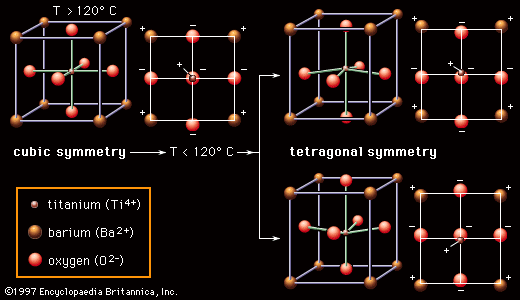
Mechanical pressure produces a voltage in a piezoelectric ceramic through the direct piezoelectric effect, which occurs in materials that lack a centre of symmetry within their crystal structure.12
When mechanical stress—such as squeezing, bending, or twisting—is applied to these ceramics, it causes small displacements of ions within the crystal lattice. These displacements result in the separation of the centres of positive and negative charge, leading to electric polarization. This internal redistribution of charge creates a potential difference, or voltage, across the surface of the material.123
In polycrystalline ceramics like lead zirconate titanate, this effect is optimized through a process called poling, where the material is cooled through its Curie point under an applied electric field to align the dipoles along a specific axis. The magnitude of the generated voltage is proportional to the applied stress, a property utilized in various nonresonant devices such as pressure gauges, accelerometers, and gas igniters.12