

lead zirconate titanate
Quick Summary
Lead zirconate titanate (PZT) is a ceramic material known for its piezoelectric properties. Piezoelectricity is the phenomenon where certain solids, like PZT, generate an electric charge when subjected to mechanical stress, such as squeezing or bending. Conversely, these materials will change their dimensions when an electric field is applied.123
PZT is a polycrystalline ceramic that lacks an inversion center, a characteristic necessary for piezoelectricity. This property makes PZT useful in various applications, including transducers for sound generation, accelerometers, pressure gauges, and gas igniters. The piezoelectric coefficient for lead zirconate titanate is approximately 3 × 10⁻¹⁰ meters per volt.21
Ask Britannica AI about this topic
Britannica doesn't have a full article on this topic, so we've curated a list of our relevant coverage.
- electricityPiezoelectricity
…and 3 × 10⁻¹⁰ for lead zirconate titanate.
Read More…and 3 × 10⁻¹⁰ for lead zirconate titanate.
Read More 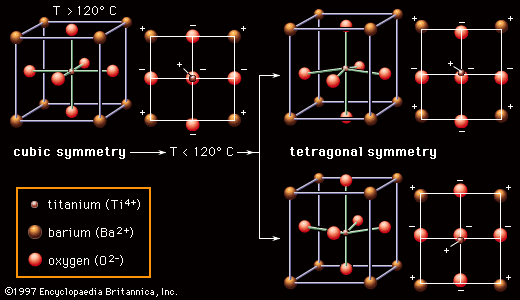 capacitor dielectric and piezoelectric ceramicsPiezoelectric ceramics
…most important are PZT (lead zirconate titanate, Pb[Zr,Ti]O2) and PMN (lead magnesium niobate, Pb[Mg1/3Nb2/3]O3). These materials are processed in a similar manner to capacitor dielectrics except that they are subjected to poling, a technique of cooling the fired ceramic piece through the Curie
Read More…most important are PZT (lead zirconate titanate, Pb[Zr,Ti]O2) and PMN (lead magnesium niobate, Pb[Mg1/3Nb2/3]O3). These materials are processed in a similar manner to capacitor dielectrics except that they are subjected to poling, a technique of cooling the fired ceramic piece through the Curie
Read More