
Britannica
Sources used in this answer
How does electric polarization occur inside a dielectric material?
Created from Britannica articles
using AI.
AI can make mistakes, so verify using Britannica articles.
capacitor dielectric and piezoelectric ceramics
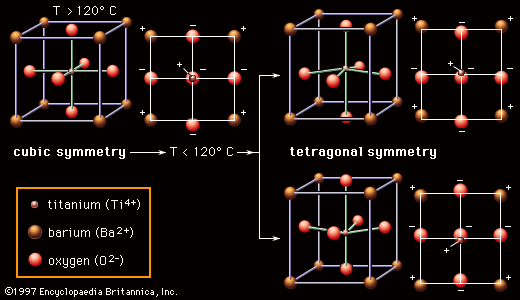
Figure 1: Ferroelectric properties of barium titanate (BaTiO3). (Left) Above 120° C the structure of the BaTiO3 crystal is cubic, and there is no net polarization of charge; (right) below 120° C the structure changes to tetragonal, shifting the relative positions of the ions and causing a concentration of positive and negative charges toward opposite ends of the crystal.
Electric polarization occurs within a dielectric material when an external electric field causes a slight relative displacement of positive and negative charges. This process can happen through several mechanisms:12
- Electronic Displacement: The electric field distorts the negative electron cloud surrounding an atom's positive nucleus, shifting them in opposite directions. This separation creates an electric dipole moment, where the atom or molecule becomes polarized with a positive side and a negative side.12
- Molecular Rotation: In materials containing molecules that are already permanently polarized (such as water), the electric field exerts a torque that causes these dipoles to rotate and align themselves with the direction of the field.12
- Ionic Displacement: In certain ceramic structures, such as perovskite materials like barium titanate, the electric field can induce ions (such as the Ti⁴⁺ cation) to shift from their central positions within the unit cell, creating a permanent or induced electrostatic dipole.34
This polarization effectively reduces the internal electric field and increases the material's capacitance when used in capacitors.24