
Britannica
Sources used in this answer
How do positive and negative charges shift when a dielectric is placed in an electric field?
Created from Britannica articles
using AI.
AI can make mistakes, so verify using Britannica articles.
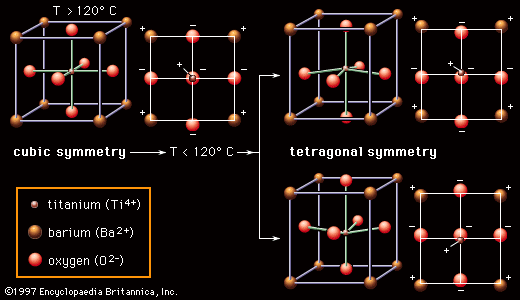
capacitor dielectric and piezoelectric ceramics
Figure 1: Ferroelectric properties of barium titanate (BaTiO3). (Left) Above 120° C the structure of the BaTiO3 crystal is cubic, and there is no net polarization of charge; (right) below 120° C the structure changes to tetragonal, shifting the relative positions of the ions and causing a concentration of positive and negative charges toward opposite ends of the crystal.
When a dielectric material is placed in an electric field, it does not conduct current because it lacks free electrons. Instead, the material undergoes a process called electric polarization.12
Under the influence of the external electric field, the internal charges within the dielectric's atoms or molecules are subjected to forces in opposite directions. Specifically:2
- Positive charges (the positively charged cores or nuclei) are displaced minutely in the direction of the electric field.12
- Negative charges (the electrons) are displaced minutely in the direction opposite to the electric field.12
This slight separation of charge causes the molecules to acquire an electric dipole moment, effectively polarizing the material. This internal redistribution of charge creates an opposing effect that reduces the strength of the electric field within the dielectric itself.21