

- Related Topics:
- launch vehicle
- Falcon Heavy
- Falcon 1
- Falcon 9

Falcon
-
What is the Falcon launch vehicle?
The Falcon is a family of privately developed launch vehicles, including Falcon 1, Falcon 9, and Falcon Heavy, created by SpaceX with funding from Elon Musk. Falcon 1 can deliver a 1,010-kg payload into orbit at a lower cost than other launch vehicles. Falcon 9 can lift payloads of up to 8,300 kg to geostationary orbit. One of its payloads is Dragon, a spacecraft intended to carry crew and cargo to the International Space Station (ISS). Falcon Heavy is designed to carry 53,000 kg to orbit, nearly twice that of its largest competitor.
The first test flight of Falcon 1 occurred on March 24, 2006. Falcon 9 had its first test flight on June 4, 2010, and the first resupply mission to the ISS was on October 7, 2012. The first Falcon Heavy test flight occurred on February 6, 2018. Falcon 9 and Falcon Heavy will be replaced in the 2020s by the Super Heavy–Starship system.
2 Britannica SourcesCreated from Britannica articles using AI. AI can make mistakes, so verify using Britannica articles. -
Who makes the Falcon launch vehicle?
The Falcon family of launch vehicles, including Falcon 1, Falcon 9, and Falcon Heavy, are built by the American corporation SpaceX, with funding from Elon Musk. SpaceX is an aerospace company that was founded in 2002. The Falcon 1 could place a 1,010-kg payload into orbit at a lower cost than other launch vehicles. The Falcon 9 can lift payloads of up to 8,300 kg to geostationary orbit. The Falcon Heavy is designed to carry 53,000 kg to orbit.
3 Britannica SourcesCreated from Britannica articles using AI. AI can make mistakes, so verify using Britannica articles. -
What is the purpose of the Falcon launch vehicle?
The Falcon launch vehicle family, developed by SpaceX, serves to deliver payloads into orbit at a lower cost compared to other launch vehicles. Falcon 1 was designed to place smaller payloads into orbit, while Falcon 9 can lift heavier payloads, such as the Dragon spacecraft, to the International Space Station (ISS). Falcon Heavy, composed of three Falcon 9 first stages, can carry very heavy loads into orbit. SpaceX is planning to replace Falcon 9 and Falcon Heavy with the Super Heavy-Starship system.
3 Britannica SourcesCreated from Britannica articles using AI. AI can make mistakes, so verify using Britannica articles. -
How many types of Falcon launch vehicles are there?
The Falcon family of launch vehicles, developed by SpaceX, includes three types: Falcon 1, Falcon 9, and Falcon Heavy. Falcon 1, the earliest version, was designed to be a lower-cost option for placing smaller payloads into orbit. Falcon 9 was created to compete with the Delta family of launchers, capable of lifting substantial payloads to geostationary orbit. Falcon Heavy is the most powerful of the three, composed of three Falcon 9 first stages joined together, designed to carry very heavy payloads into orbit. SpaceX is planning to replace Falcon 9 and Falcon Heavy with the Super Heavy-Starship system.
3 Britannica SourcesCreated from Britannica articles using AI. AI can make mistakes, so verify using Britannica articles. -
What are some key features of the Falcon 9 launch vehicle?
The Falcon 9 is a partially reusable medium-lift launch vehicle designed and manufactured by SpaceX. Some key features of the Falcon 9 are its ability to deliver payloads of up to 8,300 kg (18,300 pounds) to geostationary orbit and its reusable first stage, which can land on a floating platform. It has flown the Dragon spacecraft to the International Space Station (ISS), delivering both crew and cargo. SpaceX also intends to replace the Falcon 9 and Falcon Heavy with the Super Heavy-Starship system.
3 Britannica SourcesCreated from Britannica articles using AI. AI can make mistakes, so verify using Britannica articles. -
How has the Falcon launch vehicle changed space travel?
The Falcon launch vehicle, developed by SpaceX, has significantly impacted space travel by introducing a lower-cost alternative with reusable technology. This approach has disrupted the commercial launch industry, challenging established players and leading to the dominance of the Falcon 9 due to its competitive pricing.
The Falcon 9's partial reusability has further reduced costs and increased the frequency of launches. SpaceX has secured contracts with NASA for cargo and astronaut transport to the International Space Station, demonstrating the reliability and capabilities of the Falcon launch vehicles.
3 Britannica SourcesCreated from Britannica articles using AI. AI can make mistakes, so verify using Britannica articles.
Falcon, privately developed family of three launch vehicles—Falcon 1, Falcon 9, and Falcon Heavy—built by the U.S. corporation SpaceX with funding from South African-born American entrepreneur Elon Musk.
Falcon 1 could place a 1,010-kg (2,227-pound) payload into orbit at lower cost than other launch vehicles. Falcon 9 was designed to compete with the Delta family of launchers in that it can lift payloads of up to 8,300 kg (18,300 pounds) to geostationary orbit. One payload it launched to low Earth orbit is Dragon, a spacecraft designed to carry crew and cargo to the International Space Station (ISS). Falcon Heavy has the first stages of three Falcon 9 launch vehicles joined together as its first stage and is designed to carry 53,000 kg (117,000 pounds) to orbit, nearly twice that of its largest competitor, the Boeing Company’s Delta IV Heavy.
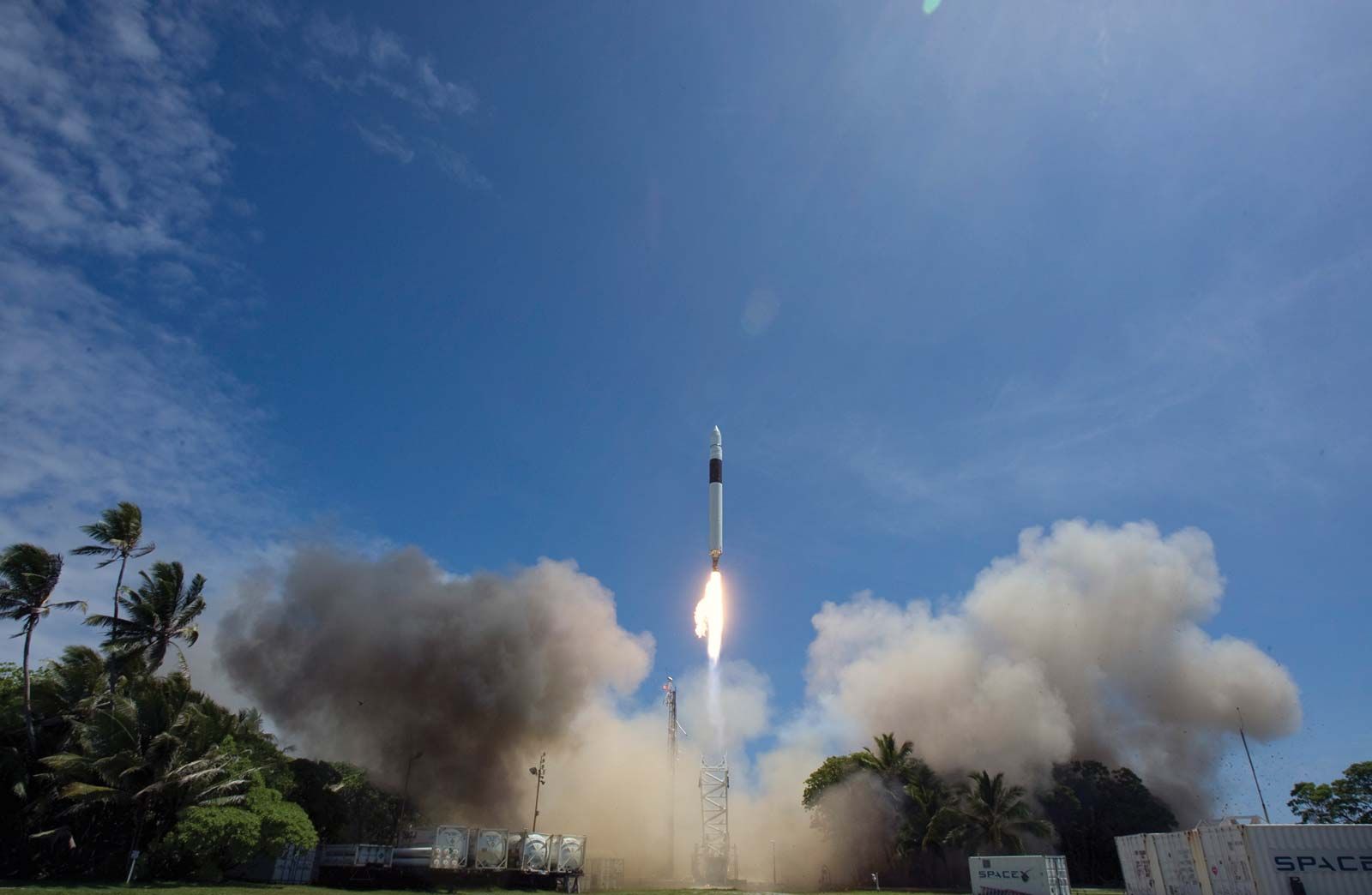
The first test flight of Falcon 1 took place on March 24, 2006, on Kwajalein Atoll in the Pacific Ocean but failed just 25 seconds after liftoff. Corrosion between a nut and a fuel line had allowed the line to leak, which caused an engine fire. Later in 2006, SpaceX won a $278 million contract from the National Aeronautics and Space Administration (NASA) for three demonstration launches of the company’s Dragon spacecraft and Falcon 9. Two subsequent tests of Falcon 1 ended in failure, but on September 28, 2008, Falcon 1 successfully entered Earth orbit. Falcon 1 made one more flight in 2009 and was retired in favour of Falcon 9.



 " height="20" alt="HEW Logo">


The first test flight of Falcon 9 was on June 4, 2010, from Cape Canaveral, Florida, and the first resupply mission to the ISS was made on October 7, 2012. In 2014 tests began on a reusable first stage for the Falcon 9 that would land on a floating platform. On December 21, 2015, a Falcon 9 launched a payload into orbit, and its first stage made a landing at Cape Canaveral. The first Falcon 9 first-stage ship landing happened on April 8, 2016, and SpaceX did its first relaunch of a previously flown Falcon 9 first stage on March 30, 2017. The first Falcon Heavy test flight occurred on February 6, 2018. The central core stage was not recovered, but the two side boosters successfully returned to Cape Canaveral. The payload, a Tesla Roadster with a SpaceX space suit buckled into the driver’s seat, was placed into orbit around the Sun. The first operational flight of Falcon Heavy launched on April 11, 2019. A Falcon 9 launched the first private crewed spacecraft, a Dragon carrying astronauts Doug Hurley and Robert Behnken, to the ISS on May 30, 2020.
Falcon 9 and Falcon Heavy will be replaced in the 2020s by the Super Heavy–Starship system. The Super Heavy first stage will be capable of lifting 100,000 kg (220,000 pounds) to low Earth orbit. The payload will be Starship, a spacecraft designed for several purposes, including providing fast transportation between cities on Earth and building bases on the Moon and Mars. SpaceX planned to use the Starship for a flight around the Moon carrying Japanese businessman Maezawa Yusaku and several artists in 2023, for flights to land astronauts on the Moon as part of NASA’s Artemis program, and eventually to launch settlers to Mars.