
- Related Topics:
- landing craft

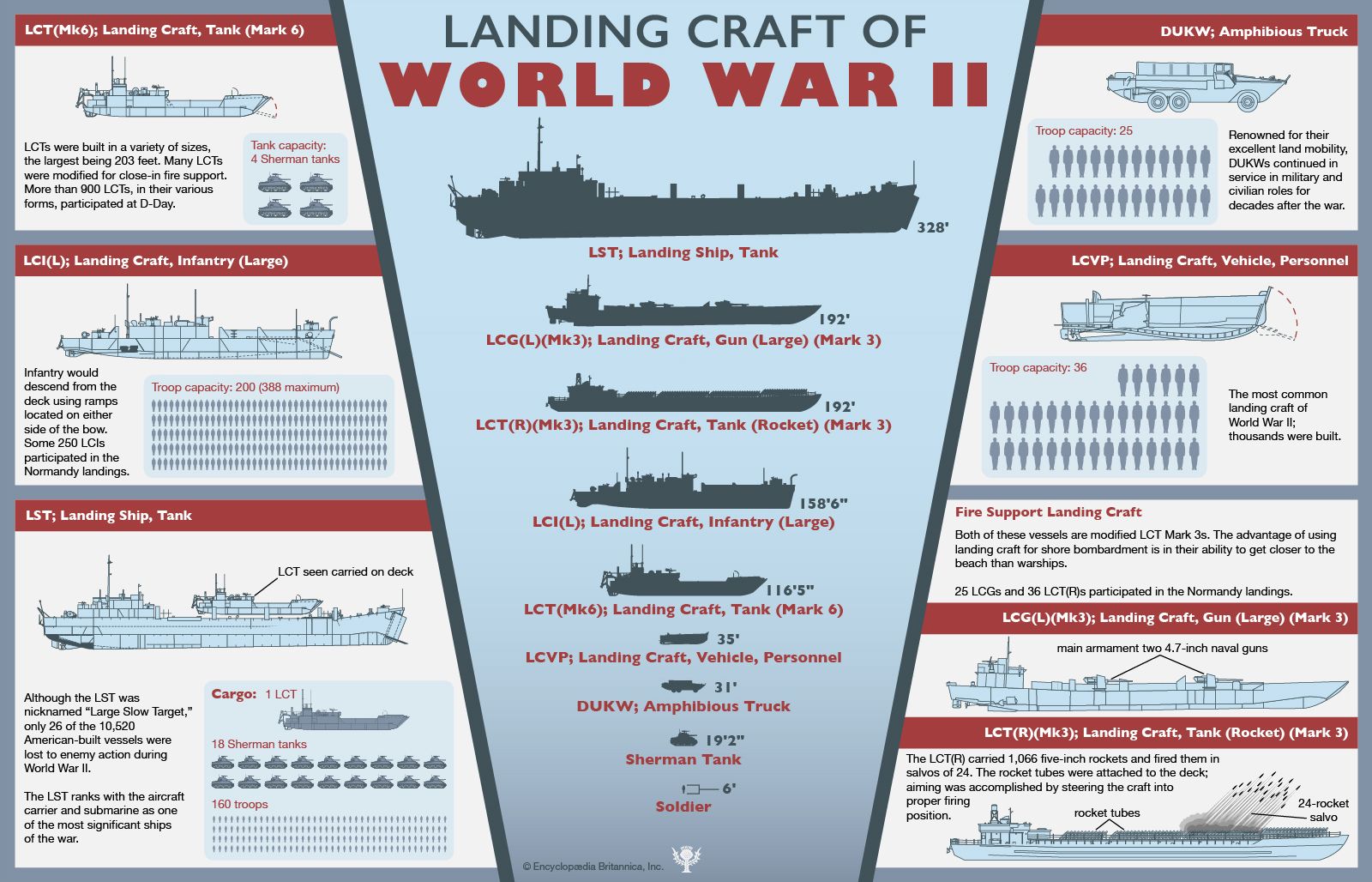
Types of Landing Craft of World War II Infographic
During World War II, Allied forces employed a variety of landing craft—relatively small naval vessels used primarily to deploy troops, equipment, vehicles, and supplies from ship to shore for offensive operations. Such vessels are perhaps best known for their role in the Normandy Invasion (the most celebrated D-Day of the war), during which some 3,000 landing craft were used. This infographic provides information on five landing craft, one landing ship, and one amphibious vehicle used by U.S. forces. It includes a chart comparing their sizes and details on each conveyance.
Size comparisons
Tapering down from the top of the infographic is a chart listing one landing ship, five landing craft, and one amphibious vehicle from largest to smallest. Each item consists of a silhouette of a conveyance (drawn to scale), the conveyance type, and its length. Some types of vessels could carry tanks or soldiers or both, so, for comparison, the chart also indicates the sizes of a Sherman tank and an individual soldier.
- The LST—or landing ship, tank—was 328 feet long.
- The LCG(L)(3)—or landing craft, gun (large) (Mark 3)—was 192 feet long.
- The LCT(R)(3)—or landing craft, tank (rocket) (Mark 3)—was also 192 feet long.
- The LCI(L)—or landing craft, infantry (large)—was 158 feet 6 inches long.
- The LCT(6)—or landing craft, tank (Mark 6)—was 116 feet 5 inches long.
- The LCVP—or landing craft, vehicle, personnel—was 35 feet long.
- The DUKW, an amphibious truck, was 31 feet long.
- The Sherman tank was 19 feet 2 inches long.
- A U.S. soldier in World War II was, on average, 5 feet 8 inches tall—here rounded for simplicity to 6 feet.
(Read Sir John Keegan’s Britannica entry on the Normandy Invasion.)
Descriptions
Below the size chart, the infographic provides detailed descriptions of the vessel and vehicle types shown on the chart. Each description includes a line drawing of a conveyance, facts about it, and, when relevant, a graph on its carrying capacity.
LST—landing ship, tank
Although the LST—or landing ship, tank—was nicknamed “Large Slow Target,” only 26 of the 10,520 built in the U.S. were lost to enemy action during World War II. The LST ranks with the aircraft carrier and the submarine as one of the most significant ships of the war. Cargo for the LST commonly consisted of 1 LCT (or landing craft, tank), 18 Sherman tanks, and 160 soldiers.
LCI(L)—landing craft, infantry (large)
Infantry would descend from the deck of the LCI(L)—or landing craft, infantry (large)—by using ramps on either side of the bow. Some 250 LCIs participated in the Normandy landings. The LCI(L) was designed to carry 200 soldiers, but it could carry up to 388.
LCT(6)—landing craft, tank (Mark 6)
The LCT—or landing craft, tank—was built in a variety of sizes, the largest being 203 feet long. Many LCTs were modified for close-in fire support. More than 900 LCTs, in various forms, participated in the invasion of Normandy. The LCT Mark 6 could carry four Sherman tanks. A version of the Sherman called the “duplex drive,” or DD, tank had extendable and collapsible skirts designed to make it buoyant enough to be launched from a landing craft and make its way to shore under propeller power.
The trusted destination for professionals, college students, and lifelong learners.
SUBSCRIBE


LCVP—landing craft, vehicle, personnel
The LCVP—or landing craft, vehicle, personnel (though often simply called the Higgins boat)—was the most common landing craft of World War II; thousands were built. Troop capacity for the LCVP was 36.
DUKW amphibious truck
The DUKW—an amphibious truck perhaps better known as the “duck”—was renowned for its land mobility. DUKWs continued to serve in military and civilian roles for decades after the war. Troop capacity for the DUKW was 25.
Fire-support landing craft: LCG(L)(3) and LCT(R)(3)
Both the LCG(L)(3) and the LCT(R)(3) were LCT Mark 3s modified to give fire support during amphibious assaults. The advantage of using landing craft for shore bombardment lay in their ability to get closer to land than deep-draft warships could. A total of 25 LCGs and 36 LCT(R)s participated in the Normandy landings.
LCG(L)(3)—landing craft, gun (large) (Mark 3)
The LCG(L)(3)—or landing craft, gun (large) (Mark 3)—had a main armament of two 4.7-inch naval guns.
LCT(R)(3)—landing craft, tank (rocket) (Mark 3)
The LCT(R)(3)—or landing craft, tank (rocket) (Mark 3)—carried 1,066 five-inch rockets and fired them in salvos of 24. The rocket tubes were attached to the deck, and aiming was accomplished by steering the craft into proper firing position.