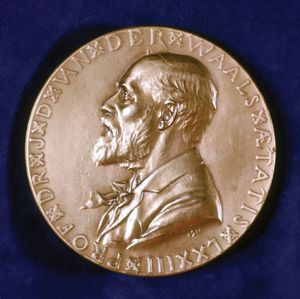
van der Waals equation
Quick Summary
The van der Waals equation is a modification of the ideal gas law that more accurately describes the behavior of real gases. It was developed by Dutch physicist Johannes Diederik van der Waals in 1873.12
The ideal gas law assumes that gas molecules have no volume and no attractive forces between them. Van der Waals recognized that these assumptions are not true for real gases. He introduced two parameters into the ideal gas equation: one to account for the volume occupied by the molecules and another for the attractive forces between them.2
The equation is written as:
[ \left(p + \frac{a}{v^2}\right) (v-b) = RT ]
where:
* p is the pressure
* v is the specific volume
* R is the gas constant
* T is the absolute temperature
* a and b are constants specific to each gas, representing intermolecular attraction and molecular volume, respectively.1
This equation allows for a more accurate understanding of gas properties, especially at higher densities where deviations from ideal behavior become significant.3
Ask Britannica AI about this topic
Britannica doesn't have a full article on this topic, so we've curated a list of our relevant coverage.