
- Related Topics:
- division

synthetic division
synthetic division, short method of dividing a polynomial of degree n of the form a0xn + a1xn − 1 + a2xn − 2 + … + an, in which a0 ≠ 0, by another of the same form but of lesser degree (usually of the form x − a). Based on the remainder theorem, it is sometimes called the method of detached coefficients.
To divide 2x3 − 7x2 + 11 by x − 3, the coefficients of the dividend are written in order of diminishing powers of x, zeros being inserted for each missing power. The variable and its exponents are omitted throughout. The coefficient of the highest power of x (2 in this example) is brought down as is, multiplied by the constant term of the divisor (−3) with its sign changed, and added to the coefficient following, giving −1. The sum −1 is likewise multiplied and added to the next coefficient, giving −3, and so on.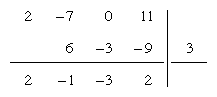
The result, 2x2 − x − 3 with a remainder of 2, can be readily checked by long division: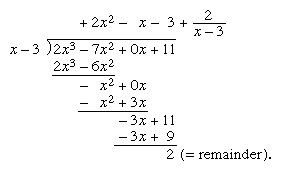



 " height="20" alt="HEW Logo">