

- Related Topics:
- anxiety disorder
- panic attack
- anxiety
- phobia
- social interaction

social anxiety disorder
News •
-
What is social anxiety disorder?
Social anxiety disorder (SAD) is an anxiety disorder marked by a fear of interacting with people due to concerns about being judged or negatively scrutinized. It can manifest in specific situations or be generalized to almost all social interactions.
Symptoms include fearing strangers, humiliation, or being judged, and avoiding situations where attention focuses on the individual, sometimes leading to physical symptoms like blushing or nausea. Cognitive-behavioral therapy (CBT) is a primary treatment that involves exposure to anxiety-provoking situations and cognitive restructuring to challenge negative self-evaluations. SAD can significantly impair social, occupational, and educational functioning, often accompanied by depression or substance abuse.
2 Britannica SourcesCreated from Britannica articles using AI. AI can make mistakes, so verify using Britannica articles. -
How does social anxiety disorder affect a person's daily life?
Social anxiety disorder (SAD) is an anxiety disorder characterized by a fear of interacting with people due to concerns about being negatively judged. SAD can significantly impair a person's daily life, leading to social, occupational, and educational disability.
People with SAD often avoid social interactions, which is a key disabling feature of the disorder and causes significant personal distress. Sufferers may experience a fear of strangers, humiliation, or being judged, and they may avoid situations where they are the center of attention. When confronted with social situations, they may experience physical symptoms such as blushing, elevated heart rate, nausea, sweating, or trembling. SAD is often accompanied by depression and an increased risk of alcohol abuse.
2 Britannica SourcesCreated from Britannica articles using AI. AI can make mistakes, so verify using Britannica articles. -
What are common signs or symptoms of social anxiety disorder?
Social anxiety disorder (SAD) is characterized by a fear of interacting with people due to worries about being negatively judged. SAD symptoms include a fear of strangers, being humiliated, or being judged by others, leading to avoidance of social situations. When confronted with social situations, individuals may experience blushing, diarrhea, elevated heart rate, nausea, sweating, or trembling. In social situations, individuals with SAD may experience panic attacks, dizziness, tachycardia, and numbness in the extremities. SAD can be specific or generalized, with the latter triggering anxiety in virtually all social interactions.
2 Britannica SourcesCreated from Britannica articles using AI. AI can make mistakes, so verify using Britannica articles. -
How is social anxiety disorder different from just being shy?
Social anxiety disorder (SAD) is more than just shyness. SAD involves intense fear of social interactions due to worries about being judged or negatively evaluated by others. This fear leads to avoidance of social situations and significant impairment in functioning. While shyness is a common feeling of discomfort in social situations, SAD is a persistent and debilitating condition that can lead to social, educational, and occupational disability, as well as mood disorders and substance abuse. The intensity of anxiety, the range of feared situations, and the negative impact on one's life distinguish SAD from shyness.
4 Britannica SourcesCreated from Britannica articles using AI. AI can make mistakes, so verify using Britannica articles. -
What causes or increases the risk of social anxiety disorder?
Social anxiety disorder (SAD) is characterized by a fear of interacting with people due to concerns about being negatively judged. SAD typically emerges in adolescence and is more common in women.
Several factors can contribute to or increase the risk of social anxiety disorder:
* Genetics Studies show that genetics can play a role in the causation of anxiety disorders.
* Complicating factors Individuals with SAD may experience additional issues such as alcohol abuse, depression, and suicidal thoughts.
* Environmental factors Stressful life events can also precipitate the onset of the illness.3 Britannica SourcesCreated from Britannica articles using AI. AI can make mistakes, so verify using Britannica articles. -
What treatments or strategies can help someone manage social anxiety disorder?
To manage social anxiety disorder (SAD), cognitive-behavioral therapy (CBT) is a primary psychosocial intervention.
Key components of CBT include:
* Behavioral mastery Through exposure to anxiety-provoking situations, individuals can develop better coping methods.
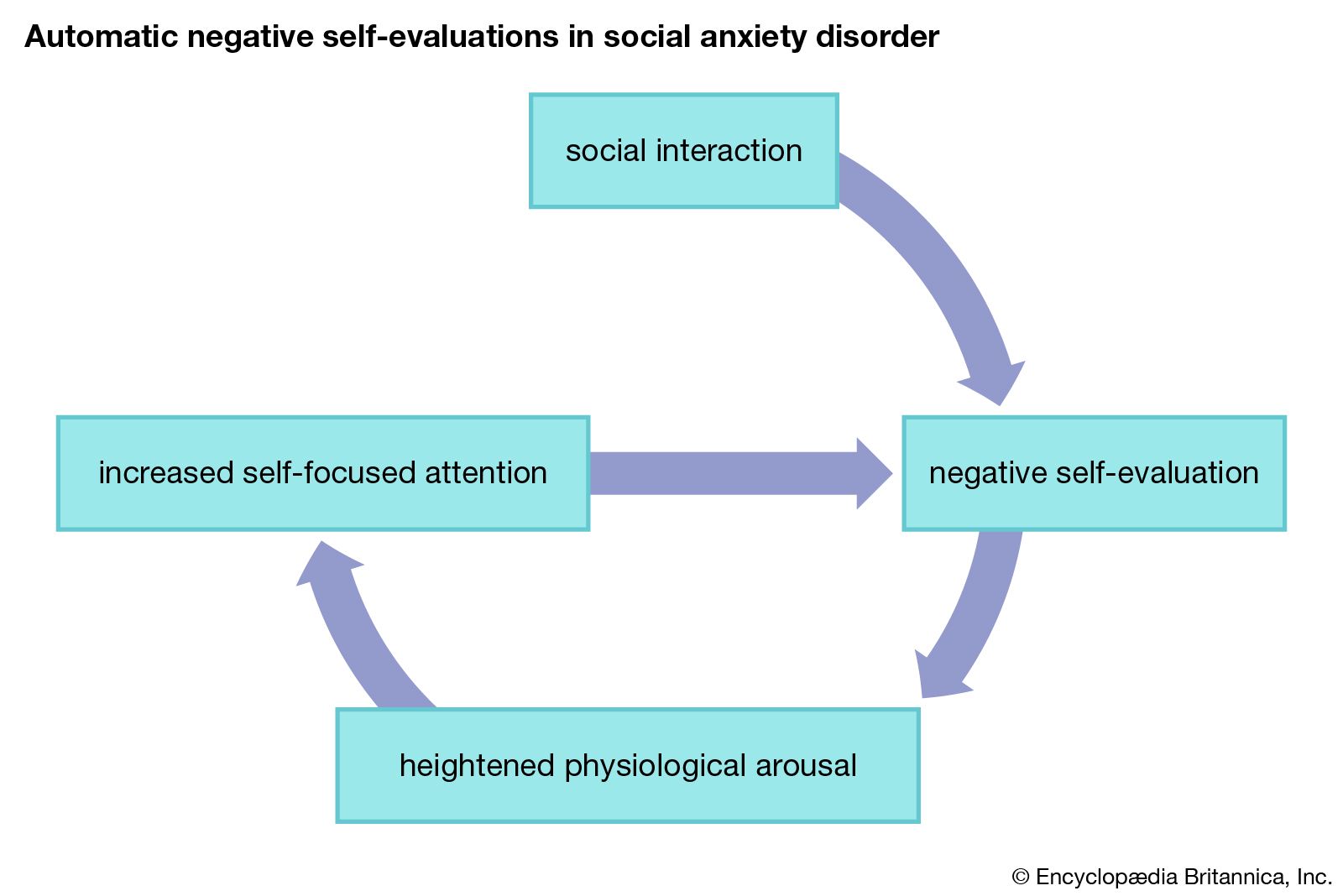
* Cognitive restructuring Training to challenge negative self-evaluations and break the feedback loop that leads to social performance breakdown. Cognitive restructuring involves awareness of negative thoughts and replacing unrealistic thoughts with balanced interpretations.
* Social and communication skills training Identifying social skills deficits and teaching strategies for increasing the effectiveness of social behaviors.
* Relaxation-based strategies Common forms of relaxation training include meditation, progressive muscle relaxation, imagery-based relaxation training, and breathing retraining.CBT may be conducted individually or in groups to enhance exposure and offer feedback.
3 Britannica SourcesCreated from Britannica articles using AI. AI can make mistakes, so verify using Britannica articles.
social anxiety disorder (SAD), a type of anxiety disorder characterized by a fear of interacting with people, due to worries over the possibility of being negatively scrutinized and judged by them. Social anxiety disorder (SAD) was once referred to as social phobia; however, the label of “phobia,” and the inclusion of SAD among the subtypes of specific phobia, created the false impression that pathology based on social apprehension was less severe than other anxiety disorders. Mounting evidence has shown that SAD is a serious and debilitating disorder that frequently leads to social, occupational, and educational disability as well as serious correlates such as secondary mood disorders and substance abuse.
The Diagnostic and Statistical Manual of Mental Disorders (DSM-5), published in 2013 defines SAD along several dimensions:
- Persistent fear (that is, lasting for six months or more) of one or more social situations. The fear is of potential embarrassment and/or rejection.
- Exposure to the feared situation virtually always leads to anxiety (which may be described as a panic attack).
- The individual recognizes the excessive and unreasonable nature of the fear.
- Social situations are avoided.
- Significant impairment of functioning due to avoidance of social situations.
- Symptoms are not due to the effects of a substance or medical condition.
While the vast majority of people may report occasions of anxiety in social situations or the common fear of public speaking, the occurrence of SAD is far less frequent. It is the intensity of the anxiety experienced, the wider range of feared social situations, and the profound negative impact on functioning that sets SAD apart from milder instances of social apprehension.



 " height="20" alt="HEW Logo">

SAD may be of two forms: specific and generalized. Some individuals experience social anxiety for a small and discrete set of social situations. The more severe and more common variant of SAD, however, is the generalized type. In this case, anxiety is triggered in virtually all social interactions (e.g., meeting an individual one-on-one as well as meeting a small group of people all at once). A survey of several studies that collected epidemiological data over different 12-month-long periods suggests that the prevalence of SAD is approximately 3–7 percent in the general population, although there are wide variations depending on culture (i.e., 0.2–0.5 percent in South Korea and as high as 3.0–5.1 percent in New Zealand).
Symptoms of social anxiety disorder
Physiological reactivity
It has been noted that during exposure to social situations, individuals with SAD may experience situational panic attacks wherein the physical symptoms closely resemble panic. Specifically, the SAD sufferer may experience trembling, sweating, dizziness, tachycardia, depersonalization (psychological state in which an individual feels that they or the outside world is unreal), numbness in the extremities, and other signs of sympathetic arousal. Reacting with panic-like symptoms when exposed to social situations is frequently accompanied by increases in warmth around the cheeks, resulting in blushing (see also erythema).
Behavioral features
One of the principal observable aspects of SAD involves avoidance of social interactions. This specific symptom is the key disabling feature of SAD, leading to significant personal distress among SAD sufferers. Self-report assessments, such as the Social Interaction Anxiety Scale (a five-point scale the sufferer uses to rate the level of anxiety he or she would experience when considering different social situations), generally focus on the anxiety associated with social interaction. This scale, used in conjunction with the Social Phobia Scale (a scale measuring responses to common stressful situations and autonomic distress), provides a detailed self-report evaluation of the severity of social anxiety.
Cognitive aspects
Most models of the etiology (cause or origin) of SAD have a prominent cognitive component that is primarily concerned with self-focused attention and self-evaluative statements that occur either during or immediately following social situations. Specifically, individuals with SAD evaluate social situations as more threatening, and others are highly likely to evaluate the SAD sufferer negatively. Numerous investigations have demonstrated experimentally that individuals with SAD consistently evaluate their performances negatively as well as make attributions that others perceive their performance negatively. The process of negative self-evaluation immediately following social interactions is sometimes referred to as the negative postmortem. These spontaneously occurring negative self-evaluations set up a pernicious feedback loop.
The trusted destination for professionals, college students, and lifelong learners.
SUBSCRIBE


Additional common complicating factors in social anxiety disorder
Given the degree of anxiety experienced by individuals suffering from SAD and the ubiquity of social interactions, the SAD sufferer cannot completely avoid severe anxiety-provoking situations. This problem frequently leads to significant difficulties aside from the primary presenting problem. For example, there is a higher probability of alcohol abuse among individuals with SAD. In addition, individuals with SAD have higher levels of depression as well as higher levels of suicidal ideation and attempts. Finally, those with SAD are significantly more likely to drop out of school compared with other anxiety disorder groups.
Treatment approach and outcome
The primary psychosocial intervention for SAD is cognitive-behavioral therapy (CBT). There have been numerous trials examining CBT for SAD (or social phobia), with generally favorable results. There are two major components to this treatment package. The first involves behavioral mastery of specific situations that formerly triggered anxious responding. This frequently involves imaginal and real exposure to events designed to develop better methods of coping with anxiety-provoking situations as well as provide an opportunity for the clinician to assess specific cognitive distortions that contribute to the maintenance of social anxiety. The second component overlaps with the behavioral procedures and involves cognitive restructuring. This additional element is essential to train the SAD sufferer in methods for challenging the accuracy of his or her negative self-evaluations and to break the feedback loop that frequently leads to a real breakdown in social performance. While treatment may be conducted individually, interventions are often enhanced in social anxiety groups, where fellow group members assist by providing an opportunity for exposure and offering feedback in the service of support and mastery.