


Adding us as a Preferred Source tells Google you trust our content, so our articles show up more often in your Google Search, Discover feed, and AI Overviews.
verifiedCite
While every effort has been made to follow citation style rules, there may be some discrepancies.
Please refer to the appropriate style manual or other sources if you have any questions.
Select Citation Style
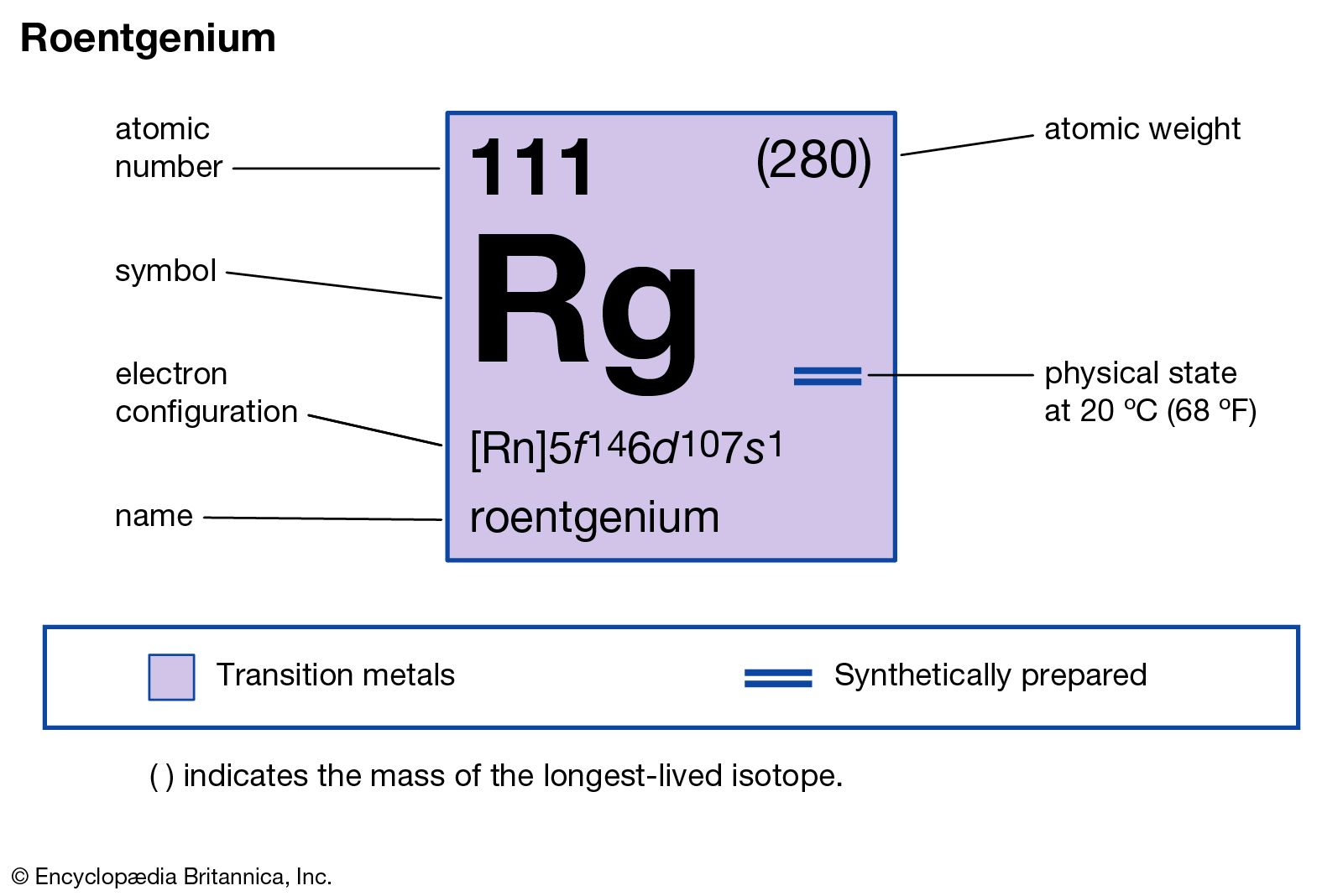
roentgenium
Properties of roentgenium.
roentgenium
chemical element
Also known as: Rg, Uuu, element 111, unununium
roentgenium (Rg), artificially produced transuranium element of atomic number 111. In 1994 scientists at the Institute for Heavy Ion Research (Gesellschaft für Schwerionenforschung [GSI]) in Darmstadt, Ger., formed atoms of element 111 when atoms of bismuth-209 were bombarded with atoms of nickel-62. The atoms of element 111 had an atomic weight of 272 and decayed after 1.5 milliseconds into atoms of meitnerium-268 by emitting an alpha particle (helium nucleus). Element 111 was named roentgenium after the German physicist Wilhelm Röntgen, the discoverer of X-rays. The longest-lasting isotope, roentgenium-280, has a half-life of 3.6 seconds and decays to meitnerium-276. Roentgenium’s chemical properties may be similar to those of gold.
| atomic number | 111 |
|---|---|
| atomic weight | 280 |
| electron config. | [Rn]5f146d107s1 |
The Editors of Encyclopaedia Britannica This article was most recently revised and updated by Rick Livingston.


Discover how ordinary objects work, and expand your understanding of the familiar.

 " height="20" alt="HEW Logo">
By clicking "Sign Up", you consent to the Britannica Privacy Policy and Terms of Use.