

resonance-ionization spectroscopy
Quick Summary
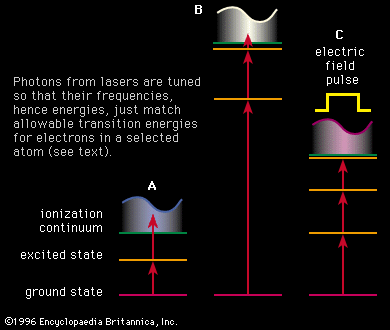
Resonance-ionization spectroscopy (RIS) is a highly sensitive and selective analytical method that uses lasers to remove electrons from atoms or molecules, creating ions and free electrons. These charged particles are then detected to identify and quantify substances in a sample.1234
RIS was developed in the 1970s and is used in physics, chemistry, and biology. It offers the ability to distinguish between different types of atoms and detect them at the single-atom level. Applications range from dating ancient materials and studying groundwater to analyzing trace elements in electronics and even determining DNA structure.1234
The process involves using photons with specific energies to excite an atom to a higher energy level, followed by another photon that completes the ionization. This stepwise excitation ensures that ionization only occurs when the laser is tuned to the atom's specific wavelength. With advanced RIS schemes, nearly all elements can be detected.14
Ask Britannica AI about this topic
Britannica doesn't have a full article on this topic, so we've curated a list of our relevant coverage.