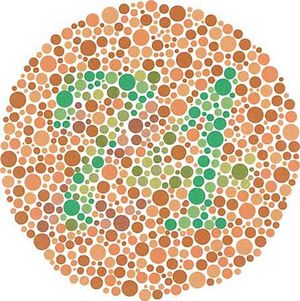
red-green colour blindness
Quick Summary
Red-green color blindness is a deficiency in color vision, ranging from an imperfect perception of red and green to seeing only tones of yellow, blue, and gray. This condition arises from issues with the cone cells in the retina, which are responsible for color vision.123
Normally, humans have three types of cones, each sensitive to different wavelengths of light: blue-violet, green, and red. When all three function correctly, it's called trichromacy. Red-green color blindness often occurs when only two cone types are functional (dichromacy), meaning individuals cannot distinguish between red and green. This is most common in males due to its inheritance pattern as a sex-linked recessive characteristic.34
Ask Britannica AI about this topic
Britannica doesn't have a full article on this topic, so we've curated a list of our relevant coverage.