Encyclopedia Britannica
SUBSCRIBE
SUBSCRIBE
SUBSCRIBE TO PREMIUM
  • Home
  • Biographies
  • Animals & Nature
  • History & Society
  • Science & Tech
  • Geography & Travel
  • Arts & Culture
  • ProCon
  • Money
  • Games & Quizzes
  • Videos
  • Today in History
  • Dictionary
  • New Articles
Biographies
  • Browse Biographies
Animals & Nature
  • Birds, Reptiles & Other Vertebrates
  • Environment
  • Fossils & Geologic Time
  • Insects & Other Invertebrates
  • Mammals
  • Plants
History & Society
  • History
  • Philosophy & Religion
  • Politics, Law & Government
  • Society & Social Issues
Science & Tech
  • Health & Medicine
  • Science
  • Technology
Geography & Travel
  • Geography & Travel
Arts & Culture
  • Entertainment & Pop Culture
  • Literature
  • Sports & Recreation
  • Visual Arts
  • Image Galleries
  • Podcasts
  • Summaries
  • Top Questions
  • Lists and Stories
  • Britannica Kids
Ask the Chatbot Games & Quizzes History & Society Science & Tech Biographies Animals & Nature Geography & Travel Arts & Culture ProCon Money Videos
ramp overthrust
References
Images
A simplified geological cross section of the Himalayas running north to south, showing the Ganga Basin as a foreland basin, crystalline rock overthrusting the Indian Plate, and a steep thrust fault ramp beneath the Great Himalayas, with labeled features including the Main Boundary Thrust, Main Central Thrust, ophiolites, and Kangdese granites.
Britannica AI Icon

ramp overthrust

geology
Written by
The Information Architects of Encyclopaedia Britannica

The Information Architects maintain a master list of the topics included in the corpus of  Encyclopædia Britannica, and create and manage the relationships between them.

The Information Architects of Encyclopaedia Britannica

Learn about this topic in these articles:

  • Mount Sir Donald
    mountain
    / Alpine- (or Himalayan-)type belts

    …thrust onto it are called ramp overthrusts. When the fault first forms, it dips at 10° to 30° (or more). Slip on this fault (i.e., the movement of one face of the fault relative to the other) brings the leading edge of the off-scraped slice of crust to the surface…

    Read More

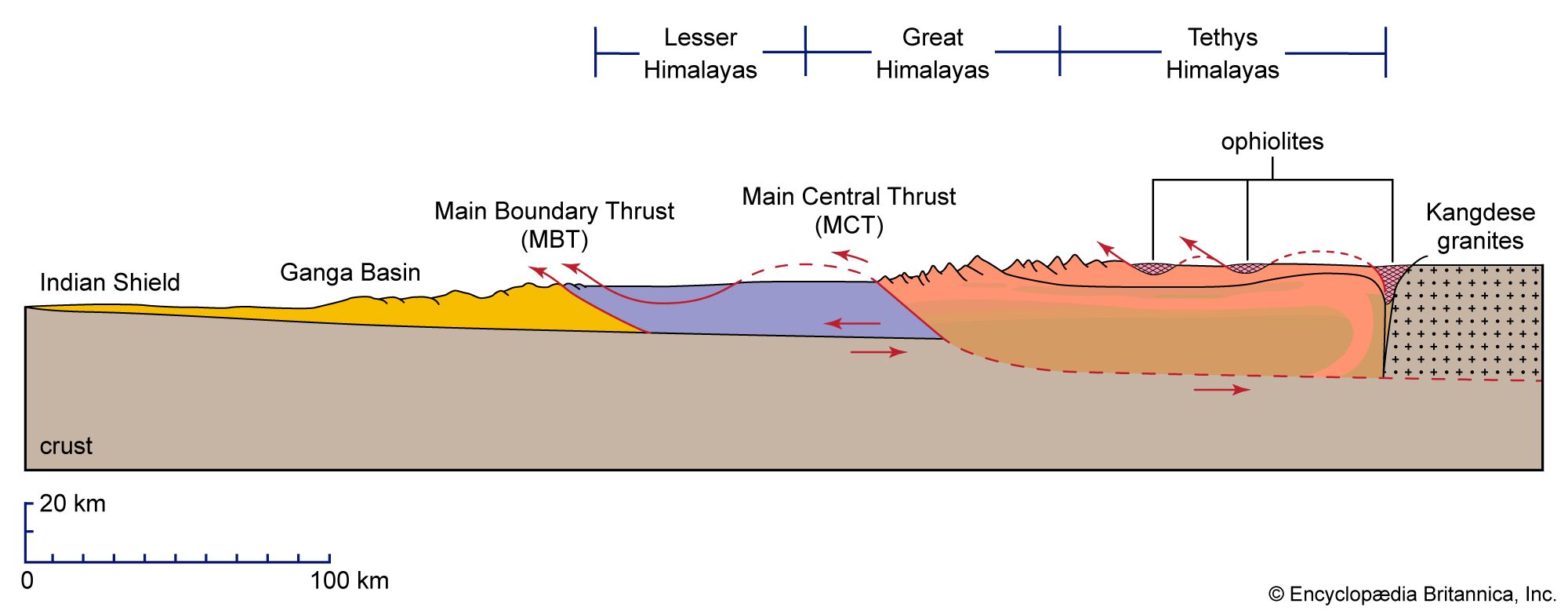
    …thrust onto it are called ramp overthrusts. When the fault first forms, it dips at 10° to 30° (or more). Slip on this fault (i.e., the movement of one face of the fault relative to the other) brings the leading edge of the off-scraped slice of crust to the surface…

    Read More