

quadratic reciprocity law
Quick Summary
The law of quadratic reciprocity is a theorem in number theory that describes the conditions under which a quadratic congruence has solutions. Specifically, it relates the solvability of the congruence (x^2 \equiv p \pmod{q}) to the solvability of (x^2 \equiv q \pmod{p}), where (p) and (q) are distinct prime numbers.1
This law was first observed by Adrien-Marie Legendre and later rigorously proven by Carl Friedrich Gauss. It is a fundamental result in the study of quadratic residues and has connections to other areas of number theory, including the theory of quadratic forms and algebraic integers. The law of quadratic reciprocity is considered a cornerstone of elementary number theory.1
Ask Britannica AI about this topic
Britannica doesn't have a full article on this topic, so we've curated a list of our relevant coverage.
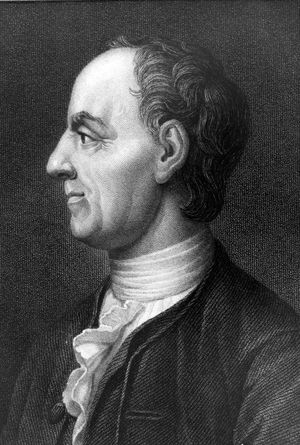 Leonhard EulerLater years
…1783, was the law of quadratic reciprocity, which has become an essential part of modern number theory.
Read More…1783, was the law of quadratic reciprocity, which has become an essential part of modern number theory.
Read More- Adrien-Marie Legendre
…proof of the law of quadratic reciprocity. The law was regarded by Gauss, the greatest mathematician of the day, as the most important general result in number theory since the work of Pierre de Fermat in the 17th century. Gauss also gave the first rigorous proof of the law.
Read More…proof of the law of quadratic reciprocity. The law was regarded by Gauss, the greatest mathematician of the day, as the most important general result in number theory since the work of Pierre de Fermat in the 17th century. Gauss also gave the first rigorous proof of the law.
Read More