

proton nuclear magnetic resonance spectroscopy
Also known as: proton NMR, proton magnetic resonance spectroscopy(Show More)
Quick Summary
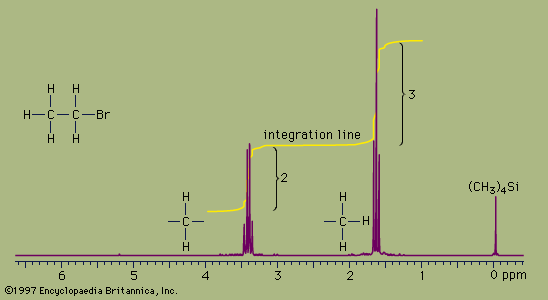
proton nuclear magnetic resonance spectrum of bromoethane
Proton nuclear magnetic resonance spectra can provide structural information about organic compounds such as bromoethane. This information is based on energy absorption by hydrogen atoms, which absorb different wavelengths of energy depending on their bonding environment.
Proton nuclear magnetic resonance (NMR) spectroscopy is a technique used to determine the structure of organic compounds by analyzing the behavior of hydrogen atoms (protons) within a molecule when exposed to a magnetic field and radio waves.12
Key aspects of proton NMR spectroscopy include:
- Reference Standard: Tetramethylsilane is used as a reference, with its proton signal assigned a value of zero on the chemical shift scale.1
- Chemical Shift: The position of a proton's absorption peak relative to the reference indicates the electronic environment around that proton, providing information about its bonding.1
- Peak Area (Integration): The area under each peak is proportional to the number of hydrogen atoms contributing to that signal, helping to determine the ratio of different types of protons in the molecule.1
- Spin-Spin Splitting: Peaks can be split into multiple smaller peaks (multiplets) due to the influence of neighboring, non-equivalent protons. This splitting pattern provides information about the connectivity of atoms within the molecule.1
These features—chemical shift, peak area, and splitting patterns—collectively offer detailed insights into the molecular structure of organic compounds.1
Summary created from Britannica articles
using AI.
AI can make mistakes, so verify using Britannica articles.
2 Britannica Sources
Ask Britannica AI about this topic
Britannica doesn't have a full article on this topic, so we've curated a list of our relevant coverage.
