

polyisoprene
-
What is polyisoprene?
Polyisoprene is a polymer of isoprene (C5H8). It is the primary chemical constituent of natural rubber, naturally occurring resins like balata and gutta-percha, and the synthetic equivalents of these materials.
Depending on its molecular structure, polyisoprene can be a resilient, elastic polymer (elastomer), as in the case of natural rubber and isoprene rubber, or a tough, leathery resin, as in the case of natural and synthetic balata or gutta-percha.
Natural rubber consists almost exclusively of the cis-1,4 polymer, produced in the milky latex of certain plants, most notably the rubber tree (Hevea brasiliensis).
3 Britannica SourcesCreated from Britannica articles using AI. AI can make mistakes, so verify using Britannica articles. -
What is polyisoprene made of?
Polyisoprene is a polymer of isoprene ((C_5H_8)), which can be sourced from petroleum or coal tar. It is the primary chemical constituent of natural rubber, balata, and gutta-percha, as well as synthetic equivalents of these materials.
The polymerization of isoprene can result in four spatial configurations, known as isomers, with the cis-1,4 and trans-1,4 polymers being the most significant. Natural rubber consists almost exclusively of the cis-1,4 polymer. The trans-1,4 isomer is dominant in gutta-percha and balata.
The properties of polyisoprene vary depending on its molecular structure. It can be a resilient, elastic polymer (elastomer) or a tough, leathery resin.
5 Britannica SourcesCreated from Britannica articles using AI. AI can make mistakes, so verify using Britannica articles. -
How is polyisoprene related to natural rubber?
Polyisoprene is a polymer of isoprene (C5H8) and is the primary chemical constituent of natural rubber. Natural rubber consists almost exclusively of the cis-1,4 polymer of polyisoprene, found in the latex of plants like the rubber tree (Hevea brasiliensis). This natural form of polyisoprene is known for its extensibility and toughness, allowing it to stretch multiple times its original length and is considered "self-reinforcing" due to its ability to crystallize when stretched, which increases its strength.
Isoprene rubber (IR) is a synthetic form of polyisoprene, created through the polymerization of isoprene from petroleum. While it is similar to natural rubber, it has a less regular structure and does not crystallize as easily.
4 Britannica SourcesCreated from Britannica articles using AI. AI can make mistakes, so verify using Britannica articles. -
How is polyisoprene produced in factories?
In factories, isoprene rubber (IR) is produced through the polymerization of synthetic isoprene, which is derived from the thermal cracking of petroleum's naphtha fraction. The polymerization process is conducted in solution, utilizing both anionic and Ziegler-Natta catalysts.
The resulting product is at most 98% cis-1,4 polyisoprene, differing structurally from natural rubber. Consequently, it crystallizes less readily and exhibits reduced strength and tackiness in its raw state. Despite these differences, isoprene rubber serves as a complete substitute for natural rubber in most applications. Both materials are primarily used in tires but are also valued for rubber springs and mountings because of their fatigue resistance and high resilience. Footwear is another significant application, and natural rubber remains in use for adhesives like rubber cement.
6 Britannica SourcesCreated from Britannica articles using AI. AI can make mistakes, so verify using Britannica articles. -
What are some common uses of polyisoprene?
Polyisoprene is a polymer of isoprene that can be both natural and synthetic. Polyisoprene exists in different isomeric forms, each having unique properties.
Common uses of polyisoprene:
* Tires for various vehicles
* Rubber springs and mountings due to fatigue resistance and high resilience
* Footwear
* Adhesives like rubber cementIn its natural form, polyisoprene is used in tires for racing cars, trucks, buses, and airplanes because of its resistance to heat buildup.
4 Britannica SourcesCreated from Britannica articles using AI. AI can make mistakes, so verify using Britannica articles. -
How do the properties of polyisoprene make it useful in products like gloves and tires?
Polyisoprene, a polymer of isoprene, is the primary chemical constituent of natural rubber. The cis-1,4 polymer form of polyisoprene gives natural rubber its remarkable extensibility and toughness, allowing it to be stretched repeatedly to many times its original length. When stretched, it crystallizes, which strengthens it.
Because of these properties, polyisoprene is ideal for products such as tires, where flexibility and durability are needed. It is also suitable for gloves, where its elasticity allows for a snug fit and ease of movement. However, natural rubber is affected by temperature and can be weakened by hydrocarbons, which can be overcome through vulcanization.
4 Britannica SourcesCreated from Britannica articles using AI. AI can make mistakes, so verify using Britannica articles.
polyisoprene, polymer of isoprene (C5H8) that is the primary chemical constituent of natural rubber, of the naturally occurring resins balata and gutta-percha, and of the synthetic equivalents of these materials. Depending on its molecular structure, polyisoprene can be a resilient, elastic polymer (elastomer), as in the case of natural rubber and isoprene rubber, or a tough, leathery resin, as in the case of natural and synthetic balata or gutta-percha.
The chemical structure of isoprene can be represented as CH2=C(CH3)—CH=CH2. Polyisoprene—built up from the linking of multiple isoprene molecules—can assume any one of four spatial configurations, or isomers, each of which imparts a unique set of properties to the polymers. As the repeating units of polyisoprene, the four isomers have the following structures: 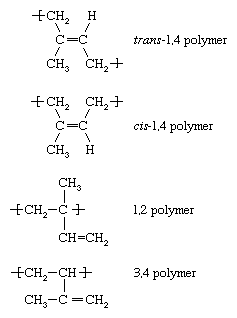 Of these four isomers, the most important are the cis-1,4 polymer and the trans-1,4 polymer.
Cis-1,4 polyisoprene
Natural rubber consists almost exclusively of the cis-1,4 polymer, which is produced in the milky latex of certain plants—most notably the rubber tree (Hevea brasiliensis). The uniqueness of natural rubber lies in its physical properties of extensibility and toughness, summarized by its ability to be stretched repeatedly to seven or eight times its original length. In the absence of tensile (stretching) stress, the polymer chains assume an amorphous, or disordered, arrangement. On being stretched, however, the molecules readily align into an ordered crystalline arrangement. Crystallinity lends greater strength to the material, so natural rubber is considered to be “self-reinforcing.” In its natural state, however, natural rubber is greatly affected by temperature: it crystallizes on cooling, taking only several hours to do so at −25 °C (−13 °F), and it becomes tacky and inelastic above 50 °C (120 °F). In addition, it is swollen and weakened by hydrocarbon oils, and it reacts with oxygen and ozone in the atmosphere, leading to rupture of the polymer molecules at the carbon-carbon double bonds and softening and cracking of the material over time. These disadvantages are overcome to a great extent by cross-linking the polymer chains through the process known as vulcanization.



 " height="20" alt="HEW Logo">
Isoprene rubber (IR) is manufactured by the polymerization of synthetic isoprene, which is obtained from the thermal cracking of the naphtha fraction of petroleum. Polymerization is conducted in solution, using both anionic and Ziegler-Natta catalysts. The product is at most 98 percent cis-1,4 polyisoprene, and its structure is not as regular as natural rubber in other respects. As a result, it does not crystallize as readily as the natural material, and it is not as strong or as tacky in the raw (unvulcanized) state. In all other respects, though, isoprene rubber is a complete substitute for natural rubber. For both materials, the principal usage is in tires, although these elastomers are also preferred for rubber springs and mountings, owing to their good fatigue resistance and high resilience. Footwear is an important application, and natural rubber is still used in adhesives (such as rubber cement).
Trans-1,4 polyisoprene
Trans-1,4 polyisoprene is the dominant isomer in gutta-percha and balata, two materials that, like natural rubber, are derived from the milky exudate of certain trees. Unlike the cis-1,4 polymer, however, the trans-1,4 polymer is highly crystalline, so balata and gutta-percha are tough, hard, and leathery materials—properties that led in the 19th century to their use as sheathings for underwater cables and golf balls. The trans-1,4 polymer can also be synthesized with Ziegler-Natta catalysts, yielding a synthetic balata of similar properties that also is employed in golf-ball covers as well as in orthopedic devices such as splints and braces.