

polyacrylonitrile
-
What is polyacrylonitrile?
Polyacrylonitrile (PAN) is a synthetic resin created through acrylonitrile polymerization and is part of the acrylic resin family. This rigid thermoplastic is known for its resistance to solvents, chemicals, slow burning, and low gas permeability. PAN is commonly used in the production of acrylic and modacrylic fibers, often as a substitute for wool in clothing and home furnishings.
Acrylonitrile (CH_2=CHCN) is made by reacting propylene (CH_2=CHCH_3) with ammonia (NH_3) and oxygen using catalysts. The polymer, PAN, is created when acrylonitrile monomers are suspended with other monomers in water and polymerized using free-radical initiators. The polymer molecules resist most organic solvents and do not melt without decomposing because of the strong chemical bonds between the nitrile (CN) groups.
1 Britannica SourceCreated from Britannica articles using AI. AI can make mistakes, so verify using Britannica articles. -
What is polyacrylonitrile made from?
Polyacrylonitrile (PAN) is a synthetic resin made through the polymerization of acrylonitrile ($CH_2=CHCN$).
Acrylonitrile is produced by reacting propylene ($CH_2=CHCH_3$) with ammonia ($NH_3$) and oxygen in the presence of catalysts. The acrylonitrile monomers are suspended as fine droplets in water, often with other monomers, and then induced to polymerize to PAN through the action of free-radical initiators.
5 Britannica SourcesCreated from Britannica articles using AI. AI can make mistakes, so verify using Britannica articles. -
How is polyacrylonitrile produced or manufactured?
Polyacrylonitrile (PAN) is a synthetic resin in the acrylic resin family made through the polymerization of acrylonitrile. During production, acrylonitrile monomers are suspended as fine droplets in water, often with other monomers, and then polymerized into PAN using free-radical initiators..
Acrylonitrile (CH₂=CHCN) is created by reacting propylene (CH₂=CHCH₃) with ammonia (NH₃) and oxygen using catalysts. The acrylonitrile repeating unit of the polymer features strong chemical bonds between the nitrile (CN) groups.
3 Britannica SourcesCreated from Britannica articles using AI. AI can make mistakes, so verify using Britannica articles. -
What are some common uses of polyacrylonitrile?
Polyacrylonitrile (PAN) is a synthetic resin created through acrylonitrile polymerization. It is a rigid thermoplastic that is resistant to chemicals and solvents, burns slowly, and has low gas permeability.
Common uses of polyacrylonitrile:
* As a substitute for wool in clothing and home furnishings
* As a precursor for carbon and graphite fibers
* In cement as a replacement for asbestos
* In industrial filters and battery separators
* In children’s sleepwear, awnings, tents, and blankets3 Britannica SourcesCreated from Britannica articles using AI. AI can make mistakes, so verify using Britannica articles. -
Why is polyacrylonitrile important in making synthetic fibers?
Polyacrylonitrile (PAN) is a crucial component in synthetic fibers because it is a hard, rigid thermoplastic material with resistance to solvents and chemicals, low gas permeability, and slow burning. Most PAN is made into acrylic and modacrylic fiber, a common substitute for wool in clothing and home furnishings.
PAN homopolymer fibers are challenging to produce because they are difficult to dissolve and dye. Therefore, PAN is often copolymerized with other monomers like vinyl acetate to create acrylic fibers with improved softness and dyeability. These acrylic fibers offer a cost-effective alternative to wool with superior sunlight, mildew, and moth resistance. Halogen-containing comonomers can modify acrylics to create modacrylics, which have flame resistance, making them suitable for children's sleepwear and other products.
4 Britannica SourcesCreated from Britannica articles using AI. AI can make mistakes, so verify using Britannica articles. -
How do the properties of polyacrylonitrile affect its applications in industry?
Polyacrylonitrile (PAN) is a synthetic resin known for its versatile properties, making it valuable across various industries. It is a rigid thermoplastic that resists solvents and chemicals, burns slowly, and has low gas permeability.
PAN's properties affect its applications:
* Acrylic and modacrylic fibers Because its properties resemble those of wool, PAN is a common, cheaper substitute for wool in clothing and home furnishings like sweaters, socks, and carpets. It also has better sunlight, mildew, and moth resistance.
* Flame resistance Modacrylics, which are acrylics modified with chlorine, are used in children’s sleepwear, blankets, awnings, and tents.
* Precursor material Acrylic fibers are used to make carbon and graphite fibers, asbestos replacements in cement, and industrial filters and battery separators.3 Britannica SourcesCreated from Britannica articles using AI. AI can make mistakes, so verify using Britannica articles.
polyacrylonitrile (PAN), a synthetic resin prepared by the polymerization of acrylonitrile. A member of the important family of acrylic resins, it is a hard, rigid thermoplastic material that is resistant to most solvents and chemicals, slow to burn, and of low permeability to gases. Most polyacrylonitrile is produced as acrylic and modacrylic fibre, a common substitute for wool in clothing and home furnishings.
Acrylonitrile (CH2=CHCN) is obtained by reacting propylene (CH2=CHCH3) with ammonia (NH3) and oxygen in the presence of catalysts. It is a flammable liquid that is highly toxic if ingested and is a known carcinogen; strictly regulated procedures are required for its handling and disposal. Acrylonitrile monomers (single-unit molecules) are suspended, almost always in combination with other monomers, as fine droplets in water and are induced to polymerize to PAN through the action of free-radical initiators. The acrylonitrile repeating unit of the polymer has the following structure: 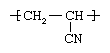 .
PAN has none of the hazardous properties of the monomer. Owing to the formation of strong chemical bonds between the nitrile (CN) groups, the polymer molecules resist most organic solvents and do not melt without decomposing. In most cases the polymer is dissolved in special solvents and spun into acrylic fibres, which are defined as fibres that contain 85 percent or more of PAN. Because PAN is difficult to dissolve and is highly resistant to dyeing, very little fibre is produced containing PAN alone. On the other hand, a copolymer containing 2 to 7 percent of a vinyl comonomer such as vinyl acetate can be solution-spun readily to fibres that soften enough to allow penetration by dyestuffs. Acrylic fibres are soft and flexible, producing lightweight, lofty yarns. Such properties closely resemble those of wool; hence, the most common use of acrylics in apparel and carpets is as a wool replacement—for example, in knitted wear such as sweaters and socks. Acrylics can be sold at a fraction of the cost of the natural fibre, and they offer better sunlight resistance, mildew resistance, and resistance to attack by moths. Acrylic fibres are also used as precursors for the production of carbon and graphite fibres, as replacements for asbestos in cement, and in industrial filters and battery separators.



 " height="20" alt="HEW Logo">
Acrylics modified by halogen-containing comonomers such as vinyl chloride or vinylidene chloride are classified as modacrylics. (By definition, modacrylics contain more than 35 percent and less than 85 percent PAN.) The presence of chlorine imparts a notable flame resistance to the fibre—an advantage that makes modacrylics desirable for products such as children’s sleepwear, blankets, awnings, and tents. However, they are not as widely used as the simple acrylics because of their higher cost and because they are somewhat prone to shrinkage in clothes dryers.
Although the polymerization of acrylonitrile had been known since the 1890s, commercial production of PAN fibre did not begin until the 1940s, after Ray C. Houtz of E.I. du Pont de Nemours & Company (now DuPont Company) discovered spinning solvents that could dissolve the polymer. DuPont introduced its trademarked Orlon acrylic fibre in 1948; Orlon was soon followed by the Monsanto Chemical Company’s Acrilan, American Cyanamid’s Creslan, Courtaulds’ Courtelle, and others. The decade of the 1950s also saw the introduction of modacrylics such as Eastman Kodak Company’s Verel and Monsanto’s SEF.