

placentation
Quick Summary
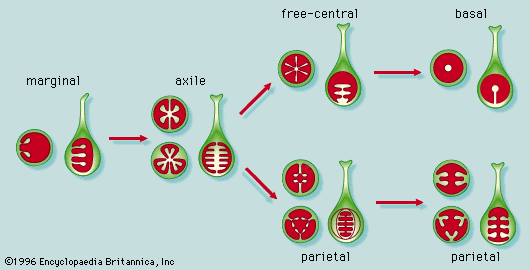
In botany, the placenta is the part of the carpel (a modified leaf) where ovules (which develop into seeds) are attached. The arrangement of these ovules within the ovary is called placentation, and it's a key characteristic for classifying plants.1
Placentation can vary:
* Submarginal: Typically found in simple pistils, where ovules are attached near the leaf margin.1
* Parietal: Ovules are along the inner ovary walls, with carpels joined at their edges.1
* Axile: Carpels fold inward, and ovules are along the central axis of the ovary.1
* Free central: Similar to axile, but the central column bearing ovules is not connected to the ovary wall.1
* Basal: Ovules are attached to the very bottom of the ovary.1
* Laminar: Ovules are scattered across the inner surfaces of the carpels.1
These arrangements are important for understanding plant reproduction and classification.123
Ask Britannica AI about this topic
Britannica doesn't have a full article on this topic, so we've curated a list of our relevant coverage.
- placenta
The placentation, or arrangement of ovules within the ovary, is frequently of taxonomic value. Placentation is usually submarginal in a simple pistil (female sex organ). In a compound pistil, two or more carpels are used in various ways, placentation being parietal, with carpels united by their…
Read MoreThe placentation, or arrangement of ovules within the ovary, is frequently of taxonomic value. Placentation is usually submarginal in a simple pistil (female sex organ). In a compound pistil, two or more carpels are used in various ways, placentation being parietal, with carpels united by their…
Read More  angiospermSeeds
The arrangement of placentae (placentation) in the compound ovary of angiosperms is characterized by the presence or absence of a central column in the ovary and by the site of attachment (Figure 14). In axile placentation the placentae are located on a central column; partitions from the central column…
Read MoreThe arrangement of placentae (placentation) in the compound ovary of angiosperms is characterized by the presence or absence of a central column in the ovary and by the site of attachment (Figure 14). In axile placentation the placentae are located on a central column; partitions from the central column…
Read More plant reproductive systemAngiosperms
…ovular attachment is known as placentation. The ovary may contain one to many ovules, which may be attached to the ovary wall (parietal placentation) or to the central axis (axial, or free-central, placentation). Despite these and other variations in the morphology of flower parts, the reproductive process is, with minor…
Read More…ovular attachment is known as placentation. The ovary may contain one to many ovules, which may be attached to the ovary wall (parietal placentation) or to the central axis (axial, or free-central, placentation). Despite these and other variations in the morphology of flower parts, the reproductive process is, with minor…
Read More