


piriformis syndrome
-
What is piriformis syndrome?
Piriformis syndrome involves the irritation of the sciatic nerve as it interacts with the piriformis muscle in the buttock. The sciatic nerve can be compressed as it passes between the piriformis muscle and the sciatic notch, or in some cases, through the muscle itself.
This irritation can stem from abnormalities like muscle enlargement, inflammation, scarring, or spasm, often caused by overuse, trauma, or prolonged pressure. Symptoms include pain in the buttock, potentially radiating to the thigh, knee, or calf. Tingling may occur in all toes. Prolonged sitting or lying on the back can worsen symptoms, while standing or walking may provide relief. Diagnosis involves physical exams and imaging studies to rule out other conditions.
1 Britannica SourceCreated from Britannica articles using AI. AI can make mistakes, so verify using Britannica articles. -
Where is the piriformis muscle located in the body?
The piriformis muscle is located in the buttock, where it passes over, under, or even through the sciatic nerve. The sciatic nerve can become irritated as it interacts with the piriformis muscle. Pressure on this nerve can cause pain in the lower back, buttock, groin, or back of the thigh and can also lead to sciatica, which causes pain, tingling, or numbness along the sciatic nerve. The symptoms of piriformis syndrome can be made worse by activities that stretch the piriformis, like rotating the hip and moving the upper leg.
1 Britannica SourceCreated from Britannica articles using AI. AI can make mistakes, so verify using Britannica articles. -
How does piriformis syndrome affect the body?
Piriformis syndrome occurs when the sciatic nerve is irritated as it passes the piriformis muscle in the buttock. The irritation and entrapment of the sciatic nerve can be caused by abnormalities such as inflammation, enlargement, or spasm, resulting from trauma, overuse, or prolonged pressure.
This syndrome commonly causes pain in the buttock, potentially radiating down the thigh, knee, and calf. Symptoms can worsen with prolonged sitting or lying down and improve with standing or walking. Some individuals may experience pelvic pain due to the piriformis muscle's proximity to the pelvic wall. Treatments include rest, anti-inflammatory drugs, muscle relaxants, physical therapy, injections, acupuncture, or surgery.
1 Britannica SourceCreated from Britannica articles using AI. AI can make mistakes, so verify using Britannica articles. -
What are the common symptoms of piriformis syndrome?
Piriformis syndrome commonly causes a dull, aching pain in the buttock, sometimes radiating to the back of the thigh, knee, and calf. Though rare, numbness can occur, and tingling may be felt in all five toes. Symptoms often worsen when sitting for long periods or lying on the back, while standing and walking can provide relief. Activities stretching the piriformis muscle, like hip rotation, can exacerbate symptoms, as can bending or extending the hip. Some individuals may also experience pelvic pain due to the piriformis muscle's proximity to the pelvic wall.
1 Britannica SourceCreated from Britannica articles using AI. AI can make mistakes, so verify using Britannica articles. -
Why does the sciatic nerve get involved in piriformis syndrome?
Piriformis syndrome involves the irritation of the sciatic nerve as it interacts with the piriformis muscle in the buttock. The sciatic nerve can be compressed as it passes either between the piriformis muscle and the sciatic notch or, in some instances, directly through the muscle.
This compression and irritation can arise due to abnormalities of the piriformis, such as hypertrophy, inflammation, scarring, or spasm. These abnormalities can result from [overuse, trauma, or excessive pressure], leading to pain and discomfort along the sciatic nerve's path.
1 Britannica SourceCreated from Britannica articles using AI. AI can make mistakes, so verify using Britannica articles. -
How do doctors diagnose and treat piriformis syndrome?
Doctors diagnose piriformis syndrome through physical exams that identify tenderness in the piriformis muscle or at the sciatic notch. Clinical tests, like the Freiberg and Pace signs, can help diagnose piriformis syndrome. Imaging, including MRI, rules out other conditions and reveals changes in the piriformis muscle.
Many cases are treated with rest, anti-inflammatory drugs, muscle relaxants, and physical therapy. Additional treatments include ultrasound, electrical stimulation, heat, and ice. If symptoms persist, steroid injections or Botox may provide relief. Acupuncture can also help reduce symptoms. Surgery is an option when nonoperative treatments fail.
1 Britannica SourceCreated from Britannica articles using AI. AI can make mistakes, so verify using Britannica articles.
piriformis syndrome, irritation of the sciatic nerve as it passes over, under, or through the piriformis muscle of the buttock. Pressure on the nerve can lead to pain in the low back, buttock, groin, or posterior thigh, and it can be a cause of sciatica, with pain, tingling, or numbness along the course of the sciatic nerve. Other nerves and structures in the area may also be impinged (compressed), leading to similar symptoms.
Anatomy
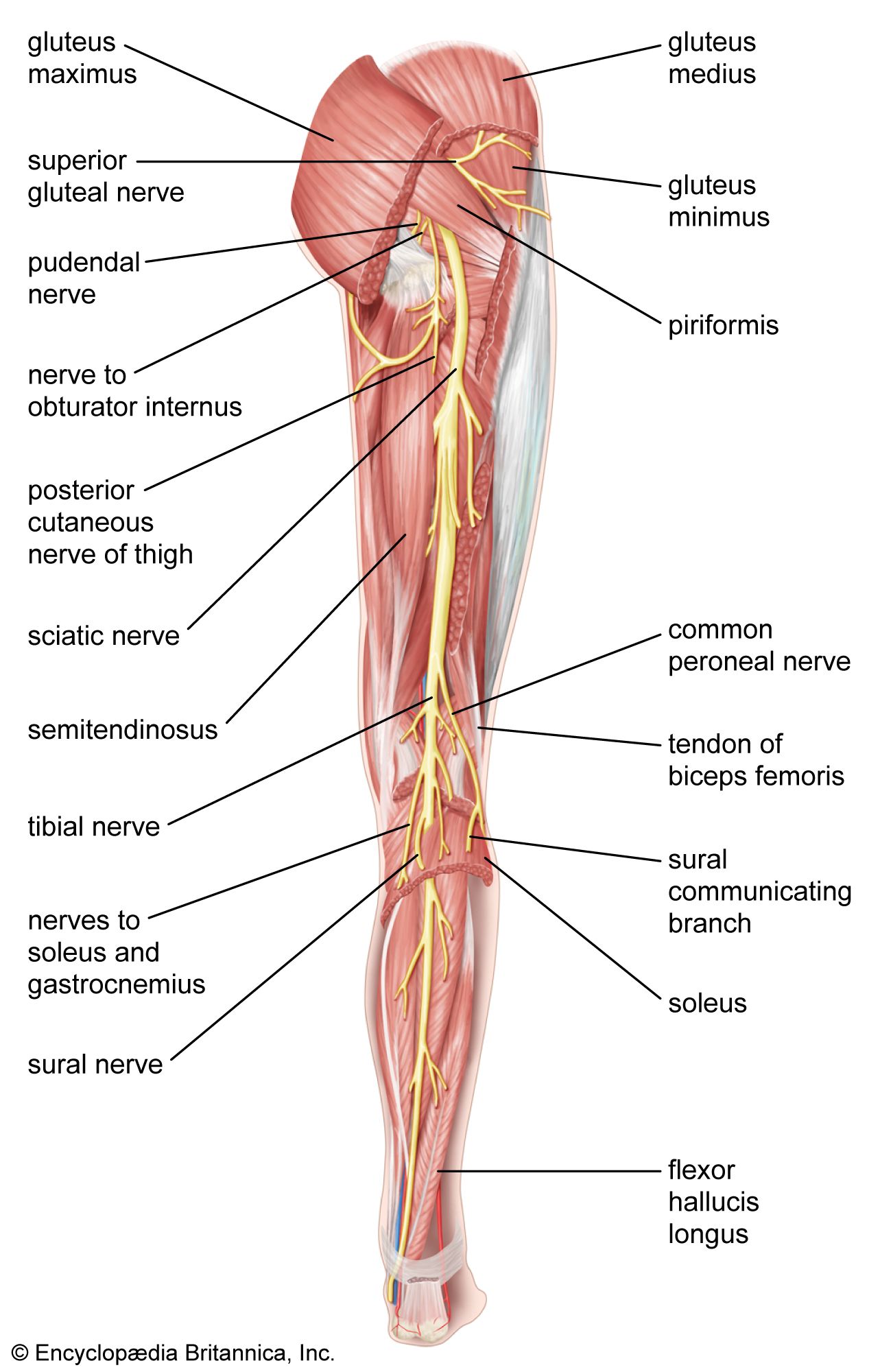
The piriformis is a triangle-shaped gluteal (buttock) muscle. The base of the triangle attaches to the sacrum (tailbone), while the opposite end attaches to the side of the femur (upper thighbone). The muscle also passes through an area of the pelvic girdle called the greater sciatic foramen. The piriformis muscle is important in turning the hip out and moving the leg away from the center of the body.
The sciatic nerve is a very large nerve, important for both movement and sensation. It innervates much of the skin of the leg, as well as the muscles of the back of the thigh, the lower leg, and the foot. It is formed from branches of the lumbar and sacral nerve roots (L4, L5, S1, S2, and S3) and travels from the lower back, out of the pelvis, into the buttock, and down the back of the thigh, where it divides at the knee into the tibial and common peroneal nerves.



 " height="20" alt="HEW Logo">
Causes
Piriformis syndrome is due to entrapment and irritation of the sciatic nerve. Depending on the individual’s anatomy, the sciatic nerve can be compressed as it passes between the piriformis muscle and the bone of the sciatic notch or, in 15% of the cases, through the muscle itself. Irritation of the nerve is more likely to occur if there is an abnormality of the piriformis, such as hypertrophy (enlargement of the muscle), inflammation, scarring, or spasm. These abnormalities can result from overuse, trauma to the area, or excessive pressure (e.g., prolonged sitting on a large wallet, or constriction by a tight low-fitting waistband). In athletes, piriformis syndrome can also be seen following activities that cause repetitive hip rotation and extension, such as running and climbing.
Symptoms
Piriformis syndrome most commonly leads to dull aching pain in the buttock, with or without radiation to the back of the thigh, knee, and calf. Numbness is rare, but tingling has been described in all five toes rather than along the path of an individual nerve. The symptoms tend to worsen with prolonged sitting or lying on the back and improve with standing and walking. Walking upstairs or uphill can be particularly painful. Activities that stretch the piriformis, such as rotating the hip and moving the upper leg, can also make the symptoms worse. Both bending and extending the hip may increase the symptoms. Also, because of the position of the piriformis close to the pelvic wall, some patients may develop pelvic pain.
Diagnosis
On physical exam, patients often have tenderness when pressure is placed on the piriformis muscle, either in the middle of the muscle or at the attachment to bone. Patients may also have tenderness to palpation of the sciatic notch and at the greater trochanter of the femur, where the muscle attaches.
A common indicator of piriformis syndrome is when the patient tries to avoid discomfort by keeping the leg in a slightly raised and externally rotated position when lying on the back. Other clinical tests include the Freiberg sign, which involves reproduction of the pain with passive internal rotation of the hip with the leg in an extended position, and the Pace sign, which is pain with resisted abduction and external rotation of the hip in a flexed position.
The trusted destination for professionals, college students, and lifelong learners.
SUBSCRIBE


Because the symptoms of piriformis syndrome overlap with those of many other conditions, it may be difficult to make the diagnosis. Other, more common causes of buttock pain and leg pain, such as muscle strain, sacroiliac joint irritation, and hip pathology, as well as other causes of sciatica, such as disk pathology and spinal stenosis, must be ruled out. Patients with lumbosacral radiculopathy - pain that radiates into the buttock and leg due to problems at the spine - often have pain with a straight leg raise test; for those with piriformis syndrome, this test is typically negative. In addition, if tingling into the toes is noted with piriformis syndrome, it tends to be in all five toes rather than along the course of any one particular nerve.
Imaging studies can be useful in making the diagnosis of piriformis syndrome. Plain x-rays are typically normal. Magnetic resonance imaging (MRI) can be used to rule out other possible causes of the symptoms and can show anatomical variation or changes in the piriformis muscle that increase the risk of the syndrome. Magnetic resonance neurography, which can be used to obtain images of nerves, can demonstrate swelling or other changes around the sciatic nerve to support the diagnosis. Electromyography, which records the electrical activity of muscles, may be helpful, but a negative test does not rule out the diagnosis.
Treatment
Many cases of piriformis syndrome can be successfully treated with conservative measures, which include rest from those activities that exacerbate the symptoms, anti-inflammatory drugs, muscle relaxants, and physical therapy for gradual piriformis stretching. Strengthening of the piriformis and other gluteal muscles can also be beneficial. Additional treatment with ultrasound, electrical stimulation, heat, and ice has also been used with success.
If symptoms persist, trigger point injections or steroid injections, generally performed with imaging guidance, may provide relief. The use of Botox (botulinum toxin type A) has also been described for treating persistent piriformis syndrome. Acupuncture can help reduce symptoms in some patients. These act to reduce pain, swelling, and/or spasm in the area of nerve compression.
If nonoperative treatment fails, surgical exploration and decompression of the nerve can address the problem. Several surgical options are available, including resection of portions of the piriformis muscle, release of muscular bands or scar tissue, and sciatic neuroplasty (surgical repair of the nerve).