

parietal placentation
Quick Summary
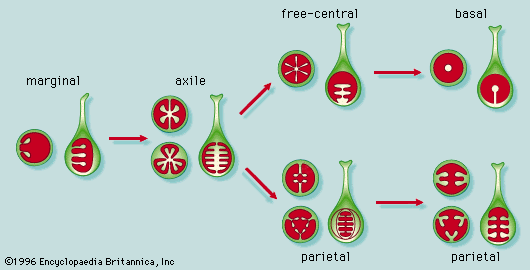
In botany, parietal placentation refers to a specific arrangement of ovules within a plant's ovary. In this type of placentation, the carpels (modified leaves that form the ovary) are united along their adjacent margins. The ovules are then attached along the inner walls of the ovary, rather than at a central axis or base. This arrangement is a key characteristic used in classifying plants. The term "placenta" in botany refers to the part of the carpel where ovules are attached. It's important to note that the term "placenta" also has a distinct meaning in the context of pregnancy in mammals, referring to the organ that develops in the uterus to nourish a growing fetus.12
Ask Britannica AI about this topic
Britannica doesn't have a full article on this topic, so we've curated a list of our relevant coverage.
- placenta
…in various ways, placentation being parietal, with carpels united by their adjacent margins and the ovules disposed along the inner ovary walls; axile, with carpels folded inward and the ovules along the central axis of the ovary; free central, derived from the axile, with a central column bearing the ovules;…
Read More…in various ways, placentation being parietal, with carpels united by their adjacent margins and the ovules disposed along the inner ovary walls; axile, with carpels folded inward and the ovules along the central axis of the ovary; free central, derived from the axile, with a central column bearing the ovules;…
Read More  angiospermSeeds
…of the ovary, and in parietal placentation the placentae are located directly on the ovary wall or on its extensions.
Read More…of the ovary, and in parietal placentation the placentae are located directly on the ovary wall or on its extensions.
Read More