
Quick Facts
- Related Topics:
- neutron
- proton
- slow neutron
- antineutron
- antinucleon

Adding us as a Preferred Source tells Google you trust our content, so our articles show up more often in your Google Search, Discover feed, and AI Overviews.
verifiedCite
While every effort has been made to follow citation style rules, there may be some discrepancies.
Please refer to the appropriate style manual or other sources if you have any questions.
Select Citation Style
nucleon
physics
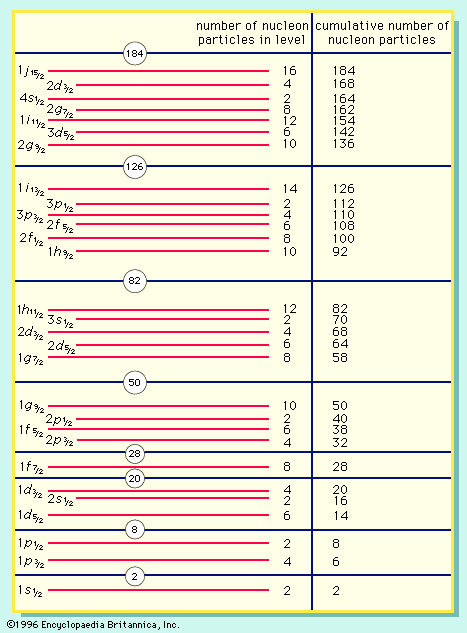
nucleon, either of the subatomic particles, the proton and the neutron, constituting atomic nuclei. Protons (positively charged) and neutrons (uncharged) behave identically under the influence of the short-range nuclear force, both in the way they are bound in nuclei and in the way they are scattered by each other. This strong interaction is independent of electric charge. Unstable subatomic particles heavier than nucleons (hyperons and baryon resonances) have a nucleon among their final decay products; the nucleon is thus the baryon ground state. The antinucleons include the antiproton and the antineutron.


Discover how ordinary objects work, and expand your understanding of the familiar.

 " height="20" alt="HEW Logo">
By clicking "Sign Up", you consent to the Britannica Privacy Policy and Terms of Use.