

mean
-
What does "mean" refer to in mathematics?
In mathematics, "mean" refers to a central value of a set of numbers. It is a measure of central tendency, with several types existing depending on the relationship governing the members of the set.
The arithmetic mean, often called the average, is the sum of the numbers divided by the count ( n ):
[
\bar{x} = \frac{x_1 + x_2 + ... + x_n}{n}
]
Other means include the geometric mean, useful for exponential growth or decline, and the quadratic mean, which is the square root of the arithmetic mean of the squares. In statistics, the mean of a random variable is its expected value, representing the theoretical long-run arithmetic mean of repeated trials.3 Britannica SourcesCreated from Britannica articles using AI. AI can make mistakes, so verify using Britannica articles. -
How do you calculate the mean of a group of numbers?
The arithmetic mean, often called the average, is used to find a central value for a set of numbers. To calculate it, sum all the numbers in the set. Then, divide that sum by the total count of numbers in the set. The result represents a point where the numbers in the set are balanced.
For example, to find the average of the numbers 2, 4, and 6:
1. Add the numbers: (2 + 4 + 6 = 12)
2. Divide the sum by the number of values, which is 3: (12 / 3 = 4)
So, the arithmetic mean is 4.4 Britannica SourcesCreated from Britannica articles using AI. AI can make mistakes, so verify using Britannica articles. -
Why is the mean sometimes called the average?
In mathematics, the term mean is often used synonymously with average to describe a central value of a set of numbers. Specifically, the arithmetic mean, calculated by summing the numbers in a set and dividing by the count of those numbers, is what people most often refer to as the average. The arithmetic mean represents a balancing point for the numbers involved.
Although mean and average are often used interchangeably, it is important to note that mean can refer to other types of averages, such as the geometric mean, quadratic mean, and harmonic mean. Each of these different types of means are calculated differently and are used in specific situations.
3 Britannica SourcesCreated from Britannica articles using AI. AI can make mistakes, so verify using Britannica articles. -
How does the mean help us understand data sets?
The mean, or arithmetic mean, is a way to find the average value in a dataset. It is calculated by adding all the numbers in a list and then dividing the sum by the number of numbers.
The mean helps to understand data sets as a typical value and a point about which the numbers in the set balance. It is used to find a single value that is typical of the rest of the data. However, the mean does not show how widely the data is dispersed around it.
3 Britannica SourcesCreated from Britannica articles using AI. AI can make mistakes, so verify using Britannica articles. -
What is the difference between the mean, median, and mode?
The mean, median, and mode are all different ways of finding the average of a data set.
-
The mean is the sum of all the values in the data set divided by the number of values. It is also known as the arithmetic mean or average.
-
The median is the middle value in a data set ordered from least to greatest. It is not affected by extremely large or small data values.
-
The mode is the value that appears most frequently in a data set.
4 Britannica SourcesCreated from Britannica articles using AI. AI can make mistakes, so verify using Britannica articles. -
-
How can outliers affect the mean of a data set?
Outliers can significantly impact the mean of a data set. The mean, or average, is calculated by summing all data values and dividing by the number of values. Outliers are unusually large or small values that can skew the mean because they are not representative of the other data points.
Unlike the median, which is the middle value and is not affected by extreme values, the mean is sensitive to outliers. A single outlier can disproportionately increase or decrease the mean, thus misrepresenting the central tendency of the data. To identify outliers, statisticians often use the standard deviation to compute a z-score; values with a z-score less than –3 or greater than +3 are considered outliers.
2 Britannica SourcesCreated from Britannica articles using AI. AI can make mistakes, so verify using Britannica articles.
mean, in mathematics, a quantity that has a value intermediate between those of the extreme members of some set. Several kinds of means exist, and the method of calculating a mean depends upon the relationship known or assumed to govern the other members. The arithmetic mean, denoted , of a set of n numbers x1, x2, …, xn is defined as the sum of the numbers divided by n: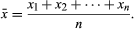
The arithmetic mean (usually synonymous with average) represents a point about which the numbers balance. For example, if unit masses are placed on a line at points with coordinates x1, x2, …, xn, then the arithmetic mean is the coordinate of the centre of gravity of the system. In statistics, the arithmetic mean is commonly used as the single value typical of a set of data. For a system of particles having unequal masses, the centre of gravity is determined by a more general average, the weighted arithmetic mean. If each number (x) is assigned a corresponding positive weight (w), the weighted arithmetic mean is defined as the sum of their products (wx) divided by the sum of their weights. In this case, 
The weighted arithmetic mean also is used in statistical analysis of grouped data: each number xi is the midpoint of an interval, and each corresponding value of wi is the number of data points within that interval.



 " height="20" alt="HEW Logo">
For a given set of data, many possible means can be defined, depending on which features of the data are of interest. For example, suppose five squares are given, with sides 1, 1, 2, 5, and 7 cm. Their average area is (12 + 12 + 22 + 52 + 72)/5, or 16 square cm, the area of a square of side 4 cm. The number 4 is the quadratic mean (or root mean square) of the numbers 1, 1, 2, 5, and 7 and differs from their arithmetic mean, which is 3 1/5. In general, the quadratic mean of n numbers x1, x2, …, xn is the square root of the arithmetic mean of their squares, The arithmetic mean gives no indication of how widely the data are spread or dispersed about the mean. Measures of the dispersion are provided by the arithmetic and quadratic means of the n differences x1 − , x2 − , …, xn − . The quadratic mean gives the standard deviation of x1, x2, …, xn.
The arithmetic and quadratic means are the special cases p = 1 and p = 2 of the pth-power mean, Mp, defined by the formula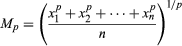 where p may be any real number except zero. The case p = −1 is also called the harmonic mean. Weighted pth-power means are defined by
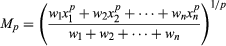
If x is the arithmetic mean of x1 and x2, the three numbers x1, x, x2 are in arithmetic progression. If h is the harmonic mean of x1 and x2, the numbers x1, h, x2 are in harmonic progression. A number g such that x1, g, x2 are in geometric progression is defined by the condition that x1/g = g/x2, or g2 = x1x2; hence  This g is called the geometric mean of x1 and x2. The geometric mean of n numbers x1, x2, …, xn is defined to be the nth root of their product:

All the means discussed are special cases of a more general mean. If f is a function having an inverse f −1 (a function that “undoes” the original function), the number  is called the mean value of x1, x2, …, xn associated with f. When f(x) = xp, the inverse is f −1(x) = x1/p, and the mean value is the pth-power mean, Mp. When f(x) = ln x (the natural logarithm), the inverse is f −1(x) = ex (the exponential function), and the mean value is the geometric mean.
The trusted destination for professionals, college students, and lifelong learners.
SUBSCRIBE


For information on the development of various definitions of the mean, see probability and statistics. For further technical information, see statistics and probability theory.