Encyclopedia Britannica
SUBSCRIBE
SUBSCRIBE
SUBSCRIBE TO PREMIUM
  • Home
  • Biographies
  • Animals & Nature
  • History & Society
  • Science & Tech
  • Geography & Travel
  • Arts & Culture
  • ProCon
  • Money
  • Games & Quizzes
  • Videos
  • Today in History
  • Dictionary
  • New Articles
Biographies
  • Browse Biographies
Animals & Nature
  • Birds, Reptiles & Other Vertebrates
  • Environment
  • Fossils & Geologic Time
  • Insects & Other Invertebrates
  • Mammals
  • Plants
History & Society
  • History
  • Philosophy & Religion
  • Politics, Law & Government
  • Society & Social Issues
Science & Tech
  • Health & Medicine
  • Science
  • Technology
Geography & Travel
  • Geography & Travel
Arts & Culture
  • Entertainment & Pop Culture
  • Literature
  • Sports & Recreation
  • Visual Arts
  • Image Galleries
  • Podcasts
  • Summaries
  • Top Questions
  • Lists and Stories
  • Britannica Kids
Ask the Chatbot Games & Quizzes History & Society Science & Tech Biographies Animals & Nature Geography & Travel Arts & Culture ProCon Money Videos
lead magnesium niobate
References
Britannica AI Icon

lead magnesium niobate

chemical compound
Written by
The Information Architects of Encyclopaedia Britannica

The Information Architects maintain a master list of the topics included in the corpus of  Encyclopædia Britannica, and create and manage the relationships between them.

The Information Architects of Encyclopaedia Britannica

Learn about this topic in these articles:

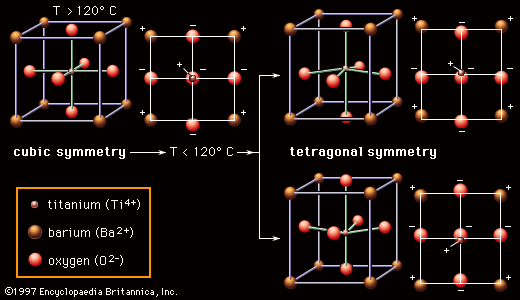
  • Figure 1: Ferroelectric properties of barium titanate (BaTiO3). (Left) Above 120° C the structure of the BaTiO3 crystal is cubic, and there is no net polarization of charge; (right) below 120° C the structure changes to tetragonal, shifting the relative positions of the ions and causing a concentration of positive and negative charges toward opposite ends of the crystal.
    capacitor dielectric and piezoelectric ceramics
    / Piezoelectric ceramics

    …titanate, Pb[Zr,Ti]O2) and PMN (lead magnesium niobate, Pb[Mg1/3Nb2/3]O3). These materials are processed in a similar manner to capacitor dielectrics except that they are subjected to poling, a technique of cooling the fired ceramic piece through the Curie point under the influence of an applied electric field in order to…

    Read More

    …titanate, Pb[Zr,Ti]O2) and PMN (lead magnesium niobate, Pb[Mg1/3Nb2/3]O3). These materials are processed in a similar manner to capacitor dielectrics except that they are subjected to poling, a technique of cooling the fired ceramic piece through the Curie point under the influence of an applied electric field in order to…

    Read More