isotropy
Quick Summary
In physics, isotropy refers to the quality of exhibiting properties with the same values when measured along axes in different directions. This is in contrast to anisotropy, where properties differ depending on the direction of measurement.1
Liquids and gases, due to the random distribution of their particles, are generally isotropic. In contrast, many single crystals are anisotropic because their atoms, ions, or molecules are arranged in regular lattices.1
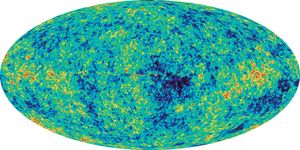
A key example of isotropy is observed in the cosmic microwave background (CMB) radiation, which fills the universe. While there are minute fluctuations, the CMB is remarkably uniform in all directions, supporting the idea that the universe is largely homogeneous and isotropic on large scales.2
Ask Britannica AI about this topic
Britannica doesn't have a full article on this topic, so we've curated a list of our relevant coverage.
- cosmologyEinstein’s model
…the universe is homogeneous and isotropic in the large (i.e., the same everywhere on average at any instant in time), an assumption that the English astrophysicist Edward A. Milne later elevated to an entire philosophical outlook by naming it the cosmological principle. Given the success of the Copernican revolution, this…
Read More…the universe is homogeneous and isotropic in the large (i.e., the same everywhere on average at any instant in time), an assumption that the English astrophysicist Edward A. Milne later elevated to an entire philosophical outlook by naming it the cosmological principle. Given the success of the Copernican revolution, this…
Read More - cosmologyInflation
…mechanism for understanding the overall isotropy of the cosmic microwave background because the matter and radiation of the entire observable universe were in good thermal contact (within the cosmic event horizon) before inflation and therefore acquired the same thermodynamic characteristics. Rapid inflation carried different portions outside their individual event horizons.…
Read More…mechanism for understanding the overall isotropy of the cosmic microwave background because the matter and radiation of the entire observable universe were in good thermal contact (within the cosmic event horizon) before inflation and therefore acquired the same thermodynamic characteristics. Rapid inflation carried different portions outside their individual event horizons.…
Read More