



island
News •
-
What is an island?
An island is a landmass entirely surrounded by water and smaller than a continent. Australia, though sometimes called an "island continent," is considered a continent because of its size, distinct geology, unique species, and indigenous population.
Coral islands are tropical islands made of the skeletons and remains of coral and other marine life. These islands are low-lying, often covered with coconut palms, and feature white coral sand beaches.
Oceanic islands, like Iceland, are formed by volcanic activity. Continental islands, such as the British Isles, are extensions of continents.
5 Britannica SourcesCreated from Britannica articles using AI. AI can make mistakes, so verify using Britannica articles. -
How are islands different from continents?
Islands and continents are both landmasses surrounded by water, but they differ in size and geological structure. Islands are smaller landmasses entirely surrounded by water. Continents are much larger; Australia, the smallest continent, is nearly four times the size of Greenland, the largest island.
Geologically, most geographers consider islands and continents as separate entities. Continents, like Australia and Asia, often sit on separate tectonic plates, whereas islands may share a plate with a continent, as Greenland does with North America. Some islands are continental in character, consisting of sedimentary rocks with structures similar to coastal mountain ranges of adjacent continents. Other islands are oceanic, formed by volcanic activity.
8 Britannica SourcesCreated from Britannica articles using AI. AI can make mistakes, so verify using Britannica articles. -
What are some ways that islands can form?
Islands can form through various geological processes:
-
Volcanic activity At subduction zones, where tectonic plates converge, one plate overrides another, leading to the formation of island arcs from the seafloor through the extrusion of basaltic and andesitic magmas. Hot spots within plates can also result in chains of volcanic islands.
-
Coral reef development Coral islands can arise from the accumulation of organic material from coral skeletons and associated organisms. Reef islands can originate through uplift, where crustal movements raise a reef system above sea level, or through accretion, where reef rock broken off by storms accumulates and is cemented together. Charles Darwin suggested that atolls form from reefs fringing a subsiding volcanic island.
4 Britannica SourcesCreated from Britannica articles using AI. AI can make mistakes, so verify using Britannica articles. -
-
What is the difference between oceanic and continental islands?
Oceanic and continental islands differ in their geological origin and composition. Oceanic islands, like Iceland, Hawaii, and French Polynesia, typically arise from volcanic activity and lack a continental rock foundation. Many are low islands of basalt, like those east of the Andesite Line in the Pacific.
Continental islands, such as the British Isles and New Guinea, are geologically connected to a continent. They share similar rock structures and sedimentary compositions with the coastal mountain ranges of their adjacent continents.
6 Britannica SourcesCreated from Britannica articles using AI. AI can make mistakes, so verify using Britannica articles. -
How do islands support unique plants and animals?
Islands often support unique plants and animals due to their geographic isolation, which fosters distinct evolutionary paths not seen on mainlands. This isolation, combined with varied environments, allows colonizing species to undergo adaptive radiation, rapidly diversifying into multiple species to fill unoccupied ecological niches. Remote islands, like the Galapagos and Hawaiian archipelagos, showcase this phenomenon, with many endemic species of plants, insects, and birds that have evolved in response to the islands' specific conditions.
6 Britannica SourcesCreated from Britannica articles using AI. AI can make mistakes, so verify using Britannica articles. -
How have people adapted to life on islands throughout history?
Throughout history, island inhabitants have skillfully adapted to their surroundings. In the Pacific Islands, people adjusted to varied landscapes, social isolation caused by rugged terrain, and limited resources by developing reciprocity-based societies. Micronesians strategically built settlements on lagoon sides of larger islands for easy canoe access and cyclone protection. They constructed raised platforms made of coral or volcanic rock for homes, and meetinghouses for social gatherings.
Root crop and sugarcane domestication began as early as 9,000 years ago, with agricultural production intensifying over millennia through water control and swine husbandry. Traditional Polynesian cultures demonstrated effective adaptation and mastery of the ocean environment. They were superb mariners with social mechanisms for coping with shipwrecks and the loss of portions of their group.
5 Britannica SourcesCreated from Britannica articles using AI. AI can make mistakes, so verify using Britannica articles.
island, any area of land smaller than a continent and entirely surrounded by water. Islands may occur in oceans, seas, lakes, or rivers. A group of islands is called an archipelago.
Islands may be classified as either continental or oceanic. Oceanic islands are those that rise to the surface from the floors of the ocean basins. Continental islands are simply unsubmerged parts of the continental shelf that are entirely surrounded by water. Many of the larger islands of the world are of the continental type. Greenland (840,000 square miles [2,175,000 square km]), the largest island, is composed of the same materials as the adjacent North American continent, from which it is separated by a shallow and narrow sea. Likewise the world’s second largest island, New Guinea (309,000 square miles [800,000 square km]), is part of the Australian continental platform and is separated from it only by the very shallow and narrow Torres Strait. A slight warping of the sea bottom in the vicinity of Torres Strait would be sufficient to join New Guinea to Australia; conversely, a slight rise in sea level may submerge a hilly coast and leave the hilltops remaining as small islands just offshore (such as those off the coast near Boston and the islands off the Maine coast).
The islands that rise from the floors of the ocean basins are volcanic. Lava accumulates to enormous thickness until it finally protrudes above the ocean surface. The piles of lava that form Hawaii rise as high as 32,000 feet (9,700 metres) above the ocean floor.



 " height="20" alt="HEW Logo">
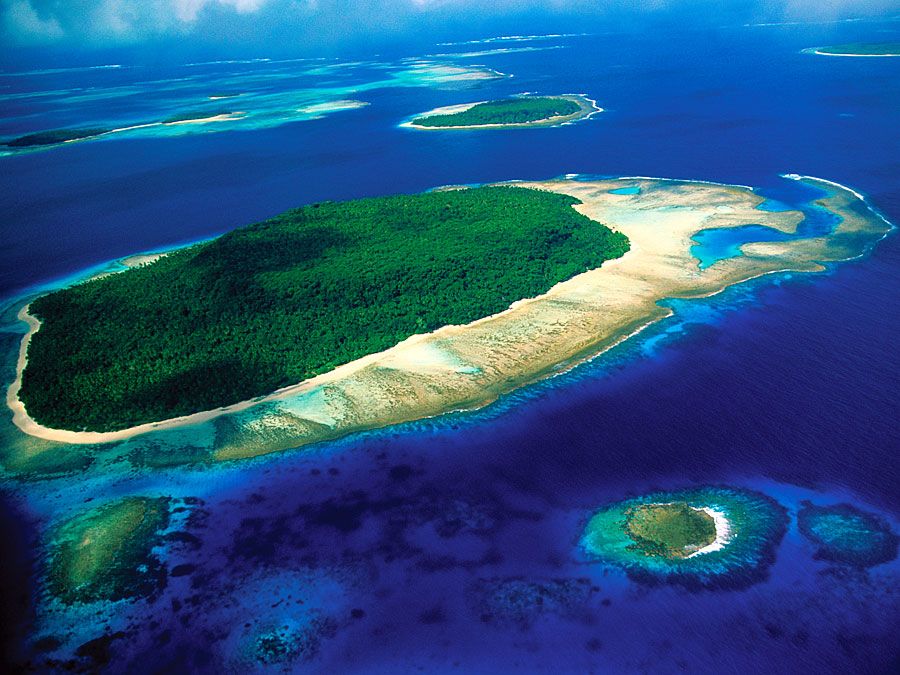
Island life exhibits features of special interest. The sea is a barrier to some forms of life but acts as a carrier of others, which, once established in their new home, frequently develop new features in their isolated surroundings. A long-established sea barrier results in marked differences between the animal life and vegetation even of adjacent islands, and from these differences may be deduced the origin of an island. Further, any detailed map of the biological regions of the globe illustrates the importance of islands in the determination of the boundaries of animal-life and vegetational types. For example, to the west of a line (Wallace’s Line) running between Bali and Lombok and between Borneo and Celebes, the islands are biologically Asian, but to the east of the line, notwithstanding the narrowness of the Lombok Strait, the vegetation and animal life are Australian. Oceanic islands are usually colonized by only a few animal forms, chiefly seabirds and insects. They are often covered with abundant vegetation, the seeds of which have been carried there, for example, by air and water currents or by birds; but the plant variety is relatively limited.
A list of the world’s largest islands is provided in the table.
| name | location | area* | |
|---|---|---|---|
| sq mi | sq km | ||
| *Area given may include small adjoining islands. Conversions for rounded figures are rounded to the nearest hundred. | |||
| Greenland | North Atlantic Ocean | 822,700 | 2,130,800 |
| New Guinea | Papua New Guinea–Indonesia | 309,000 | 800,000 |
| Borneo | Indonesia–Malaysia–Brunei | 283,400 | 734,000 |
| Madagascar | Indian Ocean | 226,658 | 587,041 |
| Baffin Island | Northwest Territories, Can. | 195,928 | 507,451 |
| Sumatra | Indonesia | 167,600 | 434,000 |
| Honshu | Japan | 87,805 | 227,414 |
| Victoria Island | Northwest Territories, Can. | 83,897 | 217,291 |
| Great Britain | United Kingdom | 83,698 | 216,777 |
| Ellesmere Island | Northwest Territories, Can. | 75,767 | 196,236 |
| Celebes | Indonesia | 69,100 | 179,000 |
| South Island | New Zealand | 58,676 | 151,971 |
| Java | Indonesia | 49,000 | 126,900 |
| North Island | New Zealand | 44,204 | 114,489 |
| Newfoundland | Canada | 42,031 | 108,860 |
| Cuba | Caribbean Sea | 40,519 | 104,945 |
| Luzon | Philippines | 40,420 | 104,688 |
| Iceland | North Atlantic Ocean | 39,699 | 102,819 |
| Mindanao | Philippines | 36,537 | 94,630 |
| Ireland | Ireland–U.K. | 32,589 | 84,406 |
| Hokkaido | Japan | 30,144 | 78,073 |