intermediate value theorem
Quick Summary
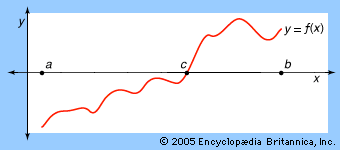
The intermediate value theorem is a fundamental concept in calculus. It states that if a continuous function f on a closed interval [a, b] has values f(a) and f(b) with opposite signs, then there must be at least one point c within the interval (a, b) where f(c) equals zero. In simpler terms, an unbroken curve must cross the x-axis at least once between two points if those points are on opposite sides of the x-axis. This theorem is closely related to Darboux's theorem, which extends this idea to the values of derivatives. The mean-value theorem, another related concept, states that the slope of a secant line connecting two points on a smooth curve is equal to the slope of a tangent line at some point between those two points.12
Ask Britannica AI about this topic
Britannica doesn't have a full article on this topic, so we've curated a list of our relevant coverage.