
- Key People:
- Richard von Hertwig

germ layer
-
What is a germ layer in biology?
During the early stages of embryonic development, three primary cell layers called germ layers form. These layers are the endoderm, ectoderm, and mesoderm. The endoderm (inner layer) gives rise to internal linings such as the gastrointestinal tract, lungs, liver, and pancreas. The ectoderm (outer layer) forms outer linings like the epidermis, hair, mammary glands, and nervous system. The mesoderm (middle layer) develops into other tissues, including the dermis, heart, muscles, urogenital system, bones, and blood. These germ layers are of interest in the study of human development and stem cell research because of their ability to differentiate into various organs and tissues.
7 Britannica SourcesCreated from Britannica articles using AI. AI can make mistakes, so verify using Britannica articles. -
How many main germ layers are there in animals?
During the early stages of embryonic development, three primary germ layers form: the endoderm, ectoderm, and mesoderm. These layers appear during gastrulation, a process where the blastula, a hollow ball of cells, starts differentiating into specialized cells layered across the developing embryo.
The endoderm, the innermost layer, develops into the internal linings of the body, such as the gastrointestinal tract, lungs, liver, and pancreas. The ectoderm, or outermost layer, forms the epidermis, hair, mammary glands, and the central and peripheral nervous systems. The mesoderm, the middle layer, gives rise to other tissues like the dermis of the skin, heart, muscle system, urogenital system, bones, and bone marrow.
The presence of the mesoderm distinguishes higher life-forms with bilateral symmetry from lower life-forms with radial symmetry, enabling the development of an internal body cavity for housing and protecting organs. Animals with three germ layers are called triploblastic, while those with two layers are called diploblastic.
6 Britannica SourcesCreated from Britannica articles using AI. AI can make mistakes, so verify using Britannica articles. -
What is the role of germ layers during early development?
During early embryonic development, the germ layers—endoderm, ectoderm, and mesoderm—are primary cell layers that form through gastrulation. These layers are essential, acting as assembly areas, and each gives rise to specific tissues and organs.
The endoderm forms internal linings such as the gastrointestinal tract and lungs. The ectoderm develops into outer layers like the epidermis and nervous system. The mesoderm, unique to higher organisms, differentiates into muscle, bone, and the circulatory system.
These germ layers are of interest in stem cell research because of their ability to differentiate into a variety of tissues.
6 Britannica SourcesCreated from Britannica articles using AI. AI can make mistakes, so verify using Britannica articles. -
What are the names of the three primary germ layers?
The three primary germ layers that form in the early stages of embryonic development are the ectoderm, the mesoderm, and the endoderm.
- Ectoderm The outermost layer, it develops into the epidermis, hair, and the nervous system.
- Mesoderm The middle layer, it forms the dermis of the skin, heart, muscles, urogenital system, bones, and bone marrow.
- Endoderm The innermost layer, it gives rise to the lining of the gastrointestinal tract, lungs, liver, pancreas, and other glands.
These layers emerge during gastrulation, as the blastula differentiates into specialized cells. Each germ layer contributes to specific tissue types and plays a crucial role in the development of the embryo.
6 Britannica SourcesCreated from Britannica articles using AI. AI can make mistakes, so verify using Britannica articles. -
Which organs or tissues develop from each germ layer?
During animal embryonic development, the three germ layers differentiate into specific tissues and organs.
-
Ectoderm The ectoderm, the outermost layer, develops into the epidermis (including hair, skin, and nails), the epithelia of sense organs, the nasal cavity, the sinuses, the mouth (including tooth enamel), the anal canal, nervous tissue (including the pituitary body), and chromaffin tissue.
-
Mesoderm The mesoderm, the middle layer, gives rise to muscle, connective tissue, cartilage, bone, the notochord, blood, bone marrow, lymphoid tissue, the epithelia of blood vessels, lymphatic vessels, body cavities, kidneys, the ureters, the gonads, the genital ducts, and the adrenal cortex.
-
Endoderm The endoderm, the innermost layer, develops into the digestive tract and lungs. Additionally, the liver and pancreas develop from the endoderm.
5 Britannica SourcesCreated from Britannica articles using AI. AI can make mistakes, so verify using Britannica articles. -
-
How do germ layers lead to the complexity of different animal body structures?
During the early stages of embryonic development, the formation of germ layers leads to the complexity of animal body structures. The three primary germ layers, which form through gastrulation, are the endoderm (inner layer), the ectoderm (outer layer), and the mesoderm (middle layer).
Each germ layer differentiates into specific tissues and organs. The ectoderm forms the skin and nervous system. The mesoderm gives rise to muscles, bones, and blood. The endoderm forms the lining of the digestive tract, lungs, liver, and pancreas. This differentiation and specialization of germ layers allows for the development of complex body structures and organ systems in animals.
6 Britannica SourcesCreated from Britannica articles using AI. AI can make mistakes, so verify using Britannica articles.
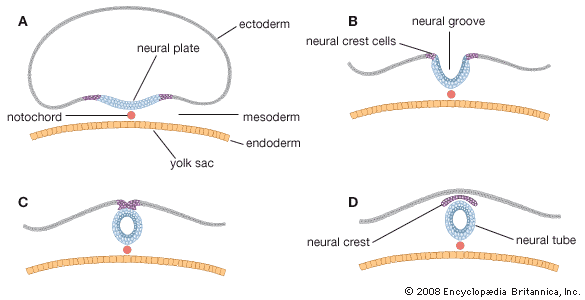
germ layer, any of three primary cell layers, formed in the earliest stages of embryonic development, consisting of the endoderm (inner layer), the ectoderm (outer layer), and the mesoderm (middle layer). The germ layers form during the process of gastrulation, when the hollow ball of cells that constitutes the blastula begins to differentiate into more-specialized cells that become layered across the developing embryo. The germ layers represent some of the first lineage-specific (multipotent) stem cells (e.g., cells destined to contribute to specific types of tissue, such as muscle or blood) in embryonic development. Hence, each germ layer eventually gives rise to certain tissue types in the body.
The endoderm is so called because it is the innermost of the three germ layers. Cells derived from the endoderm eventually form many of the internal linings of the body, including the lining of most of the gastrointestinal tract, the lungs, the liver, the pancreas and other glands that open into the gastrointestinal tract, and certain other organs, such as the upper urogenital tract and female vagina. Endoderm cells give rise to certain organs, among them the colon, the stomach, the intestines, the lungs, the liver, and the pancreas. The ectoderm, on the other hand, eventually forms certain “outer linings” of the body, including the epidermis (outermost skin layer) and hair. The ectoderm also is the precursor to mammary glands and the central and peripheral nervous systems.
Cells derived from the mesoderm, which lies between the endoderm and the ectoderm, give rise to all other tissues of the body, including the dermis of the skin, the heart, the muscle system, the urogenital system, the bones, and the bone marrow (and therefore the blood). The mesoderm is the germ layer that distinguishes evolutionarily higher life-forms (i.e., those with bilateral symmetry) from lower life-forms (i.e., those with radial body symmetry). The mesoderm allows more highly evolved organisms to have an internal body cavity that houses and protects organs, bathing them in fluids and supporting them with connective tissue.



 " height="20" alt="HEW Logo">
Because the germ layers can differentiate into a vast variety of organs and tissues, they are of particular interest to the study of human development and to stem cell research. A pluripotent stem cell is one that can become any of the three germ layers. The multipotent stem cells that then constitute the germ layers give rise to specific tissue lineages (e.g., a specific dermal layer or even one lineage within a dermal layer). The study of stem cells and cell differentiation has enabled scientists to reliably produce specific types of cells from human embryonic stem cells as well as from induced pluripotent stem cells (genetically reprogrammed adult cells), which has furthered knowledge of embryonic development and facilitated the development of novel cell-based therapies.