fibre
Quick Summary
Connective tissue is a group of tissues that provide internal support, form, and cohesion to the body and its organs. It is of mesodermal origin and comprises cells like fibroblasts, protein fibers such as collagen and elastic fibers, and a ground substance.12
There are three main types of extracellular fibers:
* Collagenous fibers: These are the most abundant and provide great tensile strength. They are found in tendons, ligaments, skin, and bone.31
* Elastic fibers: Composed primarily of the protein elastin, these fibers are highly elastic and allow structures like arteries, lungs, and skin to stretch and recoil.45
* Reticular fibers: These are fine collagenous fibers that form a network, providing the supporting tissue for many organs.61
Connective tissues include specialized forms like bone, cartilage, ligaments, tendons, and adipose tissue. They play crucial roles in structural support, tissue repair, and facilitating the exchange of nutrients and waste products between blood and cells.13
Ask Britannica AI about this topic
Britannica doesn't have a full article on this topic, so we've curated a list of our relevant coverage.
 human respiratory systemThe gas-exchange region
…a skeleton of connective tissue fibres. The fibre system is interwoven with the capillaries and particularly reinforced at the alveolar entrance rings. The capillaries are lined by flat endothelial cells with thin cytoplasmic extensions. The interalveolar septum is covered on both sides by the alveolar epithelial cells. A thin, squamous…
Read More…a skeleton of connective tissue fibres. The fibre system is interwoven with the capillaries and particularly reinforced at the alveolar entrance rings. The capillaries are lined by flat endothelial cells with thin cytoplasmic extensions. The interalveolar septum is covered on both sides by the alveolar epithelial cells. A thin, squamous…
Read More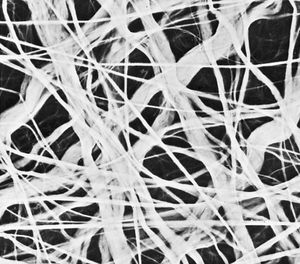 connective tissueComponents of connective tissue
…are composed of (1) extracellular fibres, (2) an amorphous matrix called ground substance, and (3) stationary and migrating cells. The proportions of these components vary from one part of the body to another depending on the local structural requirements. In some areas, the connective tissue is loosely organized and highly…
Read More…are composed of (1) extracellular fibres, (2) an amorphous matrix called ground substance, and (3) stationary and migrating cells. The proportions of these components vary from one part of the body to another depending on the local structural requirements. In some areas, the connective tissue is loosely organized and highly…
Read More- connective tissueBone
…tissues, bone consists of cells, fibres, and ground substance, but, in addition, the extracellular components are impregnated with minute crystals of calcium phosphate in the form of the mineral hydroxyapatite. The mineralization of the matrix is responsible for the hardness of bone. It also provides a large reserve of calcium…
Read More…tissues, bone consists of cells, fibres, and ground substance, but, in addition, the extracellular components are impregnated with minute crystals of calcium phosphate in the form of the mineral hydroxyapatite. The mineralization of the matrix is responsible for the hardness of bone. It also provides a large reserve of calcium…
Read More